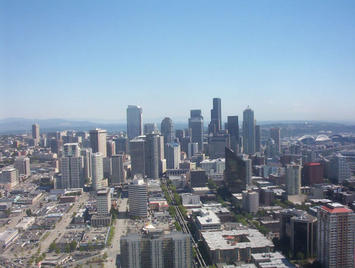
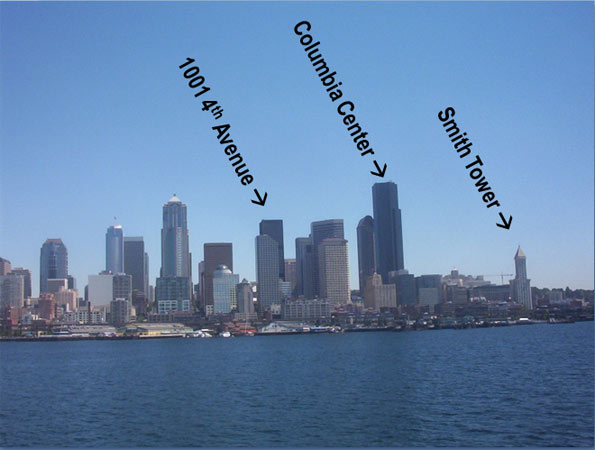
Lunching at Seattle's Space Needle, the casual observer might imagine that one of the nation's most dense urban areas is spread out below. To the immediate south of the Space Needle is one of the nation's premier downtown areas. In 2000 downtown Seattle had the seventh largest employment base in the country and was one of the most dense. Its impressive, closely packed buildings witness a storied past. For more than 60 years, between 1914 and 1990, downtown Seattle has had the tallest building on the West Coast, Smith Tower, and was the fourth tallest building in the world when built. It held the title for an impressive 55 years, from 1914 to 1969, when another Seattle building briefly took the title (1001 4th Avenue). Later (1985), Seattle's Columbia Center became the first building on the West Coast to exceed 75 floors, but by 1990 had been passed by the U.S. Bank Tower in Los Angeles (see Elliot Bay photograph and Note 1).
However, looks can be deceiving. In 2000, Seattle ranked last in urban population density out of the 11 urban areas in the 13 western states with more than 1 million population (just behind Portland, which ranked next-to-last). The Seattle urban area's density was approximately 60 percent below that of Los Angeles, the US’s densest urban area. Even the Houston and Dallas-Fort Worth urban areas, famous for their great expanse, were denser than Seattle. Updated urban area density data from the 2010 census will not be available for at least a year.
Nor is the historical core municipality of Seattle particularly closely packed. With a population density of 7,200 per square mile, the city of Seattle is considerably less dense than a number of Los Angeles suburbs such as Santa Ana (12,000) and Garden Grove (9,500). Even so, the city of Seattle is nearly two-thirds more dense than the city of Portland (4,400), despite the latter's densification claims.
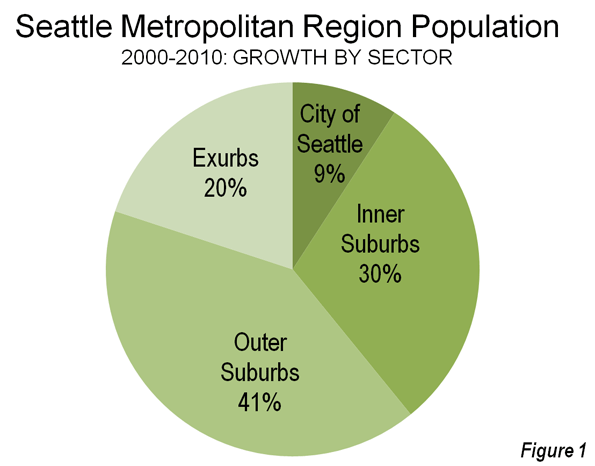
The 2010 Census: The 2010 census indicates a continuing dispersion of population in the Seattle metropolitan region (Figure 1). The Seattle metropolitan region, formally the Seattle combined statistical area (Note 2) is composed of the core Seattle metropolitan area (King, Pierce and Snohomish counties) and five exurban statistical areas, Bremerton (Kitsap County), Olympia (Thurston County), Mount Vernon (Skagit County), Oak Harbor (Island County) and Shelton (Mason County).
| Seattle Combined Statistical Area: Population 2000-2010 | ||||||
| Area | 2000 | 2010 | Change | % | Share of Growth | Share of Population |
| City of Seattle | 563,374 | 608,660 | 45,286 | 8.0% | 9.2% | 14.5% |
| Balance: King County | 1,173,660 | 1,322,589 | 148,929 | 12.7% | 30.3% | 31.5% |
| Pierce & Snohomish Counties | 1,306,844 | 1,508,560 | 201,716 | 15.4% | 41.0% | 35.9% |
| Metropolitan Area Outside Seattle | 2,480,504 | 2,831,149 | 350,645 | 14.1% | 71.2% | 67.4% |
| Metropolitan Area | 3,043,878 | 3,439,809 | 395,931 | 13.0% | 80.4% | 81.9% |
| Exurban Metropolitan Areas | 663,260 | 759,503 | 96,243 | 14.5% | 19.6% | 18.1% |
| Combined Statistical Area | 3,707,138 | 4,199,312 | 492,174 | 13.3% | 100.0% | 100.0% |
| Calculated from US Census data | ||||||
City of Seattle (Historical Core Municipality): Overall, the historical core city of Seattle grew 8.0 percent, from 564,000 to 609,000 between 2000 and 2010, which was one of the healthiest increases among major cities. In adding 45,000, the city still only accounted for 9.2 percent of the Seattle metropolitan region population growth. The city of Seattle now constitutes less than 15 percent of the metropolitan region population, down from 36 percent 1950 (same geographic area). In 1950, the city of Seattle had nearly two thirds of the population of King County. By 2010, the city of Seattle was less than one third of King County's population, despite annexations. As the city has continued to decline in its share of the metropolitan region's population, the impressive downtown area has also lost its dominance and by 2009 had fallen to 8 percent of the metropolitan region's employment.
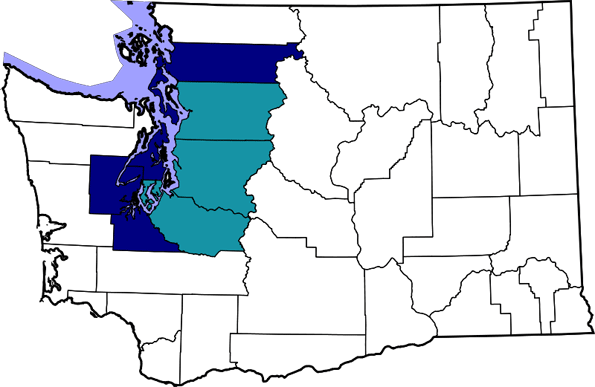
Inner Suburbs: Areas outside the city of Seattle accounted for more than 90 percent of growth in the metropolitan region. The inner suburbs, which include the residential development to the south, north and east of Seattle in King County grew more than 50 percent faster than the city of Seattle, at 12.7 percent between 2000 and 2010. The inner suburbs grew from 1,170,000 to 1,320,000, adding nearly 150,000 new residents, more than three times the city of Seattle increase. King County outside Seattle also captured 30 percent of the metropolitan region's growth and now has 32 percent of the metropolitan region's population. The eastern suburbs of King County are home to one of the nation's largest, most diverse and successful edge cities, Bellevue, as well as the Microsoft campus in neighboring Redmond.
Outer Suburbs: The outer suburbs, which include Pierce County (Tacoma is the county seat) and Snohomish County grew 15.4 percent, nearly double the growth rate of the city of Seattle. The outer suburbs grew from 1.3 million to 1.5 million, adding 200,000 new residents, more than four times the city of Seattle’s increase. Pierce and Snohomish counties captured 41 percent of the metropolitan region's growth and now account for 36 percent of the metropolitan region's population.
Exurban Areas: The exurban statistical areas grew nearly as quickly as the outer suburbs. Between 2000 and 2010, the exurban areas increased their population by 14.5 percent. The exurban statistical areas accounted for 20 percent of the metropolitan region's population growth. These more distant areas grew from 660,000 to 760,000 people, adding nearly 100,000 new residents. This is more than double the increase in the city of Seattle population. Approximately 18 percent of the population in the metropolitan region lives in the exurban statistical areas, a larger number than residing in the city of Seattle.
The Dispersion Continues: The dispersion of Seattle, like that of metropolitan regions around the nation and the world, has been going on for decades. The city of Seattle has accounted for only 5 percent of the metropolitan region's population since 1950 (Figure 2) with suburbs and exurbs accounting for the vast majority of the nearly 3,000,000 increase.
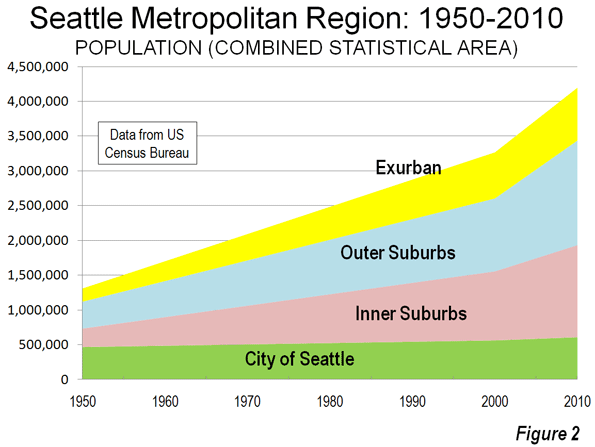
Despite the pre-2010 census media and academic drumbeat to the effect that metropolitan areas were no longer dispersing, the census revealed a totally different and even inconvenient truth. This does not mean that both residents of the entire metropolitan region, suburbs and core city, should not be proud of an attractive urban area in an incomparable natural setting. Yet, the vast majority of the region’s population and employment growth is taking place outside the core. Seattle is following the national and international pattern to ever greater dispersion.
_________
Note 1: Downtown Seattle is on a hill and the newer buildings are generally on higher ground than Smith Tower, which makes the difference in height look greater.
Note 2: "Combined statistical areas" were formerly "consolidated metropolitan statistical areas."
Top Photograph: Downtown Seattle from the Space Needle (by author)
Wendell Cox is a Visiting Professor, Conservatoire National des Arts et Metiers, Paris and the author of “War on the Dream: How Anti-Sprawl Policy Threatens the Quality of Life”
 Email this Story