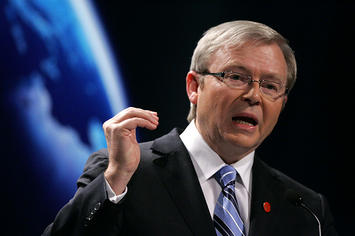
President Obama's last-minute decision to postpone his homecoming to Indonesia and a trip to Australia expands the list of friendly countries--which include France, the U.K. and most of Eastern Europe--that have received a presidential snub. Yet in putting off his Australia trip, Obama will also miss an opportunity to commune with the politician whom he most closely resembles.
Prime Minister Kevin Rudd, like Obama, symbolizes a distinct shift in his country's politics. Replacing the rough-hewn but long-serving Liberal Party leader John Howard, Rudd offered sophisticated Australians a better reflection of their own savoir faire, much as Obama restored the self-image of America's Bush-wracked educated classes. Like Obama, Rudd is widely seen as smart and worldly as well as perhaps a bit rude and arrogant.
On a more serious note, Rudd reflects a shift from the country's foreign policy orientation, which historically focused on British and, later, American ties. Like Obama, Rudd has little patience for the old ties to the English-speaking world. A confirmed sinophile, Rudd clearly sees the sun rising in the east--or in his case, the north. He has made no bones of his post-European perspective and his interest of aligning his country closer to Beijing.
Indeed the affection of Rudd, a former diplomat fluent in Mandarin, for things Chinese worries some Australians, given the Middle Kingdom’s increasingly assertive authoritarianism.. His coziness with the Communist Party bosses has provided fodder for clever comic videos from down under.
Also like President Obama, Rudd epitomizes the ascendancy of a new "progressive" educated class in Australia that has little allegiance to the traditional notions of what constitutes "the good life" for the vast majority of citizens. Down under--even more than in America--the "good life" generally means a suburban home with a backyard.
In contrast, Rudd's core supporters are disgusted by what they see as a wasteful, anti-social suburban sprawl. Like their counterparts here in North America, they have embraced a climate change agenda that, as part of its dogma, seeks to densify Australia's cities.
Although the Labour Party's roots lay with the working class and private sector unions, New City co-editor John Muscat contends that the Rudd Labour Party has transformed into an instrument of the bureaucracy and "progressive" gentry. The latter includes academics, green activists, media stars and some prominent business interests well-positioned to flourish in a hyper-regulated state.
The losers, Muscat notes, are the traditional middle- and working-class constituencies of the party. Where the Labour government has in the past sought to help people fulfill their quest for the "Australian dream," the current leadership plans to make it difficult for them to achieve it. "Green planners," Muscat says, "engage in a form of class discrimination. The costs of climate change are heaped on outer-suburban working people, who lose jobs, mobility and housing amenity, while the affluent emerge unscathed."
Such a result would seem to be unnecessary in a vast country with a population that in 2050 will be smaller than California's today. Australia has often been called "the lucky country" since its prodigious natural resources and fertile agriculture have long afforded an astonishingly high quality of life for its citizens. This position has been made even stronger as demand for commodities has skyrocketed in recent years, paced largely by demand from China, India and other developing countries.
Yet now, at precisely the time that the Australian "dream" would appear, if anything, more supportable, the administration and local state governments seem determined to wage war against the aspirations of its own citizens. Strict limits on developing land on the periphery--something supported both by oligopolistic property interests and greens--have been turning Australia from highly affordable to one of the least affordable places to buy a home in the English-speaking world.
These changes are evident in Sydney, a city that 20 years ago was filled with charming tree-lined, relatively low-density neighborhoods. Strict land regulation has made homes more expensive by restricting new subdivisions further in the periphery; indeed the city is now the second most expensive major housing market, based on income, in the English-speaking world, behind only Vancouver.
At the same time that suburban housing has been limited, Sydney has allowed the spread of high-rise apartments into formerly bucolic neighborhoods. To many natives it seems less like the very livable old Australia and more like the overcrowded, frenzied new China. Similar policies are infecting other Australian cities, including Melbourne and Perth. As the New City bloggers warn, "Enjoy your country while it still exists."
Not surprisingly, the agenda embraced by Rudd, like that of Obama, also has had negative political consequences. Rudd's attempt to force a "cap and trade" system on his country is problematic given the country's dependence on fossil fuel and mineral production as well as greenhouse-gas-gushing big agriculture. In December Rudd's cap and trade proposal was blocked by opposition in the Australian Senate, much as Obama's cap and trade legislation has been stymied by malcontents, including some in his own party, in the American Senate.
When they do finally get together, Obama and Rudd could also commiserate on their falling poll numbers. Rudd's 74% support last year has declined to a new low of 48%. He now runs neck and neck in surveys with the opposition leader, Tony Abbott. Rudd wants to run largely on the issue of climate change, a course that one suspects Barack Obama may not be so deluded as to pursue.
Of course, Rudd's gentry liberal politics still play well among Sydney's media mavens and pundits, just as Obama's does in similar circles here. But they both are running into strong opposition from voters, with whom their appeal is clearly weakening.
Ultimately, these two very modern leaders will have to face the consequences of their own worldviews, which are shaped primarily by a belief in the superiority of the prescriptions favored by the highly educated classes .This defines their approaches in everything from foreign policy and climate change to governing how people should live.
The problem with this philosophy is that neither the U.S. nor Australia functions along the lines of Plato's Republic, where the enlightened get to rule unhindered by the hoi polloi. Despite the preferences of their betters, citizens in both countries still have a say over what happens to them. This is something that may not bother Rudd's Chinese Communist allies, but it can prove troublesome for those politicians wishing to take their people places they may not want to go.
This article originally appeared at Forbes.com.
Joel Kotkin is executive editor of NewGeography.com and is a distinguished presidential fellow in urban futures at Chapman University. He is author of The City: A Global History. His newest book is The Next Hundred Million: America in 2050
, released in Febuary, 2010.


Excellent information on
Excellent information on your blog, thank you for taking the time to share with us. Amazing insight you have on this, it's nice to find a website that details so much information about different artists.naruto video games
In December Rudd's cap and
In December Rudd's cap and trade proposal was blocked by opposition in the Australian Senate, much as Obama's cap and trade legislation has been stymied by malcontents, including some in his own party, in the American Senate.new years eve 2013
He now runs neck and neck in
He now runs neck and neck in surveys with the opposition leader, Tony Abbott. Model Trains Stuff
When they do finally get
When they do finally get together, Obama and Rudd could also commiserate on their falling poll numbers. Rudd's 74% support last year has declined to a new low of 48%. He now runs neck and neck in surveys with the opposition leader, Tony Abbott. Rudd wants to run largely on the issue of climate change, a course that one suspects Barack Obama may not be so deluded as to pursue Domain Checker
In December Rudd's cap and
In December Rudd's cap and trade proposal was blocked by opposition in the Australian Senate, much as Obama's cap and trade legislation has been stymied by malcontents, including some in his own party, in the American Senate buy instagram followers
A confirmed sinophile, Rudd
A confirmed sinophile, Rudd clearly sees the sun rising in the east--or in his case, the north. He has made no bones of his post-European perspective and his interest of aligning his country closer to Beijing.android
Now-a-days every nation try
Now-a-days every nation try get more friends to increase their strength. American government should increase their diplomatic activities. President Obama and his government are trying their best to create good friendship with other countries. But the American should notice whether their interests are being harmed. People of America are looking forward to be under the strong leadership which can hold their pride always brightened.
Crikey, Mate! When a good mind goes down under...
...which is exactly what seems to happen every time jotkin leaves the realm of urban policy, in which he is entertaining and useful, and begins to pour out his Truman-veneered neo-conservatism, usually, of course, right on to the rightful heirs of Trumanism--the modern Obamian democratic party.
So, just for a little fish 'n' barrel shootin' fun, let's take a walk into this sunny land:
1. first, use words like savoir faire and hoi polloi to indicate that you are a real American, not one of them educated snobby guys in New York who won't pay proper attention to real Americans
2. Oh, look over there! Why, it's an educated, self-made black guy, raised by a single mother--he must be an elite urbocrat! Get him!
3. now, get the black guy, pour him into an all-purpose European loving, tree bark eating, citified straw man, and make him stand in for every evil that threatens the average american
4. Whoa, mate! Hey, there are other pols like him in other countries! They too must be bad--why, look, even idiotcityblog.lame says so!
5.Finally, escape from taking any true responsibility for your political views by:
a. using words like hoi polloi etc...
b. pointing to just plain weird poll numbers to support that, once again, you are on the side of the people
and...
c. ...that Barack Obama, the legitimate heir to Truman, is really the worst thing to happen to america since, who else, Bill Clinton!
Read his book, not his column
Derision aimed at the "educated class".
Joel Kotkin's snide remarks about the "academic elite" and "educated class" and seeming adulation of government by the uneducated is a call to a regression into the darkness that followed Rome. Ignorance can lead to devastation quicker than following misguided theories and examining the results using the scientific method. The ignorant don't look back for the mistakes they have made.
If we are to have freedom and a contented society people should be able to choose how they live. Suburbs should not be subsidized nor should they be penalized.
Our current system subsidizes suburbs in many subtle ways. It costs more to build homes in fireproof high rise buildings. These buildings are taxed more because of the cost of construction. Suburbs require expensive road systems that are not taxed in the same way. The road system may be built with gasoline taxes dedicated to road buildings but the more expensive high rise residential buildings are built with private funds and taxed generally to support all government. To balance the scales society should make heavy users of public infrastructure pay enough extra to equal the burden of taxes on private infrastructure. Only then would people be making their decisions without the influence of a subtle subsidy.
This applies to many government programs. California agriculture without tax subsidies in the form of federally constructed and maintained water projects would find their task of competing with farmers in the eastern USA much more difficult. Government subsidies and cheap illegal immigrant labor in the West have all but destroyed the family farms in the eastern part of the country.
Taxes on railroads support government generally while taxes on trucks just build roads in most states. Look what that did to railroads.
Mr. Kotin's prediction of one hundred million more Americans is probably is probably a correct analysis of the trend. Whether it will make a happier America is much more problematic. Ultimately America may be forced to cap its population growth with draconian measures after observing the devastating result of population growth in other countries.
Most educated people learn from observing others make mistakes. The ignorant do not learn until they make the mistakes and suffer the consequences. Sometimes it is then too late to recover.
Indeed.
Joel wants to be that intellectual who can justify ignorance as merely a different set of values; his core notion is that the "educated" class is essentially no more educated than "those people" this "educated elite" looks down on or something. There's a lot of justification of ignorance going on right now in our politic, and it's certainly unhealthy for our future. There's also plenty of times when perfectly reasonable concerns are passed off as ignorance by an out-of-touch academia. Either way, all we have to do is examine Joel's claims in their broader context to understand which of the two is likely happening here.
I'm sure there's plenty of these well-to-do, self-qualifying liberals that just hate everything suburban and would rather "poor people" have nowhere to live so they can assuage their guilt by ignoring their existence (let's ignore that the poor of the inner cities have been marginalized for years to benefit the suburban class, for this is of little relevance to Kotkin, it appears). I see this class-rooted antipathy for suburbia every day, and it's the nature of class that everyone participates in this dehumanizing social structure.
But what's really driving the argument is not the class-validation of "the liberal elite." This quality - existent as it may or may not be - is not what's persuading conservatives to begin thinking about the larger picture and support "suburb-killing" initiatives such as a carbon tax or cap-and-trade. What's causing this momentum is an appreciation for a serious national and global economic and environmental crisis that is increasing impossible to ignore. The money is just running out.
This rapidly escalating supply crunch is the reason home ownership is more and more out of reach, the reason credit is more and more unsustainable, the reason gas is getting more and more expensive, and the reason the government must spend more and more to finance its various obligations. Joel is obsessed - to the point of blind ignorance - with this idea that someone is intentionally trying to kill suburbia because they just don't like it. I'm sure some people do indeed have this position. It's just that idea is not the central issue here, it's peripheral.
The core of this debate is the fact we just can't pay for it anymore, no matter how much we want to, and those of us concerned about equity are trying very hard to make sure everyone - "the elite" and "the masses" or whatever - has access to options that allow them to enjoy a reasonable quality of life in future times of greater scarcity. Instead of simply waiting for a supply shock that hits the poor and misses the elite, environmentalists are trying to invest in and plan for adaptations now, while the burden of change is not so proportionately high. It's about thinking ahead and being able to slowly move to a world where "suburbs should not be subsidized nor should they be penalized," instead of being forced by external circumstances into this transition overnight.
A world where suburbs continue to be subsidized by the government is simply not an option no matter what we do.
"Ultimately America may be forced to cap its population growth with draconian measures after observing the devastating result of population growth in other countries."
Let me just respond briefly to this point. Be careful down this road; for it lies argumentative treachery. Rapid population growth can indeed be destabilizing, but by far the more serious economic and environmental challenge is exponentially increasing resource consumption. This consumption continues unabated even as national population growth rates all over the world continue to slow down...
Sometimes no one's really to blame
God, it really is all about suburbia to Joel, isn't it? Maybe I should quit reading Joel Kotkin. Probably should have quit much earlier. But I really do try to understand those who disagree with me.
I've heard what he has to say again and again, and it's just not getting any more interesting or persuasive. Over and over, he ignores changing economic, geopolitical, and resource realities. Over and over, he pretends as if science will just "go away." Over and over, he ignores the massive financial and energy subsidies necessary to an urban form as is suburbia; best everyone else just foot the bill and pretend those don't exist.
Few "new urbanists" or "smart growthers" or "environmentalists" or whatever advocate the total end to suburbia, we just haven't figured out yet how to continue paying for it. If Joel could address this, or even begin to explain this, or at least come up with some suggestion of why or how, as these costs continue to rise, we simply must continue the immense costs of underwriting this actually not so "overwhelming" preference for a "suburban home with a backyard," he would be on the path to convincing a great many people to embrace the bucolic suburban dream again.
Many environmentalists too seek affordable homeownership; we're just looking for a path to it that also recognizes other challenges we face. A path that isn't: "Well, damn the future, we'll be dead then anyway." It's about context, the bigger picture, expanding your perception.
But he never does any of those things. It makes me think Joel is just attached to it beyond reasoning. This is why he can claim things as observant as that the costs of climate change are disproportionately borne by the poor and then immediately dismiss a solution that would finally make the affluent pay: cap-and-trade. This inconsistency is probably fine, just as so long we know that's where the argument comes from: the fear what he's used to might change. And he's looking for someone to blame for the potentially tough times ahead, so he's fixed his sights on the people who are trying to adapt most quickly.
I only wish for Joel Kotkin that it were up to the environmentalists whether or not the world must change. Then we could maybe recognize his fear and help out or turn around. I'd like for nothing more to be able to say it's okay, and that everything is going to work out. But realizing the inevitability of change and overcoming our conditioning to fear it is arguably the highest test of humanity. The end of suburbia is not a policy decision we're making. It's a reality we're facing.
“It is not the strongest of the species that survives, nor the most intelligent that survives. It is the one that is the most adaptable to change.” -Darwin
Political and social facts are part of reality too
It is simply not politically feasible in the U.S. to make housing more affordable by making cities denser. No U.S. city in the post war period has ever made decent housing more accessible to the working class by building up. The rich people who already own property in Manhattan, L.A., Boston, etc. just will not allow for more housing units to be built, and they have the power to squash further densification of their cities, and do so all the time. Matthew Yglesias, the famous progressive blogger, has written about this if you want a source that seems less biased than Mr. Kotkin. http://yglesias.thinkprogress.org/archives/tag/dc
Also, it is unrealistically naive to think that any form of a limit on carbon emissions will be borne by the professional class. Yes, the richest .1% might pay a little bit more, but the richest .1% will respond to the increased costs by massive layoffs in factories and transportation and logistics. Workers in the tangible economy will be replaced by machines, which would have happened anyway, but the accelerated timetable will be devastating for communities and individuals reliant on the tangible economy for income. One only need look at Detroit or Lansing to realize what the social consequences of such policies will be. The future for Americans without college degrees in such a scenario is persistent unemployment and poverty. Most Americans don't have college degrees, and while we must do all that we can to expand access to education, we don't as of yet know how to accomplish that feat. Our best efforts may well not produce results that are statistically significantly different from the current status quo.
It is a persistent feature of modern society that the most vulnerable and marginalized members of a society are the least capable of successfully adapting to change.
I know.
"It is simply not politically feasible in the U.S. to make housing more affordable by making cities denser."
I totally agree this may be the case with the current political reality; but the political reality consists primarily of our collective perceptions, which, unlike environmental realities, we have more power to change. That being said, I follow your point, and there are definitely political/social limitations on infill (for example, Joel here is bemoaning the urbanization of existing suburbs, or, in other words, is being a NIMBY). NIMBYism is often thought of as a short-sighted, localized politics of defensive space, but I think that gives it too little credit.
It's in fact that same breed of "fear of inevitable change" that I mention with reference to Joel, and in that, it's completely understandable. We all experience that in our lives, and I am certainly no exception.
I don't think it's going to be altogether feasible to apply the costs of carbon emissions to the "elite" either. They'll likely control the conditions of any cap and suit it to their interests. Nonetheless, the status quo - subsidizing suburbia - will absolutely guarantee that the poor are going to fit the bill. Basically, if we don't try, we won't succeed.
All that being said, unfortunately, our positions in this debate aren't totally up to us; the resources inputs and pollution sinks that allowed the suburban dream are simply running out and society is adapting accordingly. If we don't plan for a changing reality, and proactively fight to make the adaptation more equitable, I fear that the poor and the marginalized will be left out in the cold. Or in the warming. Whatever, you know what I'm trying to say.
But my reaction to this fear is not to engage in the futility of resisting the inevitable - the changing environment - as Joel chooses to. It's to realize that unless we act decisively to make the costs of this transition equitable, and instead opt to ignore that it's happening, then we can be certain it'll be disproportionately borne by the poor.