Even if the best-seller Fifty Shades of Grey did draw more fans than the Olympics (both sports involve “play parties” and metallic neckwear), the nominal American summer game is baseball. But that celebration of agrarian mythology and fields of dreams has descended to the level of a cable infomercial: white noise blended with car sales promotions, insurance deals, and breakfast cereals.
As conceived and refined on nineteenth century sandlots, baseball was the symbol of the settled frontier, rules and regulations brought to a chaotic landscape populated with prehistoric giants (the Babe, Cobb, Teddy Ballgame, etc.). Now, in the twenty-first, it’s a video billboard; a familiar backdrop of sights and sounds orchestrated with the idea of selling something. The scores are incidental. The game has been lost to the vendors, and players are best understood less as pitchers, more as pitchmen.
Fans used to watch baseball in a kind of meditative silent reflection, trying to put themselves into the mindsets of the manager or the players. Now they go to games as cash cows, to be milked in corporate barns.
I came to these conclusions while sitting behind third base with my father at an AA minor league game between the Altoona Curve (a Pittsburgh Pirates franchise) and the Trenton Thunder (of the New York Yankees). The Curve were ahead 4-0, but the Thunder had the bases loaded and one of their sluggers, the larger-than-life Luke Murton, was at bat. The count was full, and this was the chance for Trenton to make the game close. A double would clear the bases.
At such a moment of high drama, I expected from the fans either wild cheering for Luke or silent tension, as the pitcher looked in for the payoff pitch. Instead, Waterfront Stadium never skipped a beat of its consumerism.
From the sound speakers around the stadium came the familiar game Muzak, a medley of charge bugles and recycled Top 40 hits. Around the stands fans stood in small clusters, holding beers, eating and chatting, as if at a barbecue. Luke’s at-bat felt little different from the transient images in a sports bar—something that you glance at while getting something to drink. No wonder Mighty Luke struck out. He was a footnote to the occasion.
The reason that baseball is now little more than mall television has to do with the national passion for oligopoly. When the game was a sport, freely conceived and played across the country, every village, town, and city had a local team, and above them were the professional leagues. Stadiums were fields or parks, in the best sense of the words. Crowds watched the game from folding chairs, cheap bleachers, or grassy hillsides. There was an endless nationwide demand and supply for baseball, the American pastime.
The problem with grassroots baseball, at least to the owners, was that there was too much supply of the product. Who needed to drive seventy miles to watch a dreadful team play in Kansas City, when Topeka had a good local team, with a few recognized stars and lots of bunting, sliding, and inside-the-park home runs.
Beginning with the grant to professional baseball of an anti-trust exemption in the 1920s, the inside pitch of the owners has been to restrict the game to a handful of large American cities. Baseball as a club sport among towns and smaller cities has been snuffed out.
Once baseball was in the hands of monopolists, players were no longer in it for the love of the game, and the winners were those who could dictate the prices of stadium box seats, cable subscriptions, and jersey sales. Think of Major League Baseball as a medieval guild, with the trade devoted to squeezing the fans on the rack.
Because baseball became such a scarce commodity (doled out and protected by the commissioner, according to congressional fiat), team owners could threaten to move teams away from their home cities, unless given multi-million dollar stadiums, funded by taxpayers. Who would care about this carpetbagging if other baseball teams were nearby?
Into the modern era, municipalities from New York to Altoona meekly complied with these ransom notes, and in the process have run up billions in debts and subsidies for a nominally privately-owned business that only provides jobs for ushers and shortstops.
No edifice better illustrates the folly of baseball economics than the “new” Yankee Stadium, built adjacent to the old one for about $1.5 billion. The new one is a field of corporate and political schemes—for contractors, sky-box lessors, local politicos, season-ticket holders, and concessionaires. For fans interested just in watching a baseball game, the old and new stadiums are a wash.
Although I am a Yankees fan, I find the new stadium to be a cross between former owner George Steinbrenner’s mausoleum and the sporting equivalent of Nuremberg’s rally fields. Pretentious columns of light now illuminate the façade, and around the interior are kitsch photographs of Yankee greats. The new stadium’s success can be measured in that it can cost a family of four $600 (parking is extra) to take in a game.
Even at Yankee Stadium, the actual baseball game feels like a sideshow. There are giant video screens on the scoreboard, MTV commercials everywhere, the lure of $9 beer, and vast souvenir emporiums. No wonder fans at baseball games wander the stadiums as if they were at the mall.
Another example of baseball’s descent into the service of online catalogues and corporate sponsorship can be seen, on a sports channel near you, in Williamsport, PA at the Little League World Series.
Little Leaguers used to look like the kids playing baseball in the street, who would jump for joy when they scored a winning run and wear odd-fitting uniforms that they had snatched from their brothers' closets.
Now Little League is a Major League Baseball clone, and its World Series is a tournament of Mini-Me-isms. Batters stride grimly to the plate wearing hundreds of dollars of endorsed gear, from elbow pads and batting gloves to expensive helmets and space-age metal bats. Nearby are the disapproving scowls of enraged coaches and reproving parents. Whatever the score, joy has struck out.
Contrast the morose business of Little League—chasing the same television revenue as the Red Sox and Dodgers—with the decline and fall of sandlot baseball, the felicitous schoolyard game that gave us the national pastime.
In my travels around America, usually by car but often by train and bike, I despair at the absence of boys and girls playing informal baseball on local fields. Most baseball diamonds around the United States are as idle as Ohio steel mills. On Long Island, I recently passed dozens of fields with weeds growing up in the infield. Never once did I see kids choosing up sides or shagging fly balls.
One reason so few American kids play baseball, I am sure, is because they associate it with the rigid hierarchy of parent-trapped Little League, not the pick-up games of summer I knew as a child. Those games began in the afternoon and only ended at darkness, when mothers rang the dinner bell, or we lost the ball in the woods.
During the course of a pickup game, everyone got to pitch, catch, switch-hit, bunt, and field. Winning mattered less than playing hard and sliding across home plate. Nor were there coaches, parents, television announcers, sponsors, beer commercials, or umpires. As I recall those eternal games of summer, the only spectators were the fireflies that showed up at dusk.
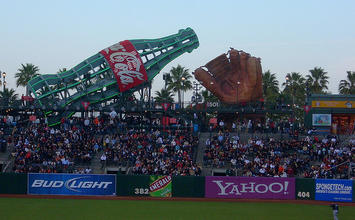
Flickr photo by LA Wad, 'Giant Coke Bottle and Baseball Glove', AT&T Park, San Francisco.
Matthew Stevenson, a contributing editor of Harper's Magazine, is the author of Remembering the Twentieth Century Limited,
 Email this Story