Broad concepts—green, socialist, or market-capitalist ideology—may animate cosmopolitan elites, but they generally do not motivate most people. Instead, the “tribe” is valued far more than any universal ideology. As the great Arab historian Ibn Khaldun observed: “Only Tribes held together by a group feeling can survive in a desert.”
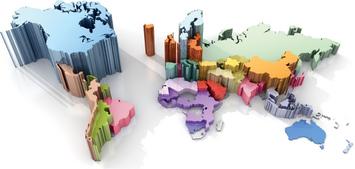
Tribal ties—race, ethnicity, and religion—are becoming more important than borders.
For centuries we have used maps to delineate borders that have been defined by politics. But it may be time to chuck many of our notions about how humanity organizes itself. Across the world a resurgence of tribal ties is creating more complex global alliances. Where once diplomacy defined borders, now history, race, ethnicity, religion, and culture are dividing humanity into dynamic new groupings.
Although tribal connections are as old as history, political upheaval and globalization are magnifying their impact. The world’s new contours began to emerge with the end of the Cold War. Maps designating separate blocs aligned to the United States or the Soviet Union were suddenly irrelevant. More recently, the notion of a united Third World has been supplanted by the rise of China and India. And newer concepts like the BRIC nations (Brazil, Russia, India, and China) are undermined by the fact that these countries have vastly different histories and cultures.
The borders of this new world will remain protean, subject to change over time. Some places do not fit easily into wide categories—take that peculiar place called France—so we’ve defined them as Stand-Alones. And there are the successors to the great city-states of the Renaissance—places like London and Singapore. What unites them all are ties defined by affinity, not geography.
1. New Hansa
Denmark, Finland, Germany, Netherlands, Norway, Sweden
In the 13th century, an alliance of Northern European towns called the Hanseatic League created what historian Fernand Braudel called a “common civilization created by trading.” Today’s expanded list of Hansa states share Germanic cultural roots, and they have found their niche by selling high-value goods to developed nations, as well as to burgeoning markets in Russia, China, and India. Widely admired for their generous welfare systems, most of these countries have liberalized their economies in recent years. They account for six of the top eight countries on the Legatum Prosperity Index and boast some of the world’s highest savings rates (25 percent or more), as well as impressive levels of employment, education, and technological innovation.
2. The Border Areas
Belgium, Czech Republic, Estonia, Hungary, Iceland, Ireland, Latvia, Lithuania, Poland, Romania, Slovakia, U.K.
These countries are seeking to find their place in the new tribal world. Many of them, including Romania and Belgium, are a cultural mishmash. They can be volatile; Ireland has gone from being a “Celtic tiger” to a financial basket case. In the past, these states were often overrun by the armies of powerful neighbors; in the future, they may be fighting for their autonomy against competing zones of influence.
3. Olive Republics
Bulgaria, Croatia, Greece, Italy, Kosovo, Macedonia, Montenegro, Portugal, Slovenia, Spain
With roots in Greek and Roman antiquity, these lands of olives and wine lag behind their Nordic counterparts in virtually every category: poverty rates are almost twice as high, labor participation is 10 to 20 percent lower. Almost all the Olive Republics—led by Greece, Spain, and Portugal—have huge government debt compared with most Hansa countries. They also have among the lowest birthrates: Italy is vying with Japan to be the country with the world’s oldest population.
4. City-States
London
It’s a center for finance and media, but London may be best understood as a world-class city in a second-rate country.
Paris
Accounts for nearly 25 percent of France’s GDP and is home to many of its global companies. It’s not as important as London, but there will always be a market for this most beautiful of cities.
Singapore
In a world increasingly shaped by Asia, its location between the Pacific and Indian oceans may be the best on the planet. With one of the world’s great ports, and high levels of income and education, it is a great urban success story.
Tel Aviv
While much of nationalist-religious Israel is a heavily guarded borderland, Tel Aviv is a secular city with a burgeoning economy. It accounts for the majority of Israel’s high-tech exports; its per capita income is estimated to be 50 percent above the national average, and four of Israel’s nine billionaires live in the city or its suburbs.
5. North American Alliance
Canada, United States
These two countries are joined at the hip in terms of their economies, demographics, and culture, with each easily being the other’s largest trade partner. Many pundits see this vast region in the grip of inexorable decline. They’re wrong, at least for now. North America boasts many world-class cities, led by New York; the world’s largest high-tech economy; the most agricultural production; and four times as much fresh water per capita as either Europe or Asia.
6. Liberalistas
Chile, Colombia, Costa Rica, Mexico, Peru
These countries are the standard--bearers of democracy and capitalism in Latin America. Still suffering low household income and high poverty rates, they are trying to join the ranks of the fast-growing economies, such as China’s. But the notion of breaking with the U.S.—the traditionally dominant economic force in the region—would seem improbable for some of them, notably Mexico, with its close geographic and ethnic ties. Yet the future of these economies is uncertain; will they become more state--oriented or pursue economic liberalism?
7. Bolivarian Republics
Argentina, Bolivia, Cuba, Ecuador, Nicaragua, Venezuela
Led by Venezuela’s Hugo Chávez, large parts of Latin America are swinging back toward dictatorship and following the pattern of Peronism, with its historical antipathy toward America and capitalism. The Chávez-influenced states are largely poor; the percentage of people living in poverty is more than 60 percent in Bolivia. With their anti-gringo mindset, mineral wealth, and energy reserves, they are tempting targets for rising powers like China and Russia.
8. Stand-Alones
Brazil
South America’s largest economy, Brazil straddles the ground between the Bolivarians and the liberal republics of the region. Its resources, including offshore oil, and industrial prowess make it a second-tier superpower (after North America, Greater India, and the Middle Kingdom). But huge social problems, notably crime and poverty, fester. Brazil recently has edged away from its embrace of North America and sought out new allies, notably China and Iran.
France
France remains an advanced, cultured place that tries to resist Anglo-American culture and the shrinking relevance of the EU. No longer a great power, it is more consequential than an Olive Republic but not as strong as the Hansa.
Greater India
India has one of the world’s fastest-growing economies, but its household income remains roughly a third less than that of China. At least a quarter of its 1.3 billion people live in poverty, and its growing megacities, notably Mumbai and Kolkata, are home to some of the world’s largest slums. But it’s also forging ahead in everything from auto manufacturing to software production.
Japan
With its financial resources and engineering savvy, Japan remains a world power. But it has been replaced by China as the world’s No. 2 economy. In part because of its resistance to immigration, by 2050 upwards of 35 percent of the population could be over 60. At the same time, its technological edge is being eroded by South Korea, China, India, and the U.S.
South Korea
South Korea has become a true technological power. Forty years ago its per capita income was roughly comparable to that of Ghana; today it is 15 times larger, and Korean median household income is roughly the same as Japan’s. It has bounced back brilliantly from the global recession but must be careful to avoid being sucked into the engines of an expanding China.
Switzerland
It’s essentially a city-state connected to the world not by sea lanes but by wire transfers and airplanes. It enjoys prosperity, ample water supplies, and an excellent business climate.
9. Russian Empire
Armenia, Belarus, Moldova, Russian Federation, Ukraine
Russia has enormous natural resources, considerable scientific-technological capacity, and a powerful military. As China waxes, Russia is trying to assert itself in Ukraine, Georgia, and Central Asia. Like the old tsarist version, the new Russian empire relies on the strong ties of the Russian Slavic identity, an ethnic group that accounts for roughly four fifths of its 140 million people. It is a middling country in terms of household income—roughly half of Italy’s—and also faces a rapidly aging population.
10. The Wild East
Afghanistan, Azerbaijan, Kazakhstan, Kyrgyzstan, Pakistan, Tajikistan
This part of the world will remain a center of contention between competing regions, including China, India, Turkey, Russia, and North America.
11. Iranistan
Bahrain, Gaza Strip, Iran, Iraq, Lebanon, Syria
With oil reserves, relatively high levels of education, and an economy roughly the size of Turkey’s, Iran should be a rising superpower. But its full influence has been curbed by its extremist ideology, which conflicts not only with Western countries but also with Greater Arabia. A poorly managed economy has turned the region into a net importer of consumer goods, high-tech equipment, food, and even refined petroleum.
12. Greater Arabia
Egypt, Jordan, Kuwait, Palestinian Territories, Saudi Arabia, United Arab Emirates, Yemen
This region’s oil resources make it a key political and financial player. But there’s a huge gap between the Persian Gulf states like Saudi Arabia and the United Arab Emirates and the more impoverished states. Abu Dhabi has a per capita income of roughly $40,000, while Yemen suffers along with as little as 5 percent of that number. A powerful cultural bond—religion and race—ties this area together but makes relations with the rest of the world problematic.
13. The New Ottomans
Turkey, Turkmenistan, Uzbekistan
Turkey epitomizes the current reversion to tribe, focusing less on Europe than on its eastern front. Although ties to the EU remain its economic linchpin, the country has shifted economic and foreign policy toward its old Ottoman holdings in the Mideast and ethnic brethren in Central Asia. Trade with both Russia and China is also on the rise.
14. South African Empire
Botswana, Lesotho, Namibia, South Africa, Swaziland, Zimbabwe
South Africa’s economy is by far the largest and most diversified in Africa. It has good infrastructure, mineral resources, fertile land, and a strong industrial base. Per capita income of $10,000 makes it relatively wealthy by African standards. It has strong cultural ties with its neighbors, Lesotho, Botswana, and Namibia, which are also primarily Christian.
15. Sub-Saharan Africa
Angola, Cameroon, Central African Republic, Congo-Kinshasa, Ethiopia, Ghana, Kenya, Liberia, Malawi, Mali, Mozambique, Nigeria, Senegal, Sierra Leone, Sudan, Tanzania, Togo, Uganda, Zambia
Mostly former British or French colonies, these countries are divided between Muslim and Christian, French and English speakers, and lack cultural cohesion. A combination of natural resources and poverty rates of 70 or 80 percent all but assure that cash-rich players like China, India, and North America will seek to exploit the region.
16. Maghrebian Belt
Algeria, Libya, Mauritania, Morocco, Tunisia
In this region, spanning the African coast of the Mediterranean, there are glimmers of progress in relatively affluent countries like Libya and Tunisia. But they sit amid great concentrations of poverty.
17. Middle Kingdom
China, Hong Kong, Taiwan
China may not, as the IMF recently predicted, pass the U.S. in GDP within a decade or so, but it’s undoubtedly the world’s emerging superpower. Its ethnic solidarity and sense of historical superiority remain remarkable. Han Chinese account for more than 90 percent of the population and constitute the world’s single largest racial-cultural group. This national cultural cohesion, many foreign companies are learning, makes penetrating this huge market even more difficult. China’s growing need for resources can be seen in its economic expansion in Africa, the Bolivarian Republics, and the Wild East. Its problems, however, are legion: a deeply authoritarian regime, a growing gulf between rich and poor, and environmental degradation. Its population is rapidly aging, which looms as a major problem over the next 30 years.
18. The Rubber Belt
Cambodia, Indonesia, Laos, Malaysia, Philippines, Thailand, Vietnam
These countries are rich in minerals, fresh water, rubber, and a variety of foodstuffs but suffer varying degrees of political instability. All are trying to industrialize and diversify their economies. Apart from Malaysia, household incomes remain relatively low, but these states could emerge as the next high-growth region.
19. Lucky Countries
Australia, New Zealand
Household incomes are similar to those in North America, although these economies are far less diversified. Immigration and a common Anglo-Saxon heritage tie them culturally to North America and the United Kingdom. But location and commodity-based economies mean China and perhaps India are likely to be dominant trading partners in the future.
This article originally appeared in Newsweek.
Legatum Institute provided research for this article.
Joel Kotkin is executive editor of NewGeography.com and is a distinguished presidential fellow in urban futures at Chapman University and an adjunct fellow with the Legatum Institute in London. He is author of The City: A Global History

Illustration by Bryan Christie, Newsweek
 Email this Story