One of the news stories circling lately is an interview with Andres Duany where he asserts that public participation requirements are too onerous to enable great work to be done. Early in my career I worked as a public historian and historic preservation specialist, so rather than launch immediately into my opinion, let me tell you a true story.
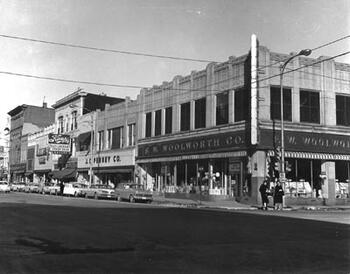
In the 1950s, business owners in downtowns across the country became agitated over the fact that their central business districts were facing a double challenge: increasing amounts of traffic congestion and increasing competition from new suburban shopping centers. One of the towns feeling these challenges was Green Bay, Wisconsin, which had a very energetic and forward-thinking business leadership circle.
The good men of Green Bay did what most forward-thinking leaders do when faced with a fearful challenge on the horizon: they hired a consultant. The consultant they chose was Victor Gruen, an architect who had recently gained fame designing the nation’s first enclosed shopping mall, in Edina, Minnesota. In the couple of years that had lapsed since the Southland Mall plans hit the streets, Gruen had become a celebrity – the Andres Duany of his day.
In a 2006 article for the New Yorker, Malcolm Gladwell described Gruen as “short, stout, and unstoppable, with a wild head of hair and eyebrows like unpruned hedgerows.” Gladwell summed up Gruen’s impact pretty succinctly:
Victor Gruen didn’t design a building; he designed an archetype. For a decade, he gave speeches about it and wrote books and met with one developer after another and waved his hands in the air excitedly, and over the past half century that archetype has been reproduced so faithfully on so many thousands of occasions that today virtually every suburban American goes shopping or wanders around or hangs out in a Southdale facsimile at least once or twice a month. Victor Gruen may well have been the most influential architect of the twentieth century. He invented the mall.
Gruen asserted in Green Bay, as he did in dozens of other cities in the 1950s and 1960s, that the key to solving downtown’s competition challenge was to completely separate vehicular traffic from pedestrians. By massively widening Main Street at the north end of the commercial district and completely enclosing the core of the existing commercial district, all of downtown’s problems would be solved. All the plan required was money and a willingness to be unsentimental and practical.
You don’t have to be Duany to understand what happened. It took 20 years for Gruen’s vision to become some form of reality, and during that time the City’s business and political leadership –and its planning staff – stuck to Gruen’s plan as diligently as the real world constraints of financing and private development would allow.
By the time it opened in 1977, the new Port Plaza Mall and associated parking lots and garages had obliterated acres of downtown buildings, dislocated a hundred residents. It sent dozens of businesses to liquidation or to the far edges of the newly-sprawling city where many of them are located today. If Gruen considered the collateral damage of grand ideas at all, I wager he simply viewed them as the price of progress.
All of this might be tolerable from a strict economic standpoint if Gruen’s grand plan had worked. It didn’t. Port Plaza Mall was a money-loser from virtually day one. By the early 1980s, Port Plaza was doing so poorly that the City took the advice of another consultant and bulldozed another full block of buildings to add the magic third anchor, which they were assured was the way to fix the mall’s ails. By the early 2000s, that anchor was gone.
Green Bay, like many other cities that drank the downtown mall Kool-Aid, continues to struggle with a downtown that is dominated by a windowless, dispiriting, too-vacant hulk where its heart should be. Meanwhile, the region’s former skid row, right across the Fox River within eyesight of the mall, has become the hottest urban neighborhood in the region, and the winner of a Great American Main Street Award.
This isn’t simply a story about the virtues of historic preservation. Gruen’s idea didn’t fail because Green Bay wanted old buildings or because the people who lived and worked in those old downtown buildings did something to undermine the plan. Like most people of that era, the majority of the City’s leadership and residents placed their faith in the expert and in the concept of progress. Any gut misgivings they may have had were pushed aside. The plan was made by a national expert, right?
Gruen’s mall failed because he envisioned and sold an ideal solution without giving any attention to economic realities, and without consideration of the myriad of unforeseen factors and unintended consequences that could, and did, develop. Gruen stood at the beginning of an era, and there was no way anyone could anticipate how the world would change in a few short decades.
The greatest failure of Gruen’s plan was that he did not recognize or acknowledge that his Grand Vision could very well turn out all wrong.
We should have learned by now that our Grand Visionary Designers are not infallible. Our landscapes are littered with Grand Visionary Architecture that was supposed to fix something, or create Something Big. And so few of those grand visions ever came out the way they were promised, or managed not to create a new set of problems. Never heard of Port Plaza? That’s because there are Port Plazas of one flavor or another in virtually every city in the country. Some are malls, some are stadiums, some are brutalistic, forsaken parks. You can pick them out easily by their Grand Design ambitions and their total lack of life.
Our failure to learn this lesson is a blot on architecture and planning.
This history is exactly why Duany is wrong about the importance of public participation. Public participation is important not just to try to get people to go along with our vision, to give us a chance to yell loud enough to drown them out, or to allow us to demonstrate the superiority of our Grand Vision over their piddling little concerns. When residents resist a new development – even when they supposedly “don’t like change” – it doesn’t take many questions or much effort to develop a real understanding of their concerns and their point of view.
We fail consistently to realize that the locals are there every day and we are not. Local residents have a level of detail and a critical perspective that can make the difference between whether a proposed project supports the health of the community or creates a new burden. Much of the time, the real concerns of the residents of an area have to do with nuts and bolts issues that can be fixed with relatively little effort or accommodation. It’s possible that local resistors might have good reasons why the proposed change is a bad idea. If we don’t enable and empower them to speak, we have made the same mistake as Gruen and we are likely to create a similar legacy.
Understanding the real reasons why people oppose a project requires the willingness to do so, the humility to listen, and the internal fortitude and self-assurance to admit that possibly, oh just possibly, we don’t know everything that there is to know. That is the real mark of wisdom.
Duany and other marquee designer types have the privilege of maintaining a distance from the dirty work of making a project functional in real life. Don’t overlook the work of the nameless landscape architects and architects who are hired by the developers after the big name architects are paid, have gathered their glory, taken their big checks and left. It is those highly competent, highly talented professionals who deal with the Grand Architect’s ignored steep slope under that proposed building or those planting beds that will block other drivers’ vision of the charming landscaped driveway emptying out onto a major intersection.
Ah, little stuff. Who cares?
If the people who live around a proposed development oppose a development, chances are those people know something that is important to the health of their neighborhood and the larger community. If we think that we know more than to have to listen to them, then we are no better than little Napoleons in big capes, creating monuments to our hubris that our children and grandchildren will have to clean up. The lessons of the damage caused by our ignorance are all around us.