Will Driverless Cars Help us Drive Less?

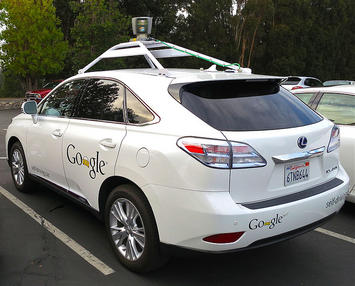
Google's_Lexus_RX_450h_Self-Driving_Car.jpg

The war on automobiles is real. Backed by a legion of city officials, environmentalists, and new urbanists, the argument to mitigate vehicle has so far been an easy sell – at least in planning circles. Their assumptions echo concerns about the trajectory American cities – the downfall of rural life and open space to name a few.  The problem is the trifecta of pollution, congestion, and urban sprawl. Out with cars, they propose – people could ride high-speed transit instead of sitting in traffic.

But technical innovation could make this proposal more like a plea. Google, along with GM, Ford, and Daimler are now designing cars that drive themselves, making private vehicles more efficient, flexible, and thereby more irreplaceable. The US is not alone. Manufacturers in Japan and Germany are coordinating with their national government to launch their autonomous cars within the next decade. IEEE, a group of technology professionals, says that self-driving vehicles would comprise 75 percent of the global traffic stream by 2040. 

“Currently, a car spends 96% of its time idle,” says Koushik Dutta of ClockworkMod. He says there’s an unforgiving economic incentive to make sure an airplane is always in use, since they spend almost their entire lifetime in operation. To leave a plane idle is inefficient and unprofitable; similar logic applies to parked car. Some predict the autonomous vehicle technology will decrease this idle time as households begin to link their commutes in one car, rather than one car per person. Sergey Brin, Google’s cofounder, believes the technology, now tangible, will be on the market in five years.

But what precisely is this new technology? As it turns out, much of it is not new; a number of automated features can be found in today’s cars: timed braking during collisions, motion sensors that detect distance between the vehicle and what’s in front of it, and adaptive cruise control. Many of the latest features have applications that use advanced sensors to self-park and prevent drifting to adjacent lanes and self-park.

Unprecedented is the use of a network for vehicles to communicate with one another. A study finds that if vehicles use sensors alone, highway capacity can increase by 43 percent, and if all of the vehicles use both sensors and vehicle-to-vehicle (V2V) communication, the increase swells to 273 percent. Additionally, networks can facilitate information exchange between vehicles and road infrastructure (V2I). With live data streams, cars will be able to inform one another about oncoming traffic, and perhaps even instinctively reroute the car onto less congested roads.

The move to driverless cars will make the private vehicle much more attractive compared to other modes of travel. This is occurring just as an aging population could lead to reduced driving ;  the coming of driverless cars brings them back onto the road. Less reliant on their friends and family as chauffeurs, boomers may happily embrace the ability to travel further and more frequently.

This appeal will extend of course to all generations. The driverless car will offer the current conveniences of the private auto,– such as door-to-door travel, safety, and status – while reducing its level of rick and mental stress. Also, the stigmas of driving are eased; self-driving cars will likely be more eco-friendly, time-efficient, and user-friendly. Once available on the market, driverless technology will change lives by saving lives. Advocates of self-driving cars believe that with less human activity and more automated maneuvering on the road, fewer accidents will occur.

But before autonomous cars can save lives, it must squirm through some political barriers. For one, city officials in large metropolitans are glued to the idea that the best communities exemplify mixed used, high-density, transit-oriented development. Hoping to reverse the still far from over exodus to the suburbs, cities like Los Angeles are banking on public transit to revitalize its inner-urban areas. Though public transit ridership has increased in the last two decades, its market share of ridership has being declining. Metropolitan officials hope that millennials, who tend to be more cognizant of mankind’s carbon footprint, will reverse the trend. It is, however, difficult to imagine why any future generation would enjoy the conveniences of taking transit if a car ride can be just as untroubled. Driverless will make vehicle ownership much more attractive. Public transit will lose its status as an amenity. One of the chief advantages of public transit is the fact that one can ride it stress free without worrying about maneuvering to the destination. With driverless cars, this advantage is superseded.

Congestion may increase because more vehicles will find the frustrations of wading in traffic mitigated. Time in congestion can be replaced with a book, movie, perhaps even a nap. But there’s also the possibility that more households will link their trips using one shared vehicle, decreasing the number of vehicles on the road. Some suggest this may help Americans come to terms with letting go of the private vehicle and, instead, embrace the idea of having one household vehicle, a prevailing trend across the rest of the world.

Transportation planners often promote tolls as revenue sources because building high-occupancy and toll (HOT) lanes. The concept is deemed equitable since it links the payers with the users, begetting a sustainable funding model. Much of the funding for these projects is based on the congestion premium - what people will pay to avoid a crammed highway. This is useful in determining how much to price a toll or high-occupancy lane. But since driverless technology will likely lower this premium, the revenue of these lanes may be overvalued.

With the pieces in place, the journey to driverless cars is vastly feasible. In September 2012, California Governor Jerry Brown enacted a state measure to legalize driverless technology in cars running on public roads; at any given moment, a dozen driverless cars are operating somewhere in California. Currently, each vehicle is manned by two testers and marked by a distinguishable license plate. In the future, the vehicle will only be required to have a one driver. And not too far is the idea of a completely unmanned vehicle, what some call the robocar, which will revolutionize not just our mode of travel but our relationship with time and distance.

Jeff Khau graduated from Chapman University with a degree in business entrepreneurship. Currently, he resides in Los Angeles where he is pursing his dual-masters in urban planning and public policy at the University of Southern California.

Retrofitted driverless Lexus photo by WikiCommons user Steve Jurvetson via Mariordo.


Comment viewing options

Select your preferred way to display the comments and click "Save settings" to activate your changes.

Well after a quick overview

Well after a quick overview on this car I have to say that technology is now quite advanced and it deliver beneficial and quick results to human being through its invention. Here we have found that how driver less car helps to drive less that automatically reduce the chances of accidents and fatal crash. Driver less car is specially design with censor technologies that works to brings down the chances of fatal crash.
Richmond car accident attorneys

I have been searching for

I have been searching for articles about valves and actuators and your post really helps. Thanks a lot for posting this.
Arrowhead Ranch homes for salè

Yes, it probably right. But

Yes, it probably right. But it is quite safe than the driving of people.
In driverless car the margin of error in drive is very very small and chance of any accident also quite small. Because it is well operated. There is no chance of any distraction from the driving. It also keep you in safety. You don't need to drive the and you can enjoy the trip without any problem. www.swedishmotorautorepair.com/Services_2.html

Well due to technology

Well due to technology advanced we have witnessed a number of varieties are introduced in cars now days; that is quite eligible to provide advanced and beneficial features. Most probably we are estimating a censor vehicle that is fully equipped with sixth sense technology such as drive without a driver this technology might be more effective in the upcoming features and also it helps to reduce accidents.
summit nj car service

We all know that the

We all know that the Nissan’s Sunderland plant has been the UK's largest car manufacturer and famous brand in automotive. This is one of the good news that Nissan is decided to produce new model at Sunderland plant which will create an additional 225 jobs at Nissan and 900 jobs at component companies supplying Nissan in the UK. Hope, this huge invenstment of nissan will also give them the good profit and great demand in Automotive Industry. Car Wraps Tacoma

Driver less cars are being

Driver less cars are being famous and soon we will be able to see these cars hitting the road. They will make driving an easy task with reduced risk of accidents and lessen the congestion in roads. But still it is hard not possible to completely depend on driver less cars. The drivers will loose their jobs and people will stop using public transportation system.

BMW repair huntington beach

New York has closed several

New York has closed several miles of roads to cars. Outside of the US it is actually a common practice given that cars make roads feel hazardous and unsafe. BUS ACCIDENT are become common in urban areas which should be control.

96% idle cars today are 96% fewer cars tomorrow.

The days of bus systems and taxi systems may be numbered with the advent of the self driving car, but the other major change will be car designs that reflect the most common use cases, driving a single person, at 35-45mph, less than two miles. This allows cars to become cheaper, lighter, more efficient, and use less space and materials.

It is trivial to build an electric car that has a 100 mile range and tops out at 50mph. It is incredibly difficult to build an electric cart with a 350 mile range that tops out at 120mph.

A huge amount (in my city's case nearly 60%) of available urban space is given up to parking. If cars are always on the move and there are 96% fewer, that space will be freed up for bike lanes, parks, and real estate increasing the livability of urban and suburban areas.

Imagine a Wal-mart without a parking lot. Self driving cars will be the end of the strip mall as we know it.

The advent of the self driving car will not result in the end of public transportation. Instead it will end the era of private car ownership. When a car is a click away, why drop thousands to own one that will just sit in a parking lot 96% of its lifetime. The real question is, how much will it cost for a ride?

I concur

In so many ways. There is a distinct change taking place. Fewer and fewer people see any romance in automobile ownership. They see the automobile as a "tool to accomplish a task" If that tool can be actually practical, then it gets used. Personal ownership an automobile, is not practical for many people. If a vehicle is a "shared tool", then the costs are spread out, and much more practical. This works well, for people that don't have an emotional attachment to a car (which always seemed a little odd to me) In many cities, people use either public transport, bicycles, or walk. Which makes paying for a full time car, a huge waste of resources.

Changes in demographics, and solutions searching for problems

The driverless automobile, will have a place. It's just not exactly where the writer indicates. The trending decrease in VMT currently taking place, as well as the decreased rates of automobile ownership/licensure among younger generations will not be resolved by automated vehicles. Many of these younger folks, have a differing value proposition. Often they place less value on vehicle ownership. This has brought about the rise of such vehicle sharing services such as "Zipcar" and "car2go". An automated vehicle may make a good alternative, as a "shared use" vehicle, provided they aren't too cost-prohibitive. The fact that it is automated, and once the technology proves itself, that would provide lower insurance/maintenance costs for companies using these as shared vehicles.

And no, there isn't a war on cars. In the three cities where I spend my time, not one single mile of roadway has ever been closed to automobiles. Not one single mile. You're attempting to use fear-based imagery, to motivate your audience. stop it. It's unbecoming.

NYC

New York has closed several miles of roads to cars. Outside of the US it is actually a common practice given that cars make roads feel hazardous and unsafe. A pedestrian zone provides a place for people to enjoy themselves, set up market stalls, and shop. They increase safety, and improve the urban environment.

I reject the negativity of a war on cars, but I eagerly embrace the battle for livable, walkable streets.

New York

I have read about the experiments in New York. What an amazing feat. I've pondered taking the train out to see it myself. I remember the drama that 'certain' groups put up. It's the same thing every time "it will hurt business!" Yet, once done, business grows. It goes to show, when you build strictly for cars, your just flushing money down the toilet

Driverless cars

As long as an adult is not required to ride along, families will love driverless cars. Imagine sending the car to pick up the kids instead of having to drive them around.

Its likely yet another nail in the coffin of public transit and dense overpriced cities.

Exactly my thoughts

Electronic chauffeurs will mean more freedom.

Dave Barnes