Newgeography.com - Economic, demographic, and political commentary about places
A critical component in the rise of market-oriented democracy in the modern era has been the dispersion of property ownership among middle-income households—not just in the United States but also in countries like Holland, Canada, and Australia, where it was closely linked with greater civil and economic freedom. In its early days, this dispersion was largely rural, but after the Second World War, it took on a largely suburban emphasis in the U.S., including within the extended metro regions of traditional cities like New York and Los Angeles. read more »
We live, as the Indian essayist Saeed Akhter Mirza has put it, in “an age of amnesia.” Across the world, most notably in the West, we are discarding the knowledge and insights passed down over millennia and replacing it with politically correct bromides cooked up in the media and the academy. In some ways, this process recalls, albeit in digital form, the Middle Ages. read more »
Republicans have been celebrating their good fortune as Democrats vying for the presidential nomination propose free medical care for undocumented people and the elimination of private health insurance, and open borders, not to mention reparations for slavery and the near-term elimination of fossil fuels. Add it up, and it may be enough to keep Doctor Demento in the White House for four more years. read more »
It would be comforting if Nike’s decision to ditch its “Betsy Ross” flag sneakers at the behest of former NFL quarterback and social justice warrior Colin Kaepernick was exceptional, but, sadly, it is not. Increasingly, many of our most powerful companies eagerly kowtow to the purveyors of political correctness — such as those who compared the revolutionary banner to the Nazi swastika flag or that of the Confederacy. read more »
‘But why can’t work be like that now?’ my colleague Julia asked when I told her about my research into the former Guinness brewery at Park Road in West London. After working on the project for the best part of a decade and a half, it’s sometimes difficult to sum up quickly. Over that time, I’ve looked at thousands of photographs, scores of staff magazines, and hundreds of documents, and I’ve talked to dozens of workers. But Julia’s question cut straight to the heart of the book. read more »
During a summer vacation season marked by long security lines and record-setting air traffic, it is easy to overlook a trend in U.S. ground travel that is winning converts from those who would otherwise fly: the rapid expansion of bus lines offering first- and business-class service on short-hop routes. read more »
Eurostat, the statistical agency of the European Union (EU) indicates that Paris is the largest metropolitan area in the EU, Switzerland and Norway, with 12.8 million residents, according to the latest estimates. This is slightly more than number two London --- which may soon be outside the Union --- with 12.4 million residents. read more »
A few months ago prominent naturalist David Attenborough told attendees at the World Economic Forum about humanity’s unsustainable population growth and his certainty that it has to “come to an end” quickly. In the meantime, he told participants, we should also eat a lot less meat. read more »
My latest column is online in the Indianapolis Business Journal. Obviously it’s about Indianapolis, but similar arguments apply to basically every other basically well-performing Midwest city. They are completely parochial talent sheds and need to attract from further afield. Here’s an excerpt: read more »
For the past decade, the soaring stock prices and nosebleed valuations of Silicon Valley’s IPOs and unicorns has been a boon for California, helping create a record budget surplus of almost $22 billion.
Yet this bonanza has occurred just as the state’s overall job creation, once among the country’s leaders, has slowed to a more middle of the road status, well below the rates for key competitors such as Nevada, Arizona, Washington State and Texas. read more »
I just spent a few days in Stockton, California visiting old family friends. They’re a recently retired Lutheran pastor and his wife who relocated from Southern California and returned to their hometown. Being lifelong members of the church has many benefits, but making lots of money isn’t one of them. They run a lean operation and found a modest three bedroom two bath fixer upper for $195,000 and proceeded to do almost all the renovation work themselves. read more »
Radical Suburbs: Experimental Living on the Fringes of the American City, by Amanda Kolson Hurley (Belt Publishing, 160 pp., $16.96)
If forced to compare an ice cream flavor with suburbia, many would pick vanilla. Yet, as Amanda Kolson Hurley writes in her new book, Radical Suburbs: Experimental Living on the Fringes of the American City, this is just one of many “misinformed clichés” about these peripheral communities. City-dwellers internalized these attitudes early on. In the early 1950s, novelist Raymond Chandler spoke for many urbanites when he disdained suburban life for its “eight-room house, two cars in the garage, chicken every Sunday and the Reader’s Digest on the living room table, the wife with a cast-iron permanent and me with a brain like a sack of Portland cement.” read more »
The nation’s worst-managed transit systems lose 65 cents for every dollar they spend on operating costs, fill only 42 percent of their seats, carry the average urban resident just 40 round trips per year, use more energy and spew out more greenhouse gases per passenger mile than the average car, carry fewer than 14 percent of low-income workers to work, and lost 4 percent of their customers in the last four years. read more »
America was conceived with the highest ideals about humanity — “all men are created equal” — but operated also as a racial republic, where rights were delineated by race, leaving only white males with the full set of powers. After all, Thomas Jefferson was also an owner of slaves. read more »
My latest article is online in City Journal and is a look at the most recent failed attempt to merge St. Louis city and St. Louis county governments in light of the backdrop of civic challenges there. Here’s an excerpt: read more »
Some people go their whole lives without seeing a ghost; me, I see them all the time.
– Detective Bernie Gunther in Phillip Kerr’s Greeks Bearing Gifts
Last month the German commissioner for “Jewish Life in Germany and the Fight Against Antisemitism” used his impressively titled office to advise German Jews against wearing kipahs in public. The commissioner’s response to a surge of anti-Semitic violence in his country was a sheepish acknowledgment that Germany is once again a dangerous country for Jews. And as Germany goes, so goes Europe. read more »
The rural to urban exodus is well known. It has driven the growth of the largest urban areas from one million residents as late as 1800 to nearly 40 million today. The United States has risen from less than 40 percent urban in 1900 to more than 80 percent today. Other, more affluent nations have experienced similar trends. Even more quickly, China has risen from 19 percent urban in 1980 to 56 percent in 2015 today, according to the United Nations. Even the least affluent nations are urbanizing rapidly. read more »
California was once a state of great builders, and its legacy of grand construction projects remains plenty visible today. Major infrastructure investments like the California Aqueduct enabled the sprawling metropolises of the Southern California desert to thrive, becoming some of the most prolific economic and cultural centers in the world. The Golden State pioneered highway construction, linking its cities with each other and the rest of the nation. And perhaps the most iconic symbol of California, the Golden Gate Bridge, was a remarkable civil engineering feat of its time. read more »
In the past, the right, notably the segment affiliated with religious belief, was closely associated with censorship and control of thought. Today, enforced orthodoxy derives primarily from the left, emboldened by near total control of the media, university curricula and cultural products. read more »
I’ll start by giving you all a chance to consider some basic questions that Mayor Eric Garcetti and his staff failed to address –- and the mainstream media left hanging -- in the wake of a report that confirmed the obvious rise in homelessness in Los Angeles over the past year or so. read more »
There seems to be no good reason why a thoroughly scientific
dictatorship should ever be overthrown.
~Aldous Huxley, Brave New World Revisited
The recent movement to investigate, and even break up, the current tech oligarchy has gained support on both sides of the Atlantic, and even leapt across the gaping divide in American politics. The immediate concerns relate to such things as the control of key markets by one or two firms, the huge concentration of wealth accruing to the tech elite and, increasingly, the oligarchy’s control over and manipulation of information pipelines. read more »
China stands as the primary exhibit of twenty-first-century urbanism. At a time when elite cities in the West barely manage to grow in population, Chinese cities have emerged out of virtually nothing, as hundreds of millions of people have moved from farm to city. read more »
I’ve been examining data lately, revisiting a topic I’m mentioned in the past, namely the smaller sizes of suburbs in Midwest cities compared to other parts of the country. This applies to much of the US east of the Mississippi as well.
West of that river, there are a number of states and regions where there are large suburbs, some of them ranking among the largest municipalities in the country. For example, here are the ten largest suburbs of Dallas-Ft.Worth: read more »
If next year’s election is a referendum on Donald Trump, you can hand power to the Democrats now. But fortunately for the president, and the Republican Party, politics remains more about interests than personalities.
More than by cultural memes touching on race, gender, and even taste, the United States are divided by where we live and how we make our living. America, after all, is a vast country and its remarkable economic diversity is what makes it so dynamic and capable against all competitors. read more »
By a majority of votes and voluminous citations, Jacobs tops the list of the 20th century's most influential urban thinkers. Had this been a transient fascination, as with literary works, it would be a major achievement in itself. In this case, it's far greater: an entire profession mesmerised in thought and action. read more »
Perhaps no issue more motivates progressive activists than social justice. Good intentions may motivate the social justice warriors, albeit sometimes sprinkled with a dollop of self-hatred. But good intentions do not necessarily produce good results. Indeed, often the policies favored by progressive idealists hinder the economic and social progress of the very people they seek to rescue. read more »
The promotion of middle-income home ownership long has been a policy priority of governments around the world. This includes New Zealand, as Gael Ferguson indicated in The New Zealand Dream, published in 1994: read more »
The recent California Democratic Party convention in San Francisco exposed the divide between the state’s progressive and working-class voters. Progressives, in their militant certitude, support left-wing policies that often don’t affect them; it’s the working class that suffers the consequences of these proposals. But the Green New Deal, widely embraced by party leaders, pushed too far, triggering a backlash at the convention. read more »
Twenty-one businesses have closed in less than two years since the city of Los Angeles reconfigured a 0.8 stretch of Venice Boulevard in the west side’s Mar Vista neighborhood. The city replaced one of three traffic lanes in each direction with protected bike lanes, removed some street parking, and installed physical barriers. The project is called a “road diet” and it’s part of the city’s “Vision Zero” and “Complete Streets” programs. read more »
The recent upsurge in support for populist conservatives, not only across Europe, but in the United Kingdom, Australia, Canada and even India has inspired talk of “a nationalist revival” and “the cosmic magnetism” of Donald Trump and Brexit. Here, it is argued, is a movement that finally can take on both the Green-oriented and increasingly authoritarian left. read more »
Today, the Walton Family Foundation released “The Most Dynamic Metropolitans,” new research ranking the economic performance of metropolitan areas in the Heartland and across the country. The study demonstrates that a knowledge-based economy spurs economic growth in metropolises across the United States. Metro areas with knowledge-based economies ranked higher than cities that have yet to make much-needed investments in technology, education, entrepreneurship and commercialization. read more »
If ever any group had it coming, it’s the giants of the tech industry. The recent decision by the Trump administration to look into monopolistic practices by the tech oligarchs—talk about collusion!—represents a welcome change from over two decades, under both parties, of sucking up to these firms as they bought up competitors and consolidated market positions that would put the likes of John D. Rockefeller to shame. read more »
I was in Atlanta last month and was encouraged to poke around by the people who invited me. For my entire life the greater Atlanta metroplex has grown in population, geographic size, economic importance, and cultural relevance. As the locals like to remind everyone, Hartsfield-Jackson is the busiest airport in North America. Half the people I went to school with in New Jersey in the 70s and 80s migrated to places like Atlanta for all the usual reasons. read more »
On the surface, the Green New Deal (GND) sounds enlightening. Use a nonexistent super grid of renewable intermittent electricity energy to replace fossil fuels so we can all breath air with no emissions from energy production. But the renewable term in all these cases is not energy in its totality, but just “electricity”. Wind and solar farms can only produce electricity, and even that is intermittent, as we need the wind to blow or the sun to shine, or both continually as far north as Oslo and as far south as Christchurch. read more »
China is building a magnetically levitated (maglev) train that will “fill the gap between high-speed rail and air transportation,” says CNN. This new train may have a top speed of 370 miles per hour, which “could narrow the gap between high-speed rail and air travel,” says Republic World. read more »
For some time, the mainstream press and conventional urban planners have been obsessed with a “dense urban” narrative. This is largely a myth, as has been demonstrated by resurgent growth in suburbs and exurbs. read more »
If you’ve ever seen a herd of elephants moving majestically across an African savannah, you’ll always remember the experience. Equally memorable yet horrifying is the sight of a dead animal killed by a poacher for its tusks. read more »
The recent debate over the Green New Deal got me thinking about a lecture I gave in 2018 at the Columbia University Seminar on Energy Ethics. The faculty who attended were mostly environmental lawyers and scientists. I am neither. But they asked me to discuss “The Fragility of the Blue-Green Alliance” – not so much the formal partnerships between union and environmental groups but rather the complex challenges of bridging differences between workers and environmentalists. read more »
If you ask an American to tell you about their country, they’ll probably paint a bleak picture. Civic bonds are fraying. Division and tribalism dominate the news. The public is losing faith in democracy as the most effective way to govern. At a time of rapid demographic and cultural change, with frustration over economic inequality reaching a boiling point, our national politics has not found a way to generate consensus. read more »
Transit ridership is plummeting almost everywhere, yet officials in many cities are still devising hugely expensive plans for transit projects. One such city is Austin, whose leaders are talking about spending between $6 billion and $10.5 billion on new transit lines (and the final cost always ends up being more than the projections). read more »
While the media tends to studiously report – and often sensationalize – the latest developments involving Airbnb, e-scooters, and ride-hailing (especially Lyft and Uber), another booming “sharing economy” sector has recently been gaining attention. Peer-to-peer carsharing enables individuals to make their privately-owned vehicles available to others for short periods of time at a fee of the owner’s choosing. read more »
The 2018 municipality population estimates indicate a general decline in the annual growth rate over the past year compared to that of the last eight years. Among the 37 municipalities (including Honolulu, see Note 1) with at least 500,000 residents, the population grew 0.39 percent, down by more than one-half from the annual rate since the 2010 US Census (0.88 percent). Critically, this measures not metropolitan populations but those of cities (municipalities) within metropolitan areas. read more »
“Saving the planet” should be an unbeatable political slogan. Yet consistently the imagined “green wave” mindlessly embraced by most of the media continues to fall short, as evidenced by recent elections in Canada and Australia, as well as across much of Europe. read more »
by Anonymous 05/24/2019
Recent statistics from Indeed.com show that Washington, DC, the winner of the HQ2 contest, ranks second only to San Jose in the percentage of high-tech job listings. This tells us that most of the 238 cities that submitted bids --- despite assurance from Amazon --- were never seriously in the running. If mid-sized places like Indianapolis did not really stand a chance, however, what does that tell us about the economic prospects for smaller, more industrial places that have virtually no software companies? read more »
A major shift took place in California’s population growth --- which has fallen below the national average --- over the past eight years. The latest Census Bureau population estimates (for July 1, 2018) show that growth has stalled in the coastal metropolitan areas. At the same time annual population growth rates have trended upward in the nearby interior areas. This article reports on these trends, dividing the state into three regions for analysis. read more »
A metropolitan economy, if it is working well, is constantly transforming many poor people into middle-class people, many illiterates into skilled people, many greenhorns into competent citizens. . . . Cities don’t lure the middle class. They create it.
—Jane Jacobs read more »
Bloomberg’s Justin Fox tweeted out a link to this piece from a professor in Peoria, Illinois who left a coveted tenure-track position because he couldn’t bear the thought of living there. Here’s an excerpt: read more »
by Anonymous 05/20/2019
In a remarkable and most unexpected outcome, Australia’s conservative Prime Minister Scott Morrison has retained the country’s leadership at the recent Australian Federal Parliamentary election (18 May, 2019). Morrison’s victory confounded a wide array of commentators, academics, advocacy groups, industry groups, all of the opinion polls, most of the media and a host of fringe political groups who not only predicted victory for the Labor opposition but an emphatic one. read more »
In the aftermath of the Communist victory in the late 1940s, the question often asked in Washington was: “Who lost China?” That fueled the McCarthyite inquisition that followed. The question our children might ask is: “Who lost America?” read more »
In the run-up to the elections for the European Parliament, The Economist magazine suggests that the old political divisions no longer apply (“Between somewhere and anywhere: The politics of suburbia in Europe,” May 11, 2019). As the chaos of a British Parliament is unable to meet its self-defined Brexit deadline, The Economist observes that “Culture wars have taken hold of European politics and eclipsed the old left-versus-right distinction,” suggesting that the traditional majority social democrats and Christian democrats could find themselves outnumbered after the election: read more »
Due to circumstances entirely within the city of Milwaukee’s control, it can’t afford to fix potholes in city streets and it certainly won’t pay to repair the damage to at least 45 cars caused by those potholes so far this year. read more »
Mayors have had little success in becoming president, with only one big-city chief executive, Grover Cleveland of Buffalo, later governor of New York, actually making it to the White House. read more »
The notion that an ever growing and/or wealthier population can only deliver environmental doom has been the standard foundational belief of the modern environmental movement. The latest variation on this theme was arguably best summed up over a decade ago by business magnate and long-time population control advocate and financial backer Ted Turner who blamed global warming on the fact that “too many people are using too much stuff.” read more »
Alex Kotlowitz, author of There Are No Children Here, returns with a new book called An American Summer that is an extremely powerful portrait of the impact of violence in Chicago. It’s hard to really review a book that is a collection of people’s stories, but I have one up over at City Journal. An American Summer is a very moving and disturbing work I highly recommend. Here is an excerpt from my review: read more »
For decades California’s regulatory and tax policies have undermined our middle class, driving millions out of this most favored state. Perhaps nowhere is this clearer than in a drive that seeks to destroy the single-family neighborhoods preferred by the state’s middle-income households. read more »
The allure of Los Angeles may be the good weather, beaches, and the glitz and glam of Hollywood. However, the Los Angeles area has around 50,000 people who are currently experiencing homelessness. Natasha Sokol, a student at Chapman University, shows us how extreme the inequality really is in her video below. read more »
The fiasco surrounding Amazon’s recent escape from New York reflects a broader, potentially devastating trend. By driving the Seattle-based behemoth out of the Big Apple, New York’s increasingly militant progressives have created a political paradigm that could resonate in cities across the country. read more »
Atlanta’s Hartsfield-Jackson International Airport continues to be the largest in the world in terms of volume, with 107 million passengers, according to preliminary 2018 data released by Airports Council International. Atlanta has held the top position since 2000. However, Atlanta’s passenger growth over the last eight years has been the smallest of the top 20 airports, at 20.2 percent. read more »
Somehow Californians are proud (or oblivious) to the fact that the Golden State has become a national security risk. Both California’s in-state crude oil production, and Alaskan oil imports have both been forced into decline and are now unable to meet the states’ energy needs. read more »
I wrote my latest piece about Providence, but it could apply to a lot of cities. It’s a bit of a contrarian take on civic engagement. For some people, too much civic engagement can result in a fixation on problems, which then turns them negative on the community. This makes the grass look greener in other places. Whereas if they just enjoyed the good things about a city instead of worrying about civic challenges, they might enjoy life more and be more likely to stay. Here’s an excerpt: read more »
Es iz schwer tzu sein a yid. It is hard to be a Jew. — Sholem Aleichem
The recent deadly assault on the Chabad temple in Poway — just six months after a bloodier massacre in Pittsburgh — reflects the sad reality that anti-Semitism, in all its hoary forms, is back. read more »
Few places on earth are better suited for middle-class prosperity than Australia. From early in its history, when it was a refuge for British convicts, the vast, resource-rich country has provided an ideal environment for upward mobility, from the pioneering ranches of the nineteenth century to the middle-class suburbs of the late twentieth. Journalist Donald Horne described Australia in 1964 as “a lucky country run mainly by second-rate people who share its luck.” read more »
When we think about organizing precarious “gig” workers, the task seems biblical. The workers may be ready, or not, but the spirit and the flesh are weak. We all bemoan the rise of gig workers. Low pay, few hours, no benefits are some of them, worsened by the uncertainty of a position where you can only work to deliver something being demanded by consumers at a premium you are powerless to control. read more »
The French nobility, observed Tocqueville in The Ancien Regime and The Revolution, supported many of the writers whose essays and observations ended up threatening “their own rights and even their existence.” Today we see much the same farce repeated, as the world’s richest people line up behind causes that, in the end, could relieve them of their fortunes, if not their heads. read more »
Thanks to an urban-growth boundary, Denver has a housing affordability problem. Apartment rents have increased by 65 percent in the last decade, while the nationwide cost of living in that time rose by just 18 percent and rents nationwide increased by an average of 28 percent. read more »
It’s far too early to predict which party will win next year’s election, but not too early to announce the national media as a clear loser in terms of national influence and prestige.
Pew reports that millennials have become as negative about major media as older generations, with their rate of approval dropping from 40% in 2010 to 27% today. Gallup tracks a similar pattern, finding 70% losing trust in the media, including nearly half of Democrats. read more »
Our world is changing faster than ever before. As our relationships to work, place, information, place, and most importantly, each other, have massively shifted, we are stuck in an uncertain place yearning for a common ground. Can fostering character formation in these uncertain times spark meaningful change in people's lives? read more »
The Antiplanner has often called San Jose’s Valley Transit Authority (VTA) the nation’s worst transit agency (with some competition from DC Metro). It would be nice, however, to confirm that with hard data. The question is what are the best ways to measure agency performance? read more »
If you haven’t been paying attention, and you should have, the balance of power energy-wise has shifted. Today, the U.S.A., Russia, and Saudi Arabia are neck and neck in oil production. The other OPEC countries, Iraq, Iran, United Arab Emirates (UAE), Kuwait, Venezuela, Nigeria, Angola, and Algeria together run a close second. read more »
Given his consistently poor approval ratings, and growing concern about the polarization that he has exacerbated, Democrats should have little trouble ousting President Trump next year. But instead, with a series of outlandish and often deeply unpopular proposals, they have morphed effectively into the Committee to Re-Elect the President. read more »
There was big news in the 2018 population estimates just released on metropolitan areas in the United States. For the first time all three of the largest metropolitan areas lost population. This unprecedented development includes New York, Los Angeles and Chicago. All of the other 12 top metropolitan areas in the nation increased their population, including Detroit, which has lost population in many years. read more »
(In the mid-1980's the Chicago White Sox were struggling on many levels -- to win on the field, to excite a fan base, and to upgrade their old home ballpark. That spurred them to push for a stadium deal either in the Chicago area or elsewhere. The Sox nearly moved to suburban Addison until the promise of a new stadium was narrowly defeated in a referendum, and nearly moved to Tampa Bay until the Illinois State Assembly intervened. That deal brought us the Guaranteed Rate Field the Sox have today, which opened in 1991. read more »
The actress Felicity Huffman—along with 13 other parents charged in the college admissions scandal—entered plea deals last week, putting pressure on actress Lori Laughlin and her husband, designer Mossimo Giannulli, to do the same. Prosecutors are hinting that if Laughlin doesn’t accept a deal she could face 20 years in prison, 3 years of probation, and a $250,000 fine. read more »
Can the California grid handle the charging challenges for the EVs the state is promoting to be on the grid? The knee-jerk reaction to going green as fast as possible has the potential to crash California’s already fragile economy. No one’s even talking about the load it’s going to put on the current grid. The silence is deafening. read more »
My latest piece will be in this Sunday’s Philadelphia Inquirer but is already available online now. It’s about the nascent revival in Philadelphia over the past decade, and its relevance, or rather lack of relevance, to many other struggling cities in Pennsylvania. Here’s an excerpt: read more »
This year’s basketball season, with the collapse of the Lakers and the surprising rise of the Clippers, poses a metaphor for the region. On the one hand, there’s the Laker obsession with the “star system” and impressing outsiders, notably on the East Coast. The Clipper model, reflecting a culture of hard work and teamwork, relies not only on celebrity but the raising of often obscure people into prominence. read more »
Since the end of the Second World War, middle- and working-class people across the Western world have sought out—and, more often than not, achieved—their aspirations. These usually included a stable income, a home, a family, and the prospect of a comfortable retirement. read more »
The 2019 update of Demographia World Urban Areas, just released, provides population, urban land area, and average urban density estimates for the known 1,072 urban agglomerations with 500,000 or more residents (called “larger urban areas: in this article). The report can be downloaded here. read more »
In the free-form, roller derby race for the Democratic presidential nomination, few candidates are better positioned than California’s Senator Kamala Harris. She is a fresh and attractive mid-fifties face, compared with septuagenarian frontrunners Joe Biden and Bernie Sanders, or the aging progressive Elizabeth Warren. Part Asian-Indian, part Afro-Caribbean, and female, Harris seems the frontrunner in the intersectionality sweepstakes that currently largely defines Democratic politics. read more »
Late last month, the Federal Highway Administration reported that Americans drove a record number of miles in 2018: 3.225 trillion miles in all. While the Department of Transportation heralded this as a sign of a “robust economy,” detailed data show that driving grew by only 0.38 percent over 2017. read more »
The current frenzy of new IPOs — Uber, Lyft, Slack, Postmates, Pinterest and Airbnb — seems destined to reinforce progressive notions that California represents the future not just for the state, but the nation. It will certainly reinforce California’s fiscal dependency on tech-dominated elites — half of the state’s income taxes come from people making over $500,000 a year — and provide a huge potential multi-billion dollar windfall for the state treasury. read more »
Whatever one thinks of Donald Trump’s proposal to build a “beautiful wall,” it is unlikely to resolve the crisis sending ever more people—largely from Central America—to America’s borders. The problems that drive large numbers to leave their homes and trust their families to criminal gangs will not be solved by bigger fences but better thinking. Fundamentally, the United States should regard Mexico and Central America not as adversaries but as economic partners in a world increasingly defined by competition between the U.S. read more »
The nation’s high-density central business districts of the major metropolitan areas have the largest shares of adults over the age of 25 with bachelor’s degrees or higher, which is consistent with popular perception. At the same time, because such a small percentage of people live in the central business districts, by far the most bachelors degree and higher adults live in the suburbs. read more »
Aaron Renn wrote a great piece over at his Urbanophile blog entitled The Challenge of Change. In it, he discusses some of the negative reaction that he got to his recent post on Kokomo, Indiana and its Mayor Greg Goodnight’s efforts to reinvent the city using what Renn describes as “the model of the working-class/creative-class, blue-collar/white-collar synthesis that many believe we need today.” read more »
Californians need to give up on their dream of a “ranch-house lifestyle” and an “ample backyard” and the state should become “more like New York City,” writes LA Times columnist George Skelton (reprinted in the Mercury-News and East Bay Times in case you run into the LA Times paywall). After reading his article, the Antiplanner has just one question: Why? read more »
My latest Manhattan Institute study was just released, discussing the particular difficulties facing America’s most distressed cities. Post-industrial metro areas with less than one million people that have experience significant decline are in a different category than other places. read more »
In much of the country a powerful energy boom is providing a serious stimulus to economic growth. But in California, where fossil fuels are considered about as toxic as tobacco, we are lurching toward an anticipated energy shortage that will further exacerbate the state’s already deep geographic and class divisions. read more »
A reader recently made a comment I took seriously:
“I am certainly not here to try and refute much of what you have brought to light, only to suggest that your comments are not in the least bit constructive on the whole. That is why I have decided to pin you with the prestigious “Captain Hindsight” award.”
This post is my response. read more »
The problem with the California economy is not greenness. It’s homelessness. Get these people off our streets first. Make living like a human being affordable again. If there is no incentive to work, why work.
Every year there are over 2,500+ new bills expected to fill the annual calendar of the 80 Assemblymen and 40 Senators of the California State legislature. Fortunately, most never make it to the Governor for signature. read more »
Public policies to cap population in China’s two largest municipalities are yielding results. The latest annual statistical communiqués indicate that Shanghai and Beijing are now at population levels below the all-time peaks reached earlier in this decade, as population growth is being steered to peripheral areas in exurban and rural areas. This article describes population trends through the end of 2018. read more »
The steady decline in transit ridership, combined with the growth of driving, is revealed in passenger-mile data published by the Department of Transportation. The table below shows changes in transit’s share of motorized travel for the nation’s 25 largest urban areas. Outside of these areas, transit’s share declined by more than 10 percent in Sacramento, San Jose, Indianapolis, Milwaukee, and Charlotte, among many others. read more »
While Ohio has been trending Republican for more than two decades, electing mostly Republican governors and state legislators, it is not yet fully a red state. If not quite color blind, Ohio remains purple. read more »
In their race to save an unpopular president and their lack of a positive agenda, many Republicans and conservatives increasingly identify the rise of “democratic socialism” as their ultimate, if you will, Trump card. Given the fact that most Americans, particularly older ones, still favor capitalism and are less than enthusiastic about expanding federal power, this approach might work. read more »
This report takes a close look at the impact of California’s very high residential prices on the ability of construction workers — the very people who build our homes — to afford to live within the markets where they are work.
It does so by reviewing the number of workers and pay scales in 50 different construction occupations. It distinguishes between pay levels for all construction workers and those who are in unions. The research separately studies Southern California and the San Francisco (SF) Bay Area since real estate markets are subject to very different forces depending upon their geographic location. read more »
The thousands of young climate change activists in more than one hundred countries that played hooky to march to save the climate on March 15th were vague on their definition of “renewables”. The mass hysteria among politicians, the press, and environmentalists is a constant bombardment about renewable energy and the goal of the Green New Plan for a super renewable grid. read more »
Alain Bertaud’s new book, Order without Design: How Markets Shape Cities (MIT Press), is particularly timely, because of the rising concern about the challenges facing middle-income households. The broad based affluence that followed World War II brought unprecedented affluence to many millions of people, principally in the high income nations. This also raised the standard of living for people living in or near poverty. read more »
Denver’s Regional Transportation District (RTD) has entered what is known in the transit industry as the Transit Death Spiral. Ridership has fallen 7 percent since 2015. This reduces the funds available to operate RTD buses and trains, so RTD has cut service and increased fares to be some of the highest in the nation. read more »
A thoroughly scientific dictatorship will never be overthrown — Aldous Huxley
In contemporary China, it’s hard to know what people outside the party dictatorship think about the future. As in the former Soviet Union, often the best guide may be not in the controlled media or cowed academia, but in the speculative wanderings of writers. read more »
That means less cronyism and more competition.
“Inequality is not necessarily bad in itself: the key question is to decide whether it is justified.”____ Thomas Piketty in Capital in the Twenty-First Century.
Piketty’s words read like a premise that is only half right, followed by a problematic corollary. Reasonable people will agree that some inequality is not only “not necessarily bad” but also very desirable and very necessary in order to stimulate the economy’s entrepreneurial and innovative spirits. Further, if some inequality is desirable, how much is enough and how much is too much? And who gets to decide? read more »
In her 1961 book, Jacobs made daring observations about how the “good city” works. A good number of passages in the book dealt with safety, such as the following:
“The basic requisite for such surveillance [of the street] is a substantial quantity of stores and other public places sprinkled along the sidewalks of a district; enterprises and public places that are used by evening and night must be among them especially. Stores, bars and restaurants, as the chief examples, work in several different and complex ways to abet sidewalk safety.” read more »
While the North Texas economy is booming, the core city of Dallas faces challenges bedeviling other cities: a dwindling middle class, bifurcation into neighborhoods of haves and have-nots, and an emerging home affordability problem. read more »
The people who build our homes increasingly can no longer afford them. As the state elite and their academic cheering crew celebrate our progressive boom, even the most skilled, unionized construction workers, notes an upcoming study, cannot afford to live anywhere close to the state’s major job centers. read more »
Last year a neighbor began flying a State of Jefferson flag on the side of his house that faces mine. I had no idea what it represented, so I looked it up. Short version: the 23 rural northern counties of California want to break away from the rest of the state so they can do their own thing. read more »
INRIX has released its 2018 traffic congestion numbers for more than 200 urban areas around the world. Unfortunately, the company changed its methodology from previous years, so the numbers aren’t comparable. It also isn’t clear how INRIX ranks congestion.
For example, the INRIX web page notes that, “In 2018, Bogota drivers lost 272 hours due to congestion — more than any other city in the world.” Yet Bogota is ranked number three behind Moscow (where drivers lost 210 hours) and Istanbul (where drivers lost only 157 hours). read more »
Economists at the Federal Reserve Board have published exhaustive research on Millennial spending patterns and generally find that they are similar to those of other generations (See: “Are Millennials Different?,” by Christopher Kurz, Geng Li, and Daniel J. Vine). The research examines Consumer Expenditure (CE) Survey data and the conclusion is summarized by the authors: read more »
Ships under foreign flags arrive daily at ports of call up and down California’s coastline carrying a precious cargo that the State can produce itself, yet it imports it because the powers that be won’t let California’s historically successful oil industry tap into the resources already available. read more »
Today’s big news is that New Yorkers are pleading with Amazon to reconsider its decision to halt its HQ2 project in their city. The Wall Street Journal reports that Gov. Andrew Cuomo has been in contact with Amazon executives, urging them to rethink their decision to abandon plans for a headquarters campus – and 25,000 jobs – in Queens. read more »
President Trump’s attempted end-run to fund his “beautiful” wall has been widely, and properly, denounced as a naked power grab by both the left and even some on the right. Yet if Trump’s action is ham-handed and likely dangerous, it also sadly reinforces a long-standing trend that seems to be leading us, inexorably, toward an ever-more imperial presidency. read more »
“If it turns out that there is a God … the worst that you can say about him is that basically he’s an underachiever.”—Woody Allen
If you go into a Reform or Conservative temple, it’s likely that you will notice two things: The congregation is becoming smaller and older. Across the United States and Europe, Jewish congregations are aging at a rapid rate, a phenomenon increasingly common for mainstream religions across the high-income world. read more »
When Amazon decided to locate its second headquarters in New York, it cited the supposed advantages of the city’s talent base. Now that progressive politicians have chased Amazon out of town, the tech booster chorus has been working overtime to prove that Gotham, and other big, dense, expensive cities, are destined to become “tech towns” anyway, because of their young, motivated labor pools. read more »
The continuing expansion of metropolitan regions is indicated by the latest geographical delineations from the Office of Management and Budget (September 2018). This article examines metropolitan regions based on these boundaries, providing population figures, as well as highlighting significant changes and updates the analysis provided in 2015. read more »
by Anonymous 02/25/2019
“Around the world, the vast majority of people are moving to cities not to inhabit their centres but to suburbanise their peripheries. Thus when the United Nations projects the number of future ‘urban’ residents… these figures largely reflect the unprecedented suburban expansion of global cities.” read more »
When the late Steve Jobs died in 2011, even protesters from the left-wing Occupy Wall Street movement mourned his passing. Today, it is unlikely that the passing of a tech giant would elicit much in the way of sympathy from progressives or, for that matter, almost anyone else. read more »
Should the direction of Dallas urban growth continue to grow north? Does inserting low-income housing in North Dallas create an inclusive urban growth direction for Dallas? Does the direction of Dallas and its current goal of moving low-income wage earners closer to higher wage jobs in North Dallas increase or decrease wealth for low-income families? The SMU/George W. Bush Institute Conference, Policies to Promote Inclusive Urban Growth, was a meaningful conference on the direction of Dallas and cities and gave clues to all these questions. read more »
When you consider the push for electrical vehicles (EVs) to replace gas and diesel combustion transports on our roadways, the carbon footprint valuation appears quite attractive. The batteries that power those EV’s are however dependent on exotic minerals to function which exposes the dark side of green technology. read more »
As American as baseball, hot dogs and apple pie, Main Street America - and its small towns - is a central component to understanding the economic forces at work across the United States. Dotting the U.S. map – in the Heartland and beyond – are 531 small towns, better known as micropolitan statistical areas, which comprise of one or more counties with at least one city with more than 10,000 but less than 50,000 in population. read more »
Airbus’ cancellation (February 14) of the four engine, wide-body A380 jumbo jet ends the troubled life of a plane that always was too big and out of sync with changing market realities. read more »
President Trump may take blind patriotism too far, but his often nativist stance seems likely to prevail against Democrats whose policy prescriptions increasingly draw from “models” as China, Scandinavia or Germany. Such infatuations have been commonplace for a century among intellectuals inspired variously by Imperial Germany, fascist Italy, the Soviet Union or mercantilist Japan. read more »
American cities are laboratories of democracy. Their differences in policies and economic patterns shed considerable light on the challenge of promoting upward mobility and alleviating poverty.
As we have studied America’s top 60 metropolitan areas over the last several months, five – Minneapolis-St. Paul, Salt Lake City, Denver, Portland (Oregon), and Omaha – stand out for their success in delivering broad-based prosperity. read more »
The Antiplanner might be behind the times, but has anyone else noticed that it is the Democrats who are playing the role of Alexander Hamilton — the conservative who wanted to centralize government and concentrate power in New York banks — while the Republicans are playing the role of Thomas Jefferson — the civil libertarian who wanted to keep economic and political power decentralized? read more »
Governor Gavin Newsom has canceled the bulk of the state’s long-proposed high-speed line between Los Angeles and San Francisco, leaving only a tail of the once-grand project—a connection between the Central Valley’s Merced and Bakersfield, not exactly major metropolitan areas. “Let’s be real,” Newsom said in his first State of the State address. “The project, as currently planned, would cost too much and take too long. There’s been too little oversight and not enough transparency.” read more »
High speed rail may be proposed as a climate change panacea here and elsewhere, but the results on the ground are less than promising. California Governor Gavin Newsom announced this week that the California high speed rail project would be scaled back to the route between Bakersfield and Merced, in the San Joaquin Valley (which the state has enough money for). In his “state of the state” speech the Governor said “…let’s be real. The project, as currently planned, would cost too much and take too long. There’s been too little oversight and not enough transparency.” read more »
Virtually everyone, including Gov. Gavin Newsom, is aware of the severity of California’s housing crisis. The bad news is that most proposals floating in Sacramento are likely to do very little to address our housing shortage.
Newsom has promised to have 3.5 million homes built over the next seven years to solve the problem. That is, conservatively stated, more than 2.6 million that would be built at the current rate of construction. read more »
We may live amidst what seems a libidinous culture, but oddly also an increasingly sexless time. Of course, the drop in early teen sex - and even more so, teen pregnancies - represents positive developments, but when lack of social interaction leads to celibacy in the twenties, thirties and beyond, the implications are less than wholesome. read more »
Looking back just a few short centuries, we’ve come a long way since the horse and buggy days, before medications, doctors, cosmetics, plastics fertilizers, and transportation from jet engines, diesel trucks, and automobiles that has been the primary cause of globalization, as well as the thousands of products that we get from fossil fuels that are the basis of every infrastructure in our daily lives. read more »
by Anonymous 02/06/2019
In San Francisco, the former site of the Hunters Point shipyard is now being developed with over 10,000 units of housing, 2.6 million square feet of office and R&D space, and about a half million square feet of retail. The project will also include about 75,000 square feet of maker space, or less than 1% of the total building area, most of which will probably go to artisanal firms making food, fashion and furnishing, things like beer, bread and bicycles, sold to the upscale consumers of the region. read more »
The headline trumpeted “Report: 98 Percent Of U.S. Commuters Favor Public Transportation For Others,” in a 2000 edition of The Onion, the leading national satirical newspaper. The spoof suggested a national transit promotional campaign with the slogan “Take The Bus… I'll Be Glad You Did,” and quoted a Los Angeles 80 mile daily commuter “Expanding mass transit isn't just a good idea, it's a necessity… My drive to work is unbelievable. read more »
The Trump uprising, with a renegade capitalist serving as the tribune of the forgotten working class, appears headed toward an inevitable denouement. Trump’s intemperance, jingoism and lack of political skills have undermined the GOP’s ability to reach beyond its base in the South, the exurbs and parts of middle America. read more »
While the debate continues unabated on the impact of the physical and land use characteristics of a city on crime a critical aspect is left out – resident transience. Jacobs took notice and feared its negative influence: was she right? read more »
The Dallas-Fort Worth area has experienced stunning growth, however Dallas remains one of the most economically and segregated cities in America. Through eye-opening data and pointed solutions, Cullum Clark argues that Dallas can become a national leader in reviving upward mobility in his essay, "Gentrification in Dallas". read more »
What role does gentrification play in Los Angeles? In their essay, "Gentrification in Los Angeles", Marshall Toplansky, Karla López del Río and Ken Murphy examine how gentrification has impacted the polycentric and dispersed city. Their piece is part of the latest report from the Center for Opportunity Urbanism, Beyond Gentrification: Towards More Equitable Growth, which explores how unbalanced urban growth has exacerbated class divisions, particularly in the urban centers of our largest's metropolitan areas. To read or download the full report click here. read more »
If Los Angeles Mayor Eric Garcetti runs for president, he will no doubt point to the high-rises that have transformed downtown L.A. into something of a hipster haven. He could also point to fevered dense development, both planned and already in process, spreading across the Los Angeles basin, particularly near transit stops, as well as an increasingly notable art scene. read more »
After drifting toward decrepitude since the 1970s, many core cities have experienced real, often bracing, turnarounds. Yet concern is growing that the revitalization of parts of these cities has unevenly benefited some residents at the expense of others. The crucial, and often ignored, question remains whether the policies that have helped spark urban revivals have improved conditions for the greatest number of residents. read more »
Soviet dictator Joseph Stalin once labeled writers and other creative people “engineers of the soul.” In his passion to control what people saw and read, Stalin both coddled artists and enforced unanimity through the instruments of a police state. Today, fortunately, we don’t face such overt forms of cultural control, but the trends in American and to some extent European mass culture are beginning to look almost Stalinesque in their uniformity. read more »
Someone in Bend must be reading this blog, or at least thinking along the same lines. In 2017, after the Wine Country fires had burned homes in Santa Rose, the Antiplanner noted that the problem was the homes were too dense and needed a buffer of low-density homes around them. I made the same point after the Camp Fire burned homes in Paradise.
Now Deschutes County is zoning a buffer between Bend and the national forest for low-density housing. read more »
METRO recently released a draft $7.5 billion 2040 transit plan they’ve labeled “A Plus” (the previous “A” plan plus some additions), but unfortunately it’s more like a B- when it comes to addressing Houston’s real transportation needs over the next two decades. It has some wonderful, cost-effective local and express bus improvements – including bus-rapid transit (BRT) at less than one-third the cost per mile of light rail – but continues to throw mountains of good money after bad on wasteful new light rail extensions. read more »
Pittsburgh and Rochester have the best housing affordability among 91 major markets (metropolitan areas with more than 1,000,000 population) in eight nations. Both have a median house price that is 2.6 times the median household income, a measure called the Median Multiple. This is the conclusion of the 15th Annual Demographia International Housing Affordability Survey, which rates housing markets based on estimates from the 3rd quarter of 2018. read more »
I occasionally find myself in an Uber or Lyft. I like to hear about the lives of the people who do the driving. They’re overwhelmingly from the distant suburbs and drive in to the city to collect fares. An hour away is the most typical distance. I ask why they don’t just drive near where they live. The numbers don’t add up. Not enough volume. The distances are too far and the empty round trips burn up miles with no income. And the price they get for each trip is geographically sensitive based on supply and demand. read more »
Ever since the economy began to bounce back, with unemployment at an all-time low, the familiar refrain from pundits has been that growth, particularly of the higher wage variety, would head to the tech-oriented elite cities along the coasts. Yet, today, despite the headlines about Amazon’s expansions in New York and Washington, D.C., the real story is the aggressive growth taking place on a changing stage, both in terms of geography and changing labor demands. read more »
US major metropolitan areas show considerable differences in their median house sizes and median lot sizes among major US metropolitan areas. Reviewing the median square footage for owner occupied housing units (single-detached and manufactured/mobile homes) and median lot sizes for single unit houses varies significantly between metropolitan areas although, by contrast, median house sizes are remarkably similar. read more »
by Anonymous 01/15/2019
Countries have broken up for very serious reasons like slavery, religious differences and ethnic tensions. But, so far, never in history has a country been at risk of breaking up because of a harmless gas – carbon-dioxide. Canada could, thanks to an ideologically-driven federal government. read more »
In the poker match between President Donald Trump and China’s new all-but-emperor, Xi Jinping, it’s widely assumed that Xi holds the best hand. Yet President Xi’s hand may not be as awesome as it appears, while the United States, even under this very flawed president, may hold some fine cards. read more »
The Democratic Party’s triumphal romp through suburbia was the big story of the midterms.
In 2016 the suburbs, home to the majority of American voters, voted 50 to 45 for Donald Trump; this year, 52 percent went Democratic. read more »
by Anonymous 01/11/2019
We think of the movements of high-tech firms as illustrative of totally new phenomena but it resonates as well with earlier industrial history. The “gilded age” of America, when industries expanded rapidly, produced a growing appetite for labor. Automation in production also expanded output and revenue, but also a growing need for workers. read more »
Working-class people often get blamed for their troubles. They should have planned better, been less demanding, or just been smarter. Those are just some of the judgments that surfaced again in the weeks after General Motors’ announcement late in November that it would close five plants in the U.S. and Canada, leaving thousands of workers without jobs. read more »
A new poll by Sotheby’s International Realty suggests substantial disappointment among Canada’s young urban families, unable to afford to purchase the types of houses that they prefer. The poll determined that young urban households in Canada strongly prefer detached houses, but they are often “motivated by (financial) necessity to purchases houses, especially condominiums, they do not prefer." read more »
UCLA management professor Jerry Nickerson thinks he has found a solution to California’s housing affordability problems: high-speed rail. Based on years of data, he has concluded that some Japanese who work in Tokyo and other expensive cities make long commutes on high-speed trains to more affordable cities elsewhere in the country. read more »
A youthful and handsome appearance, the blessings of the autocrats and clerics of our times, and a fawning media — all these belonged to French President Emmanuel Macron just a year ago. He was praised as everything from the “new leader of the Free World” to Europe’s Reagan.
Today Macron’s presidency is adrift, paralyzed by grassroots opposition to his policies — mostly from the middle and working classes — and a popularity rating about half of that suffered by Donald Trump. Is this the fate that awaits our new governor, Gavin Newsom? read more »
America’s suburbs and exurbs continue to dominate population growth among post-college Millennials, those aged 25 to 34 in the 53 major metropolitan areas. This is indicated by data in the just released 2013/2017 American Community Survey (ACS), which provides a mid-decade snapshot of US demography. With its middle sample year of 2015, the 2013/2017 ACS is most representative of the middle of the decade between the 2010 and 2020 censuses (Note 1). read more »
I was included in an e-mail thread last week about a 19,000 unit master planned community on the far edge of Los Angeles County. There’s an on-going debate about whether this is part of California’s housing solution or part of the problem. Centennial is one of three proposed residential developments at Tejon Ranch. It hugs the border of Kern County thirty miles outside of Bakersfield and three mountain ranges from LA proper. After a couple of decades of negotiations it was finally approved by the authorities. read more »
From public forums to mobility conferences to office watercoolers, dockless electric scooters (“e-scooters”) are a hot topic these days. Travelers are turning to e-scooters to shave precious time off their commutes and experience urban environments in fun new ways. City officials, meanwhile, are asking difficult questions about their safety and impacts on sidewalk use and transit. read more »
Indianapolis Monthly magazine just ran an interesting feature article on Gwendolyn Rogers, proprietor of a local store called the Cake Bake Shop. I have never been to it and am not the target market. But I thought there were a few interesting elements to it that are relevant not just to marketing businesses but cities. read more »
On the first day of the new year, here’s a look back at the most popular articles published by New Geography in 2018. Happy New Year and thanks for reading. read more »
If this undisguised reality series played by Hollywood rules, it would have already been canceled. The President Trump show has failed to grow its audience, and the reviews, even from the mildly sympathetic, are consistently bad. read more »
When cities pass zoning rules (as Missoula, Portland, and many Portland suburbs have done) mandating minimum-density zoning — so that people are forced to either build high-density housing in existing low-density neighborhoods or build nothing at all — libertarians lead the charge against such rules. But urban planners have managed to achieve the same result, and gain the support of some who consider themselves libertarian, by: read more »
The pews are emptying virtually everywhere in the higher-income world. The Catholic Church is divided and enmeshed in scandal, unable to prevent even historically cleric-dominated Ireland from liberalizing abortion. read more »
Perhaps nothing will define our future politics more than the dispensation of Latino voters. Once limited to a few states, Latino voters are now an important and growing factor in many parts of the country beyond the Southwest or New York. read more »
Starting in the 1980s, the central Puget Sound region committed itself to a network of four-car light-rail trains having less passenger capacity than the eight-car heavy-rail subway rejected by King County voters in 1968 and 1970, a service territory that included Seattle and Bellevue. The plan back then did not include tracks into Snohomish County to the north and Pierce County to the south. Those two jurisdictions were added to the voter-approved Sound Transit plans beginning in 1996. read more »
The new Census Bureau population estimates for the states have been released. The nation has experienced its slowest growth since 1938, adding only 0.6 percent to the population between 2017 and 2018, according to Brookings Institution demographer Bill Frey. Overall, since 2010, the nation has gained 6.0 percent in population and now has 327.2 million residents. This is an increase of 18.4 million. read more »
Just like the TV commercial that asked, “where’s the beef,” it’s time to focus on whats the substance behind demands we reduce our dependency on fossil fuels? Why aren’t any of the proposed “solutions” to reduce greenhouse gases (GHG) actually effective? read more »
In a recent article published in Housing Wire (and in many other places), it was told that Minneapolis will abolish single family housing as part of the Metropolitan Councils 2040 plan. Much of the reason seems to be based on the idea that people in single family homes are discriminating against minorities and the poor, who can only afford apartments, although of course many people of color own homes, or would like to. read more »
Little over a decade ago, the housing sector almost brought down not only the American but the world economy. Today the reprise of the housing decline will be playing a very different tune. read more »
The prospect of a purple and eventually blue Texas thrills progressives who see the Lone Star State as the key to their drive for post-Trump domination. Before draining their champagne glasses and filling their bongs, the coastal crowd should sober up enough to consider what happens if the Texas miracle comes to an end. read more »
America’s suburbs and exurbs continue to receive the most population growth among the 53 major metropolitan areas. This is indicated by data in the just released 2013-2017 American Community Survey (ACS), which provides a mid-decade snapshot of US demography. With its middle sample year of 2015, the 2013-2017 ACS is most representative of the middle of the decade between the 2010 and 2020 censuses (Note 1). read more »
I'm the oldest of three siblings. My siblings left the Rust Belt for the East Coast; my sister and her family are in suburban Washington, D.C., and my brother's family lives in Brooklyn. Both have been encouraging me for years to make the leap and join them. I stay in touch with friends and other family from my birthplace of Detroit and my current hometown of Chicago via Facebook, and they have fanned throughout the country -- Atlanta, Los Angeles, Las Vegas, Phoenix, Denver, Dallas, Houston. read more »
I’ve written about Kokomo, Indiana before and also posted a podcast with its mayor. It’s a small manufacturing city in Indiana, far from glamorous and with its own set of challenges, that has been seeking to reinvent itself for the 21st century. My latest City Journal article is a look at Kokomo and what it’s been up to. read more »
The Center for Urban Opportunity (COU) has developed a measure (the “COU Standard of Living Index”) that estimates the purchasing power of real average pay in metropolitan areas compared to that of the average employee who moves to a new residence. We have found that the places that return the most for median pay are varied. read more »
In launching their now successful protests against President Emmanuel Macron’s gas hike, the French gilets jaunes (yellow jackets) have revived their country’s reputation for rebelling against monarchial rule. It may well foreshadow a bitter, albeit largely avoidable, battle over how to address the issue of climate change. read more »
I scratched my head over this one for a while before I eventually came around. Give me a minute to come full circle here. read more »
Home ownership is finally increasing in the United States, following the housing bust. The Census Bureau reports that 63.9 percent of households owned their own homes in 2017. This represents the first annual home ownership increase in more than 10 years, as a string of losses followed the housing bust after 2006. The home ownership rate has continued to increase, and stood at 64.4 percent in the third quarter of 2018. read more »
Life expectancy for Americans has fallen to an average of 78.6 years. This is a drop from the most recent estimates—indicating a downward trend that is virtually unheard of in Western countries. read more »
It’s become common folklore that California is booming and incoming Governor Newsom and the Democratic supermajority have more taxpayer money than they will know how to spend, save, or invest. Nothing could be farther from the truth; and it’s the California voters and taxpayers who will continue to be pay for this mistake. We literally owe trillions that isn’t being discussed. read more »
I have been a steadfast critic of the project to build two new bridges across the Ohio River in Louisville for over a decade. In fact, my first critical post on the bridges proposal was put up in 2007 less than six months after starting my original Urbanophile blog.
The end result was even worse than I anticipated. The project has proven to be a money waster of the highest order, and in fact by far the biggest American transportation boondoggle I can identify in the 21st century so far. read more »
Thirty-five years ago Tracy Kidder electrified readers with his “Soul of a New Machine,” which detailed the development of a minicomputer. Today we may be seeing the emergence of another machine, a political variety that could turn the country toward a permanent one-party state. read more »
In 2004, President George W. Bush announced the aim of promoting a broader “Ownership Society,” in which more Americans could benefit from owning a home, retirement accounts, and other financial assets. “If you own something,” he declared, “you have a vital stake in the future of our country. The more ownership there is in America, the more vitality there is in America.” President Bush’s premise echoes ideas advanced by virtually all presidents since Franklin Roosevelt. read more »
Two days after the mid-term elections, The Washington Post published an analysis under the headline “These wealthy neighborhoods delivered Democrats the House majority.” That headline is false in several different ways, but it is being repeated among a large group of the punditry because it fits into a class narrative that sees affluent, college-educated white people who live in suburbs as citadels of tolerant decency while white folks read more »
Portland New Urbanist Joe Cortright has rarely seen a high-density development he didn’t like. Like Marxist economists who always begin their papers by referring to quotations from Karl Marx, Cortright takes his cues from Jane Jacobs. read more »
The rise of automation and artificial intelligence is keeping many Americans up at night, worrying about their jobs, and certainly those of their children. The World Bank predicts that 57 percent of all jobs in developed countries could be automated in the next two decades. Some studies suggest that almost half of all current jobs will be made redundant while others suggest that past technological innovation created enough new jobs to make for those lost. read more »
Frederick Wiseman turned his documentary filmmaking lens to the Midwest in his new work Monrovia, Indiana. My review of the film is now online at City Journal. Here is an excerpt:
"Wiseman spent ten weeks filming in this small Indiana town of about 1,500 people, creating a fair and insightful portrait of a section of the rural Midwest. He shows us quotidian aspects of life in Monrovia that are likely exotic to a typical big-city documentary-film audience: corn and hog farming, locals holding court at the town diner, a mattress-sale fundraiser for the local school, a farm-equipment auction, a Lion’s Club board meeting, and more. read more »
Two audacious quotes in planning literature underpin this article and substitute for an introduction: read more »
In this year’s elections, particularly in California, the suburbs spoke, and essentially destroyed Donald Trump and the Republican Party. In affluent suburban districts once controlled by the GOP – outside Houston, Dallas, Atlanta, Seattle, Kansas City, Philadelphia and Orange County — long held GOP seats have flipped and may prove unlikely go back to the GOP unless Democrats alienate their new constituents. read more »
When understanding and examining energy storage for wide-scale, societal deployment that is scalable, affordable and reliable these factors need to be included: energy security, renewable power production and cyber security. At this time energy storage doesn’t meet any of these criteria. read more »
It turns out that tech oligarchs aren’t much better than old dogs at learning new tricks. By splitting his much coveted supposed second headquarters between New York City and greater Washington D.C., Amazon’s Jeff Bezos is repeating what worked for him in Seattle while saying “yes, sir” to power. read more »
by Anonymous 11/17/2018
Schlomo ‘Solly’ Angel is a world renowned urbanist and author of countless books including “Atlas of Urban Expansion”, “Planet of Cities” and “Tale of Scale.” He is adjunct professor at New York University (NYU) and senior research scholar at the NYU Stern Urbanization Project, where he leads the Urban Expansion initiative. He has advised the United Nations, the World Bank, and the Inter-American Development Bank (IDB). read more »
On any given night in California, there are about 134,278 people without a home. California, with 12 percent of the U.S. population, has 25 percent of the nation’s homeless people. California’s homeless population increased 13.7 percent between 2016 and 2017. About 36 percent of the homeless population are families with children. About 25 percent of the homeless population have jobs. read more »
There are few issues, if any, more important than income and poverty. The most successful political jurisdictions, where national or sub national, are characterized by rising incomes and falling rates of poverty. A large and growing middle-class is key to that. But measuring the size and trend of the middle-class is easier said than done. read more »
A couple of folks had interesting counterpoints to the superstar effect. Neil Strickland gave me permission to post the following email he sent: read more »
Already anointed by The New Yorker as the “head of the resistance,” Gavin Newsom could well think he’s also king of California politics. He can both sell himself as the model of progressive virtue and also lord of the world’s fifth-largest economy, home to three of the world’s most powerful and influential companies. read more »
Even as many Americans look with horror on the authoritarian blusterer in the White House, we are slowly succumbing to a more pernicious, less obvious and far more lasting tech oligarchy gaining ever more control over our economy, culture and politics.
“We are certainly looking at” bringing antitrust cases against Amazon, Facebook and Google,” Trump said in an interview just before the election, adding that he’s had “so many people” warning him about their overwhelming power. read more »
Amazon, obviously embarrassed at the way their HQ2 process has been received, leaked the results of the competition the night before Election Day, ensuring coverage will be largely muted.
Amazon has reportedly decided to split HQ2 between two locations, New York City (Long Island City, Queens) and Washington (Crystal City, VA). read more »
Ronald Reagan is not coming back, but California may be avoiding a trip to the insane asylum. Yes, the GOP’s lackluster gubernatorial candidate, John Cox, lost by almost 20 points, and the only issue in the legislature is whether the Democrats regain their supermajority in both houses. But it could have been much worse. read more »
All politics is local, Tip O’Neill observed, and despite the national battle between Donald Trump and the Democratic “resistance,” the mid-term elections in rural states and the Midwest showed this dictum still holds. read more »
The Pearl River (Zhujiang) Delta has developed into the world’s ultimate city (Figure 1). More people live in the urbanization there than in any space of similar size in the world (Figure 2). Once home to separate urban enclaves comprising 9 million residents in 1980, the now adjacent urban areas of the Pearl River Delta are home to 55 million residents, nearly one-half more in either the Yangtze Delta adjacent urban areas (which have undergone a similar development process) or the Tokyo-Yokohama urban area with 38 million residents (Note 1). read more »
California is home to the largest crude oil reserves in America, but the States’ choice to not drill for that oil requires in-state manufacturers to “export” billions of dollars annually to oil rich foreign countries to import their oil to meet the state’s energy demands. read more »
America seems to be heading inexorably toward a Weimar moment, a slide toward political polarization from which it could be increasingly difficult to return. Weimar — that brief, brilliant and tragic German republic of the 1920s — was replaced by Hitler’s murderous regime in 1933. read more »
California’s Republican Party was once a force to be feared, not only in the state, but across the country. Nowadays, it’s at most a mild irritant and sometimes a convenient whipping boy for the Democratic progressives, who run the state almost entirely. Nothing is working much for the GOP this year. The Republican gubernatorial candidate, John Cox, has little charisma, no discernible local roots, and no compelling message. He sneaked into the runoff election because too many Democrats vied for the job. He’ll be thrashed by Lieutenant Governor Gavin Newsom, likely by a wide margin. read more »
The homeownership rate in California equaled the national rate from 1950 well into the 1960s. Yet, by 2005, California’s homeownership rate was 13.3 percent below the national average and the 49th lowest in the nation. In the second quarter of 2018, the homeownership rate in California was 54.3 percent, the third lowest in the nation, and 10 percent below the national average of 64.3 percent. read more »
Urban planning guru says driverless cars won’t fix congestion,” says the New York Times. Naturally, the Times is referring to Peter Calthorpe, one of the few people who might be considered an urban planning guru and the one who has the most to lose if driverless cars are successful. read more »
According to an October 21, 2018 Los Angeles Times article, experts “agree that the fundamental issue underlying the state’s housing crisis is that there are not enough homes.” In contrast, according to the article, is that “the public doesn’t believe it.” Only 13 percent of registered voters cited “too little homebuilding” as a principal reason for California’s housing unaffordability, in a USC/Dornsife Los Angeles Times poll. read more »
Carmel, Indiana is an upscale business suburb of Indianapolis that I’ve written about previously, noting them as a paradigm of the new aspirational suburb. Strong Towns and Charles Marohn have been critics of Carmel, mostly because of that city’s billion dollars in debt (on a population of 93,000). read more »
Once upon a time, the California Republican Party was a fearsome political instrument, forging the ground for two presidents. But today the California GOP is fighting rearguard actions to save its last remaining seats in once solidly Republican strongholds as Orange, San Diego and even in inland California, potentially costing them upward of seven House seats. read more »
Among my many friends here in San Francisco is a guy who works in the field of affordable housing. In the parlance of the profession he identifies and empowers stakeholders to work synergistically to blah, blah, blah. He’s basically the lubricant in an immensely complex collection of processes involving public and private actors who are all at odds with each other. One of his recent “successes” was a dozen below market apartments for seniors in a third tier suburb of a second tier city in another state that required many years and a dozen separate funding sources. read more »
Almost all news coverage of the current election season has focused on cultural issues such as gender, race, and immigration. What the media have missed are deep socioeconomic trends driving parts of the country in divergent political directions. President Trump has overseen a significant transformation in the geography of the nation’s growth and prosperity. Instead of clustering along the coasts—as many progressives may have preferred—the nation’s economic expansion is now increasingly benefiting red states, notably in the southeast, Texas, and the intermountain West. read more »
All 7.8 billion on this planet want affordable, scalable, reliable electricity. And for countries like the United States, China, India, most of Africa and the European Union (EU) the cheapest way to produce electrons is by burning coal. Carbon dioxide emissions are rising because the world will need more energy in the decades ahead in order to raise the living standard for the 1.3 billion people living in energy poverty according to the International Energy Agency (IEA). read more »
The ship known as the American Republic sails on, but its crew is made up of irresponsible and vicious children cast from “Lord of the Flies.” Prisoners of their own emotions, they increasingly seem impervious to the notion that their gyrations might topple their own vessel. read more »
Is the California Dream unraveling? Joel Kotkin and Marshall Toplansky warn how California is headed towards an increasingly feudal future in their latest report, "California Feudalism: The Squeeze on the Middle Class." Click the PDF link below to read the full study. read more »
The Middle East may well be the birthplace of cities, and maybe capitalism itself, but for the most part, it continues to lag in developing a modern, workable urbanism. Yes, the region has produced high-tech hubs (e.g., Tel Aviv) and postmodern cities (e.g., Dubai), which can be regarded as rising international business centers, but it’s also home to megacities afflicted by mismanagement, poor planning, and some of the world’s highest unemployment rates. read more »
America is becoming less mobile than in the past, but there are some major metropolitan areas --- and areas within them --- that have fewer people move in and out than others. US households tend to live longer in their present residences where population growth has been more modest. The data also indicates that across all major metropolitan areas, households tend to have lived longer in suburbs and exurbs than in the urban core. read more »
The USA is now a net exporter of crude oil, with crude oil exports exceeding imports. This oil boom is beneficial to 49 states, but not to California. The American shale boom has important security implications as well, as America is now less dependent on crude oil from the turbulent Middle East, again, except for California.
Even more impressive is the fact that the U.S. has now overtaken Saudi Arabia in recoverable oil reserves. read more »
In the imaginations of its boosters, and for many outside the state, California is often seen as the role model for the future. But, sadly, California is also moving backward toward a more feudal society.
Feudalism was about the concentration of wealth and power in a relative handful of people. Historically, California created fortunes for a few, but remained a society with enormous opportunity for outsiders, whether from other states or countries. read more »
Here’s the ubiquitous American landscape with a dash of central New Jersey local color. It’s not the rain and dark skies that make it look so bleak. No amount of sunshine can brighten this much asphalt, synthetic stucco, and vinyl siding. There’s no point in complaining about any of it. It exists and will continue to do so for the duration. Shrug. read more »
According to the 2017 American Community Survey, about 7.6 million Americans, or 5.3 percent of commuters, take transit to work. However, the actual question on the survey asks, how do you “usually get to work last week.” If someone took transit three days and drove two, then transit gets checked. So how many really use transit on any given day? read more »
Long a hotbed of new technologies, California insists on seeing its transit future in the rear mirror. Rather than use innovative approaches to getting people around and to work, our state insists on spending billions on early 20th century technology such as streetcars and light rail that have diminishing relevance to our actual lives. read more »
A couple days ago I referenced Pete Saunders’ observation that Sunbelt cities in their growth phase need to take advantage of their day in the sun to put in place the foundations for future next level prosperity. read more »
There’s a literary trope in which an ambitious young man goes to work in the mines for a few years to earn an income with which to go back home. In the US it’s bundled into narratives of the Wild West (where incomes were very high until well into the 20th century), but it also exists elsewhere. For example, in The House of the Spirits, the deuterotagonist (who owns an unprofitable hacienda) works in the mines for a few years to earn enough money to ask to marry a society woman. read more »
Big cities have big responsibilities. Coming with that are big scale, scope, complexities, priorities, and challenges. Texas has growth and all the other `bigs. We are not shying away from the `bigs’ and building great communities. To get there requires numbers with lots of zeros behind them. A recent Strong Towns website entry challenged Colin County with road projections. Challenge is good and not something to shy away. read more »
The plunging of birth rates has emerged as one of the most significant demographic trends. For the first time, there appears to be the prospect of nations that will become materially smaller in population as a result. For example, the latest projections from the Japan’s National Institute of Population and Social Security Research are that by 2115, the population will be only 50.5 million, down 60 percent from the present 126 million. read more »
Two years ago, I described the Youngstown area as “crossover ground zero” for Donald Trump and the politics of resentment in working-class and rust belt communities. In local rallies during the 2016 campaign and since he took office, Trump has repeatedly promised an economic renaissance and immigration reform. These issues resonated with local voters. read more »
A lot has been written about how the internet undermined and destroyed media. What we are seeing today may be the more important story, however, which is the tech industry is explicitly buying out the media, particular culture making elite media institutions. read more »
Ever since the election of Donald Trump, many of our leading academic voices, like Paul Krugman, predicted everything from a stock market crash to a global recession. Slow growth, mainstream economists like Larry Summers, argued, was in the cards no matter who is in charge. That was then. Now the United States stands as by far the most dynamic high-income economy in the world. read more »
In 1901 John D. Rockefeller of Standard Oil (now ExxonMobil) began purchasing hundreds of acres of land around the town of Lakewood, New Jersey an hour and a half south of New York. He then built a thirty bedroom, twenty bathroom country estate. Lakewood was a prosperous year round vacation destination complete with swimming, tennis, golf, and ice skating, as well as numerous hotels, fine restaurants, a theater, and many large elegant homes. read more »
Why do we travel? Alain de Botton suggests in his engaging meditation on this question, The Art of Travel, that it’s the human craving for variety that impels us to leave home and incur the headaches of exploring the world. read more »
The latest wildfire situation report indicates that about 7.3 million acres have burned to date this year. That’s about 1.2 million acres less than this same date last year, but about 1.5 million acres more than the ten-year average and a lot more than the average in the 1950s and 1960s, which was about 3.9 million acres a year. read more »
Nearly three decades ago, journalist and educator Joel Garreau coined a new term, “Edge cities,” to describe the rise of commercial centers outside the downtowns (central business districts or CBDs) largely of the United States (Note 1). read more »
Someone who took issue with my treatment of Minneapolis’ attraction issue sent me a link to this Star Tribune piece noting that migration into the region increased last year.
To be clear: this article is from March of this year, so I’m late to the game in analyzing it. But I don’t recall seeing it previously.
Here’s an excerpt: read more »
We may be celebrating — if that’s the right word — the tenth year since the onset of the financial crisis and collapse of the real estate market. Yet before breaking out the champagne, we should recognize that the hangover is not yet over, and that a new housing crisis could be right around the corner. read more »
As a life-long railfan, I love passenger trains. But as a transportation economist, I hate subsidies for the way they dilute productivity and transfer wealth from the many to the few. Thus, I am a reluctant opponent of subsidies to Amtrak and urban rail transit.
Romance of the Rails, a new book that the Cato Institute will publish in October, is my attempt to reconcile these views by looking deep into the history of passenger rail transportation. read more »
The new American Community Survey data indicates at least two significant narratives with respect to work access trends (commuting and working at home). One is transit work is becoming even more concentrated in only six of the nation’s 20,000 municipalities, the six transit legacy cities. The second is that working at home has passed transit in access to jobs, it now trails only driving alone and car pools. read more »
One trend we’ve seen in many domains is the bifurcation of society into two tiers, the successful and unsuccessful. One way we see this divergence playing out is between cities in the same state. This NBC article looks at divergence in Ohio between Dayton and Columbus. read more »
Recently a follower sent me an interesting e-mail. He said he recently re-read The Organization Man by William Whyte, originally published in 1956. The suburban Chicago village of Park Forest, IL, about 30 miles directly south of the Loop, figured prominently in the book, as an example of the kind of Levittown-style suburban development that was taking America by storm at the time. In checking in about Park Forest today, he found that yesterday’s model of white middle class and middle management homogeneity is now a black-majority community. read more »
Neither Kevin Kwan’s novel “Crazy Rich Asians” nor the movie based on it should win any prizes as literature or film. Yet the “Crazy” phenomena — both the best-selling book, its sequels and the smash movie — represent a critical moment not only in Asian, and Asian-American, history, but in how we look at race. read more »
The collapse of Lehman Brothers 10 years ago today began the financial crisis that crippled and even killed for some the American dream as we had known it. Donald Trump might be starting to change that, at least for Americans who aren’t determined to remain in our bluest and priciest cities. read more »
In the late 1990s and the early Aughts, when the last Gen Xers and the first Millennials were launching into their adult lives, “Urban America” was a very different place. On many fronts, the choices young ambitious graduates had were fast becoming limitless, save on one key front: the cities where they could reasonably want to live. read more »
Milwaukee and Oklahoma City are both planning to open new streetcar lines later this year, so it is worth taking a look at how the dumbest form of transit is working in other cities. The table below shows all of the streetcar lines reported in the July, 2018 National Transit Database spreadsheet. Ridership numbers are shown for January and July and annual growth compares the last full year (August 2017-July 2018) with the year before that. read more »
Chicago has a storied history in skyscraper development, so much so that it has been called the birthplace of the skyscraper. Nearly all of that history occurred in and around the “Loop,” which is the historic downtown, or central business district (CBD). Recently, I took the opportunity to walk around the Loop, to photograph buildings, old and new. read more »
Mark Rantala recently wrote an op-ed for Crain’s Cleveland Business that talks about Cleveland’s need for talent: read more »
California is the great role model for America, particularly if you read the Eastern press. Yet few boosters have yet to confront the fact that the state is continuing to hemorrhage people at a higher rate, with particular losses among the family-formation age demographic critical to California’s future. read more »
I was recently invited to give a talk at a housing conference down in Los Angeles. Once again my fellow speakers engaged in the usual arguments. Aging Baby Boomers asserted that we need to keep building more 1957 style suburban homes on the edge of the metroplex because that’s what people want and can afford, particularly once they marry and have children. Then a group of Millennials sang their sad song of high prices and a lack of options in the places they really want to live. read more »
For the first decades of mass suburbanization, the movement from urban cores often has been referred to as “white flight” (Note 1). But now major metropolitan area living patterns indicate something much different, what might be called “ethnic flight.” The four largest racial and ethnic groups (called “ethnicities” in this article) are overwhelmingly concentrated outside the urban core, in the suburbs and Exurbs. These four largest ethnicities are White Only Not Hispanic, African American Only, Asian Only and Hispanics (Note 2). read more »
The Phoenix city council is considering delaying or even killing some planned light-rail lines because it is concerned that city streets are falling apart and too much money is being spent instead on an insignificant form of travel. read more »
Noah Smith at Bloomberg has a new column where he provides another look at the geographic distribution of venture capital investing. Below is his chart of VC deals by market in 2017. read more »
It’s hard for most of us to recall any period in the last fifty years that we could call the “good times” for labor in the U.S. Membership density in American unions has been on a steady decline. The National Labor Relations Board has certified few new unions, and mergers have become common. Almost none of the major corporate enterprises founded over the last thirty years are unionized. read more »
Where do we go after Trump? This question becomes more pertinent as the soap opera administration seeks its own dramatic demise. Yet before they can seize power from the president and his now subservient party, the Democrats need to agree on what will replace Trumpism. read more »
The person who sent me Orianna Schwindt’s New York magazine piece on the “unbearable sameness of cities” asked if I had written it under a pen name. Indeed, she hits so many of my themes about American cities: read more »
Will AI cause mass unemployment?
No. New technologies have always enabled the economy to produce existing products with fewer workers, freeing up people’s resources for new products and freeing up workers to produce them. Farm automation reduced agricultural work as a share of the labor force from 38 percent in 1900 to two percent today, and we produce more food than ever. Education, recreation, and healthcare, which absorbed a tiny share of household spending in 1900, now account for almost half our spending and many millions of jobs. read more »
New Zealand’s Minister of Housing and Urban Development Phil Twyford reasserted the coalition government’s intention to abolish Auckland’s urban growth boundary at a recent environmental summit. Environmental Defense Society (EDS) CEO Gary Taylor expressed concern about eliminating “rural-urban boundaries” (urban growth boundaries, or UGBs) altogether, an Labour Party election promise. read more »
The Economist just ran a nice article on “the flourishing Midwest.” Milwaukee in particular gets singled out for some favorable coverage, so congratulations to them.
Many Midwest cities have been doing well. Even the ones with poor headline numbers like Cleveland are seeing areas of strength when you look at a finer grained level. Some of the declines Midwest locations are experiencing are a result of the overhang of previous decline. Change and restructuring is happening in many places. read more »
I have my gas station diet down pat. Coffee, water, bananas, nuts, hard-boiled eggs, and the occasional peanut butter cup indulgence. Ok, sometimes I also eat beef jerky. You have to learn these things when you spend 10,000 miles on the road talking to small business owners for a podcast. read more »
Given the endless scandals swarming around him, Donald Trump’s presidency may prove, to quote Thomas Hobbes, to be “nasty, brutish and short.” But even if Trump ends up out of office sooner than planned, we will continue to live in a world shaped by him for years to come. read more »
The prelude to my round trip by train across the Gobi Desert from Lanzhou (Gansu) to Urumqi (Xinjiang) was a trip from Hong Kong to Lanzhou. This article includes photos from that trip, and some from previous trips, as noted on the figures. The travel highlight was a 10.5 hour and 2,700 kilometer (1,700 mile) train trip from Guangzhou to Lanzhou, through southern and central China, then turning west along the Yellow River. read more »
Americans are increasingly prisoners of ideology, and our society is paying the price. We are divided along partisan lines to an extent that some are calling it a “soft civil war.” In the end, this benefits only ideological warriors and their funders. read more »
Last year the New York Times ran a story on Ms. Sheila James, a 62-year-old woman who commutes two hours and 50 minutes each way between her home in Stockton, California, and her $81,000-a-year government job in San Francisco. read more »
Over the last half-century, Houston has developed an alternative model of urbanism. As the New Urbanist punditry mounts an assault on both suburban growth and single-family homes, Houston has embraced a light regulatory approach that reflects market forces more than ideology. But last year’s Hurricane Harvey floods severely tested the Houston model. read more »
Ian Hathaway at the Center for American Entrepreneurship recently took at look at startup financing to see whether tech was dispersing or concentrating. He found that first financings remain heavily concentrated in the top five markets: read more »
If there’s an award for environmental virtue signaling, California would win the prize. Yet for all the constant self-promotion, shameless grandstanding and endless moralizing, perhaps it’s time to reconsider the impact, and failures, of our current green obsessions. read more »
What’s this now? A few acres of suburban gardens? Yes. And no. It’s the mini farm adjacent to The French Laundry in California’s Napa Valley. Local. Organic. Seasonal. It’s the full expression of a particular trend in foodie culture. It’s strange to see so ordinary a thing – veggies growing in a suburban plot – elevated to near monastic tidiness. It’s illegal to grow food on the front lawn in many places these days, either by municipal regulation or private home owners association bylaws. Even where it is legal, most people simply don’t do it. Food is cheap. Gardening is a lot of work. Why bother? read more »
When I traveled to Oklahoma City for the first time a few years ago I was shocked to discover that in the civic narrative of the city’s transformation – it’s origin story if you will – the triggering event for change was losing a competition for a United Airlines maintenance facility in 1991 to Indianapolis. read more »
by Anonymous 08/15/2018
We’ve been here before – concerns about our capacity to house a large population are not new. But lately, hostility to rapid rates of population growth is gaining traction. There have been calls for a population inquiry and former PM Hon Tony Abbott has called for immigration (and hence population growth) to be slashed. He joins a chorus of other voices, from business to community groups. Voters are pushing back against growth and political leaders are feeling the pressure. read more »
As a spirt, bourbon is heavily associated with the state of Kentucky. But while major spirits firm Brown-Forman is located in Louisville, traditionally bourbon was distilled in rural – and ironically, dry – counties like, say, Bourbon County. read more »
One of the last regions settled en masse by Europeans, California’s trajectory long has been linked to its partners across the Pacific. Yet these ties could be deeply impacted by President Trump’s immigration and trade policies, as well as resulting blowback by the authoritarian regime in Beijing. read more »
Many public transit agencies are struggling to sustain lightly-used routes as passenger traffic dips in response to relatively cheap automobile fill-ups, a rise in work-from-home lifestyles, and the growing popularity of transportation network companies (TNCs), such as Lyft and Uber. The brunt of the decline has been sharpest in small and mid-size communities, where some bus services are infrequent, follow meandering routes, and stop running after peak hours. read more »
Expect to hear about folks in the Los Angeles area taking stands on the app-based, pay-by-the-mile electric scooters that seem to be scattered about the City of Angels in greater numbers by the day. Tough to tell how many, since scooter brands such as Bird are on a fast track that involves dropping scooters off on street corners, where customers take over, dispersing the two-wheelers without any set route or distribution plan involved. read more »
Planners and journalists are often uneasy about suburban development, wondering how people will get to work in the center from more distant locations. They needn’t worry. Only a relatively small percentage of people work in the center (generally less than 10 percent). Indeed the residential employment dispersion in American metropolitan areas has been a major factor in keeping work trip travel times among the shortest in the world. read more »
The Midwest is simply not in the picture when it comes to migration nationally. Even its best performing regions are often migration losers with the rest of the country.
Columbus, Indianapolis, and Minneapolis-St. Paul all have growing populations, and basically healthy economies. Yet all of them are have net migration losses with the country when you look only at migration from out of state. read more »
This seems about the worst possible month to be suggesting that anybody should try to emulate anything going on in America. The place seems to be going mad in ways no longer funny to laugh at from very far away.
So it’s a bit of a shame that the best lessons on infrastructure financing and affordable housing come from a few places in the United States that have really figured things out. If the exact same lessons had come from Canada, or the UK, or Estonia, Infrastructure New Zealand would have an easier time marketing its latest report. read more »
“If my thought dreams could be seen
They’d probably put my head in a guillotine” — Bob Dylan, “It’s All Right Ma”, 1965
We live in a newly censorious age, where old crudities are never forgotten. To be sure, there are some clear malefactors, like Harvey Weinstein and many others, who should be punished to the extent of the law, but there’s clearly a distinct danger to free expression as the emboldened thought police steadily expand their domain. read more »
Lisbon, Portugal’s capital is located on the wide estuary of the Tagus River, with a bridge modeled after San Francisco’s Golden Gate Bridge connecting the core city to the suburbs to the south. Lisbon also resembles San Francisco in being picturesque, with the urbanization mixed with the complex geography of the coastal waters, dominated by hills. read more »
I've written quite a bit about segregation and its impact on cities lately, and more specifically on its impact on people of color. I won't link to everything I've done recently but encourage you to scroll through articles here, and on my Forbes site. You'll find a reasonable flavor of the things I've written about segregation's legacy in cities.
But today I wanted to use my own family history to show how it's had a personal and generational impact. read more »
The Chicago Council on Global Affairs is hiring a research associate for their global cities program. If interested, check out the listing.
In 2009 I posted an article that proclaimed Columbus, Ohio “the new Midwestern star,” a prediction which proved prescient. I won’t go too much into performance right now as I’m planning an article on the subject, but just as one quick stat, Columbus has been the fastest growing major Midwest metro in population since 2010 at 9.0%, with a bit of a gap to the #2 performer Minneapolis at 7.3%. read more »
When he takes office this January, as seems inevitable, Gavin Newsom, a self-styled futurist, will inherit an economic legacy that could be turning sour. After a rapid expansion that seemed to make all things possible, Newsom may face challenges for which he may be poorly prepared. read more »
The passing this week of Jonathan Gold, Los Angeles’s Pulitzer Prize-winning restaurant critic, reminded us of why we have lived in Southern California for more than four decades. When we arrived in L.A. in the 1970s—from New York and Montreal, respectively—the city was known largely for glitter and celebrities but little else. read more »
Urumqi (alternate spelling “Wulumuqi”) is the most remote large city in the world from a seacoast. Urumqi is approximately 1,500 miles (2,400 kilometers) from the Bay of Bengal, in the Indian Ocean, just south of Dhaka, Bangladesh (Image 1). It is farther from Beijing, China’s national capital than to India’s national capital, Delhi. read more »
Progressives praise California as the harbinger of the political future, the home of a new, enlightened, multicultural America. Missouri Senator Claire McCaskill has identified California Senator Kamala Harris as the party leader on issues of immigration and race. read more »
The “us vs. them” tone of American politics, most visibly emanating from the White House, but infecting all the country’s political rhetoric, has now spread to daily life. The polarization leads some to question the country’s ability to keep its democratic traditions and hold together as one nation. read more »
You may recall my City Journal feature on Buffalo from 2015. This was written about the time New York Gov. Andrew Cuomo’s Buffalo Billion program – a pledge to spend $1 billion in state funds to bring back the city economically – was in the earlier stages of development. read more »
It’s common knowledge that millennials long for "community." What’s less understood is the concrete expression of that longing in cities and suburbs across America, especially now that the older tier of millennials between ages 28 and 34 are buying homes, starting companies, running for office, and throwing around their consumer weight. read more »
Donald Trump and the Republican Party, increasingly his subsidiary, should be headed to a reckoning of historic proportions. But, despite his own often unforced errors, Trump may have found an unwitting ally far more impactful than Vladimir Putin: the Democratic Party. read more »
Part of my ongoing plan to create a more resilient and adaptable life includes finding alternative ways to satisfy daily needs with simple affordable work-arounds. I want electric lights at night and I want to charge my cell phone and small devices even if the power goes out in a storm. This little $80 portable foldable solar panel does the trick. I placed my wallet next to the folded panels for scale. The package is the size of a book. read more »
Urban planners predicted that Millennials would prefer renting apartments in dense cities over owning homes in low-density suburbs. So they told regional governments to restrict low-density development and promote high-density housing instead. Now, Millennials are 18 percent less likely to own homes than their parents did when their parents were young: in 1990, 45 percent of 25-34-year-olds owned their own homes; by 2015, it was just 37 percent. read more »
It may be en vogue among a certain group to express concern about the influence of Russian oligarchs within our political system, but perhaps we should all be a bit more concerned about the home-grown variety, the Silicon Valley and tech billionaires. Given their huge wealth, influence and control over information, we need to start having serious discussions about how best to deal with their impact on our democracy, which they increasingly seem to want to co-opt with their money and power. read more »
City Journal just ran a very interesting piece on Lagos by Armin Rosen. Lagos is by some estimates Africa’s largest city and is well known as a creative capital. I don’t know anything personally about the city, but found Rosen’s description balanced and fascinating. Here are some excerpts: read more »
As the economy has improved, popular concern, both here and abroad, has shifted to issues of migration and identity. Just last year, immigration, according to Gallup, was seen as the most important issue by barely 5 percent of the population, while the economy was cited by more than four times as many. But now, immigration and undocumented aliens is now the biggest concern to 15 percent of the population, equal to that of the economy. read more »
In recent years, China has substantially increased the size of its railway system and has overtaken long-standing leader India in total passenger travel. As a result, it has become far more convenient to travel longer distances by train. read more »
My home state of Iowa famously gave Barack Obama a convincing victory in the Democratic caucuses in 2008, the first triumph that launched a young U.S. senator from Illinois to become the first African-American president. Obama ultimately won two terms, and each time Iowans favored him by considerable margins. Iowa was also one of several Midwestern states that famously flipped to support Donald Trump in 2016. read more »
Some recent pieces I wrote about segregation in the past few weeks got me thinking of how to express a particular feature of segregation I've witnessed in the Rust Belt, what one might call "diversity without integration", plays out in some cities. read more »
Once the rich protected themselves by aligning with Republicans who would protect their property from high taxes and their firms from regulation.
Some still do—notably the Koch brothers—but this breed of right-winger is gradually losing out to more progressive tilted plutocrats. read more »
With his decision to move to Los Angeles, LeBron James has given our metropolis another reason to feel good about itself. When it comes to sports, and celebrity, Los Angeles’ lead is only growing, as evidenced by the recent movement of two football teams to the area, the proposed construction of a new basketball facility for the Clippers and the winning of the 2028 Olympics games. read more »
One of the things you’re sure to hear about if you read up on Nashville is a local dish called “Nashville hot chicken,” a local culinary specialty.
To listen to people talk about it, you’d think eating Nashville hot chicken was some kind of ancient local religious rite. In fact, Nashville hot chicken appears to be a dish of fairly recent provenance. According to the Wikipedia entry for it: read more »
Environmental extremism increasingly dominates California. The state is making a concerted attack on energy companies in the courts; a bill is pending in the legislature to fine waiters $1,000—or jail them—if they offer people plastic straws; and UCLA issued a report describing pets as a climate threat. read more »
Federal District Court Judge William Alsup dismissed the "global warming" lawsuits of the cities of Oakland and San Francisco against large oil and gas companies, In so doing, the Judge provided important lessons in history, logic and public policy. read more »
No state in the union has been more adamant in opposing President Trump’s policy on immigration than California. The Golden State widely sees itself — and is widely seen in progressive circles — as the harbinger of America’s multi-cultural future, a “sanctuary state” that epitomizes ethnic ascendency. read more »
The Dallas city manager and housing director are proposing a devastating blanket zoning change: allowing ADUs (additional dwelling units), better known as backyard rental houses, in single-family zoned neighborhoods. This change would allow a 44-foot wide by 30-foot tall rental house to be built on the back of a standard 50‑foot wide by 150-foot deep lot. Backyard rental houses would deforest the older neighborhoods, undermine neighborhood stability, accelerate gentrification, reduce diversity of housing, and diminish attainably priced opportunities for homebuyers. read more »
Normandy—cold, green, and charming—should be the scene of celebration for liberal democracy. The northern region of France produced seminal writings from its aristocratic native son, Alexis de Tocqueville, and was the setting for the landings on D-Day, which reestablished liberalism on a continent locked in the grip of fascism. read more »
I've written quite a bit about Detroit's recent history, particularly the Motor City of the last ten years -- Kwame Kilpatrick and the aftermath of his corrupt administration, the subsequent bankruptcy and emergence from it, the binding of local government, business and nonprofit forces in creating a new template for leadership, and the very real rebound that Detroit is currently experiencing. Detroit is indeed booming, but it's not growth generated by external forces. read more »
For some time now urban core proponents have boasted about a "return to the cities" from the suburbs. And while the urban core cities (historical core municipalities) have done better in recent years than before, the claim has been significantly overblown. Suburbs have continued to capture the "lion's share" of metropolitan growth in the United States. read more »
This is an excerpt of a new report, California, Greenhouse Gas Regulation, and Climate Change, from Chapman University’s Center for Demographics and Policy. The report is authored by David Friedman and Jennifer Hernandez, and edited by Joel Kotkin. Read the full report (pdf) using the attachment below. read more »
In recent years, many of America’s leading lights have embraced Europe as the model for America. Books like “The European Dream” and “The United States of Europe: The New Super-power and the End of American Supremacy”, both published in 2005, as well the 2010 “The European Promise: Why the European Way is the Best Hope in an Insecure Age” reflected a broadly progressive view that Europe represented the essence of an enlightened future. read more »
I spent the afternoon yesterday helping my neighbors pack, clean, and complete a series of fix-it projects around their apartment. They’re moving from San Francisco to a semi-rural town of 28,000 in western Massachusetts.
My neighbor bought her one bedroom apartment a decade ago for what seemed like the outrageously high price of $400,000. Today the place is worth $900,000. read more »
Alan Mallach is out with a new study from the Lincoln Institute of Land Policy called “The Empty House Next Door.” It’s a look at vacant housing in America’a cities. This chart should give you a feel for the problem in a number of places. read more »
Another day, another story about how evil single-family zoning makes housing expensive. This one is from Seattle, whose urban-growth boundary was drawn more than 30 years ago and, as far as I know, has never been changed. read more »
The Harvard Crimson just published a piece on where the Harvard class of 2018 is going after graduation.
22% of them are going to New York (state I believe), 20% to Massachusetts, and 15% to California. The next biggest destination is Washington, DC at 4.9% (District of Columbia only?) read more »
This Father’s Day takes place amid growing assault on what is widely called “patriarchy.” In the era of #MeToo-inspired militant feminism, it’s become increasingly fashionable to reject maleness and castigate fatherhood, as largely irrelevant and even damaging. read more »
By all measures economists use to assess the quality of life a place offers—job availability, cost of living, commute times, recreation, etc.—Wisconsin stacks up pretty well. Very well, in fact. Problem is, people don’t consult economists when choosing the best place to pursue their passions. As CEO of NEWaukee, I devote my professional life and much of my personal life to promoting Milwaukee and Wisconsin as a career and lifestyle destination. read more »
I was streaming “Killing Eve” on BBC America last night when the internet got glitchy. The picture sporadically pixilated and the audio became garbled for a few minutes at a time. Then the streaming would crash and need to be restarted again. I also noticed there were as many commercials on a streaming service as with broadcast TV. Someone has to pay for these shows and that business model hasn’t changed since the early days of radio. read more »
Over the past few weeks, ridesharing in the United States has rolled in an important new direction: Uber has expanded “Uber Express Pool” to twelve urbanized areas: Atlanta, Boston, Chicago, Denver, Los Angeles, Miami, Philadelphia, San Diego, San Francisco, Washington D.C., Seattle and northern New Jersey. The new service, like Uber Pool, provides customers with a lower fare in exchange for accepting other pick-ups and drop offs along the way. read more »
Vermont, like many states, is suffering from demographic challenges. It has the fourth slowest population growth of any state since 2000. It has the lowest share of its population who are children under 18 (if you exclude the District of Columbia, a “city-state” from the figures). Vermont is also impeccably progressive, has many quaint cities and towns, and is known for natural beauty. None of these factors has driven population growth there. read more »
Every year over the past decade, in the Forbes’ annual “Best Places for Jobs” survey, we have been fortunate to assess Southern California’s economy and compare it to other large metropolitan areas. The results point to some strong points but also many long-term problems that regional leaders need to address. read more »
Jet fighters, smart bombs, terrorism and ethnic cleansing have not exactly improved the Middle East. Yet the perennial world trouble spot is not without resources — an increasingly educated population, massive energy resources and ample capital — but still suffers economically, with the world’s worst unemployment rates. read more »
In recent years we have been using the City Sector Model (Figure 6, see City Sector Model Note below) to analyze the extent of urban core, suburban and exurban trends in major metropolitan areas. The City Sector Model gives a more accurate picture of how much modern metropolitan areas are dominated by the automobile oriented suburbanization that has occurred since World War II. read more »
One doesn’t expect the unexpected in California elections. A progressive Democrat will become governor; Dianne Feinstein will return to the Senate yet again; and so on. Nuances still matter, particularly at the congressional level, in part due to the “jungle primary” system, but nothing much has changed. Statewide, the ideological die, at least for now, is cast. read more »
Universities and health care, “eds and meds”, have been in a huge growth cycle over the last few decades. Many communities have been pinning their hopes on anchor institutions like a university or research hospital to retool their economies for the 21st century.
Yet the higher education industry is facing a convergence of several trends and forces that are threaten their future. At a minimum, schools need to be figuring out how to navigate these choppy waters ahead. read more »
Jerry Brown’s long political career will likely end in January 2019, when the 80-year-old’s second stint as California governor concludes. In the media’s eyes—and in his own mind—Brown’s gubernatorial encore has been a rousing success. read more »
Look away from President Trump and it’s easier to see how three long-term demographic and geographic trends are reshaping American politics. read more »
Higher female literacy is a reliable predictor of lower fertility and improved prosperity.
In a previous article, we highlighted a clear connection in sub-Saharan Africa between a country’s total fertility rate (TFR = average number of children per woman) and its young female literacy rate. read more »
Professional and business services have long been identified with the downtowns of cities like New York, Chicago and San Francisco, where lawyers, accountants and architects are thick on the ground. However, in recent years there's been a clear shift in the geography of this vital sector, with some of the strongest job generation emerging far from the high-rise canyons. This shift is of profound importance given that professional and business services is by far the largest high-wage job sector in the U.S. read more »
(Note: this past Sunday I wrote a 20-tweet (!), 657-word (!!) tweetstorm that was largely a response to some things from about a month ago. Yeah, I can hold onto a grudge. Anyway, here I'm offering an expanded version of the content from that tweetstorm, but also some elaborations that can provide more clarity and nuance. -Pete) read more »
The 2017 Census Bureau population estimates shows that population growth in the nation’s largest municipalities (incorporated cities and equivalent) has declined substantially relative to the healthier gains posted earlier in the decade. read more »
Let’s stipulate that Donald Trump is a vulgar, ignorant and often reckless narcissist. Yet he also may well prove a historical necessity, someone who, intentionally or not, has rendered apart a bi-partisan consensus well past its usefulness. read more »
In the 1940s, American oil workers in Saudi Arabia stumbled across ruins in the desert. They had found Qaryat al-Fāw, a pre-Islamic city located deep in the deserts of the Arabian Peninsula. When the sand was dug up, the remains of a trading hub bustling with houses, squares, and a large marketplace was discovered. Centuries before the birth of Islam, caravans carrying textiles, minerals, and grains across Arabia had passed through the city. Its inhabitants had worked in trade and agriculture, and relied on seventeen local wells for water. read more »
The ‘80s futurist John Naisbitt once called manufacturing a “a declining sport,” and to be sure the share of Americans working in factories has fallen far from the 1950 peak of 30% to roughly 8.5% last year. read more »
The most recent Census Bureau population estimates have made it clear that migration to the suburbs and away from urban cores has accelerated dramatically since the early years of the Great Recession (see here and here). read more »
The Wall Street Journal just ran an interesting interactive feature looking at where college grads move after graduation. They looked at 445 schools, and tracked destinations by metro area. They discovered that graduates, particularly from stronger schools, are flocking to major metro areas. The Big East, Ivy League, Pac-12, Big-12, ACC, and Big Ten are all over 70% in sending college grads to major metro areas (but see below for caveats). read more »
Karl Marx’s birthday may have been 200 years ago, but his philosophy has come back from the dead. Today, China, an emerging superpower, is celebrating his “genius,” while Marxist ideology is gaining adherents among a whole new generation in the West. read more »
In the rare moment that the Minneapolis weather allows and I have the time, I ride my bicycle instead of driving. I’m not one of those people who have a $4,000 bike wearing Lance Armstrong clothing, I ride slow and leisurely. I’ll admit, most don’t go slow and are fast bikers. If I want to go fast on a bike I have a Buell Motorcycle that is a whole lot quicker on two wheels than a bicycle. I’d rather get the exercise on my bike. This city is known to be one of the most walkable and bikeable cities in the nation. read more »
The sound-bite version of American politics tends to come from our dominant media centers on the coasts, while the right-wing counter-culture snarls back from the smaller cities and towns of the heartland. Yet the real future of America, including that of its politics, lies in a place with little voice in the political debates — suburbia (which includes the more far-flung exurbs). read more »
Madrid is the capital of Spain, as well as its largest built-up urban area, with an estimated 6.4 million population in 2018. Madrid’s urban area plus economically connected rural and small town areas make up the metropolitan area, which has nearly 7,000,000 residents. The area has an urban population density of 4,700 per square kilometer (12,200 per square mile), ranking it third among the European Union’s built-up urban areas over 1,000,000 population. read more »
We are often told that America’s future lies in our big cities. That may no longer be entirely true. Some of the strongest job creation and population growth is now occurring in cities of 1 million people or less. read more »
The current conundrum for many people is simple. You might want to live in one of the expensive bubbles of economic and cultural vibrancy in order to access good paying jobs and upward mobility. But the cost of property and rent are insane. You could live in a radically less expensive part of the country where homes and rent are mercifully low, but not everyone longs for a tract home on the edge of Houston. I’ve argued for years that there are all sorts of cost effective towns and cities in the Midwest that are far better than many people assume. read more »
Since 2014, the City Sector Model has been used to portray population trends by functional area within the 53 major metropolitan areas (major metropolitan areas). The current edition classifies small areas (zip code tabulation areas) by demographic factors into five categories (Figure 1). The first two are urban core (central business district and inner ring), while the last three are suburban or exurban. read more »
An article about the resurgence of independent bookstores has been making the rounds.
"Between 2009 and 2015, more than 570 independent bookstores opened in the U.S., bringing the total to more than 2,200; that’s about a 35 percent jump after more than a decade of decline. The surprise recovery may hold lessons for other small retailers. Stores like Anderson’s are helping Harvard Business School professor Ryan Raffaelli solve an economic mystery. “I often say, these are stories of hope,” Raffaelli laughed."
read more »
Today it is commonly believed that advanced business is a European or even American invention, while the Middle East is a place of eternal non-economic conflict. Yet in reality, the first enterprises and banks evolved in Iraq and Syria, many millennia ago. For most of human history, the bazaars of Aleppo, Baghdad, and Hormuz have been among the most outstanding, and prosperous, centres of global commerce. read more »
Among America’s largest metropolitan areas, the economic leaders come in two flavors: Southern-fried and West Coast organic. The first group flourishes across a broad range of industries, fed by strong domestic in-migration and a friendly business climate. The other is driven largely by technology and high-end business services clustered around expensive but highly desirable urban areas. read more »
It’s been a half century since Ronald Reagan shocked California, and the nation, by beating the late Pat Brown for governor by a million votes. Yet although the Republican Party is a shadow of its mid-20th century form, there are some clear signs that growing discontent — including among independents and many Democrats today — with the regime forged by Brown’s son Jerry, with which so many progressives are deeply enamored. read more »
Urban planning exists to serve people and communities, not the other way around. Unfortunately, urban planners these days, perhaps under the influence of academic arrogance as well as the lure of developer dollars, seem to forget this simple truism. read more »
With unemployment down and wages rising, there’s growing concern that a lengthy and potentially crippling talent shortage will sweep the U.S. Addressing this could become a critical issue for businesses competing with Asian and European firms facing similar and, in many ways, more severe shortages. read more »
Rent control supporters in California recently announced that they have enough signatures to qualify a state proposition to remove limitations on municipalities to control rents. Their purpose is to improve housing affordability in the nation’s most unaffordable state. However, should the proposition pass, the net effect is likely to be less new rental housing, as investors are likely to flee the market, as they routinely have before. read more »
In the past, wrote historian Kevin Starr, California “was a final frontier: of geography and of expectation.” Today in the Trump era, California remains a frontier, but increasingly one that appeals largely to progressives. “California,” recently suggested progressive journalists Peter Leyden and Ruy Teixeira, “today provides a model for America as a whole.” read more »
Last week I posted an article talking about the maturity curve, or the lifecycle arc from incubation to growth to maturity to decline that applies to so many things. And this weekend my review of Bruce Katz and Jeremy Nowak’s book The New Localism was published in the New York Times Book Review. These two items are related. read more »
The Midwest is booming, but not where you might think. Kansas City, Minneapolis, Indianapolis, Columbus, Grand Rapids, and Des Moines are the fastest-growing cities in the Midwest—lapping bigger hubs like Detroit, Cleveland, Buffalo, Pittsburgh, St. Louis, and even Chicago that are still suffering from stagnant economies and slow or even negative population growth. read more »
I have argued that the primary infrastructure need in the US is for maintenance, not new builds or expansion. But clearly building nothing new isn’t realistic, so what projects should we build and why?
I just released a new Manhattan Institute issue brief highlighting some criteria for when new infrastructure can be justified, along with a list of 10 specific projects that make sense. I include transit, freight rail, highways, airports, and energy on the list. read more »
The Antiplanner is frequently reminded of H.L. Mencken’s statement that “there is always a well-known solution to every human problem: neat, plausible, and wrong.” Millennials, for example, blame baby boomers for ruining the world. Most of the mistakes that baby boomers made were in adopting simple and plausible but wrong solutions to complex problems. read more »
In the 50 plus years since Jane Jacobs coined the phrase “eyes on the street”, most planners have taken it as an article of faith. After all, some argue, it is common sense. But as we found out when looking at complex, self-organising systems such as cities, common sense is woefully inadequate to explain, let alone predict, outcomes. read more »
Never in history have so many people lived in urban areas (that is, outside rural areas). There are now 37 megacities (urban areas with more than 10 million residents) in the world, according to the 14th Annual Demographia World Urban Areas. This represents a substantial increase over the past century. But most urban growth, contrary to popular belief, is not taking place in megacities but in large urban areas that have not achieved megacity status. read more »
The decision by Speaker Paul Ryan to leave the House reflects the failings of our current flawed political configuration. Ryan may have been personally a cut above his critics on the right and left, but he ended up the victim of his own ideology. read more »
Many years ago I remember a television commentator saying more Americans have outhouses than computer connections. This was in the early days of dial up modems. He seemed to suggest that household computers were little more than Japanese video games, which was actually true at the time. Well, thirty years have passed and this afternoon I received a package for one of my neighbors. Evidently he ordered a shovel on the interwebs. read more »
On UN projections between 2015 and 2050, the world population will grow by nearly 2.38 billion people, from 7.35 billion to 9.73 billion. Although this 32% growth is a big increase, it marks a slowdown from the 66% growth rate recorded in the preceding 35 years (1980-2015). Total Fertility Rates (TFRs) have come down all over the world and are expected to continue falling. read more »
Nashville is the 36th largest metropolitan area in the nation, having long since passed historic Tennessee leader Memphis. Nashville was the 10th fastest growing major metropolitan area in 2017. At the current growth rate Nashville will reach 2 million residents by the 2020 census and seems likely to pass slower growing San Jose soon after. read more »
America is fascinated by the skill, pluck, and personal composure of the students from Parkland, Florida who survived the horrific shooting at Marjory Stoneman Douglas High School on Valentine’s Day. Their initial quick success in getting the recalcitrant Florida legislature to make some modest changes to one of America’s loosest set of gun laws brought a ray of hope to a nation depressed by the inability of its civic institutions to accomplish just about anything. read more »
The California High Speed Rail Authority has released its 2018 Business Plan. It portends to finally reveal the true cost for construction of Phase I of the project. The new cost estimate is at a base of $77.3 billion to a possible $98.1 billion dollars. Completion of Phase I is now projected for year 2032. Please remember the old promise to the voters was the project would be running by 2020 and the cost to California voters would be $10 billion (the rest of the $32 billions needed to build Phase I would come from Federal and private sources). read more »
Over the past decade, the old urban model, long favored by most media and academia, became the harbinger of the new city. We were going back to the 19th century, with rising dense urban cores, greater densities and thriving transit systems. read more »
Out of the 53 metro areas with more than a million people, only four lost population last year. The two biggest losers were Pittsburgh and Chicago.
Both cities are ones where a significant cadre of local boosters brush off population loss, arguing that a closer look shows that they actually are undergoing a demographic transition that is actually putting them in a stronger position. So let’s take a look. read more »
America is amid a period of intense stress on its political and governmental values and institutions. Two of the leading candidates for President in the last election said our politics was “rigged,” and one of them won.
A recent poll by the Democracy Fund Voter Study Group found that nearly 30% of Americans would prefer government “with a strong leader who doesn’t have to bother with Congress and elections” or even “army rule” to our current constitutional democracy. For those of us who regard freedom and democracy as the cornerstones of American identity this is alarming. read more »
Since the internet, and particularly smartphones, became household commodities, mass media's impact on people and societies has increased exponentially.
As you might expect, there is a swinging pendulum of public opinion which often shifts from decrying the ills of this trend to extolling the many virtues of on demand technology. read more »
This year, as in 2017, there are 37 megacities --- urban areas estimated to have more than 10 million residents. The 20 largest urban areas are indicated in Figure 1. Tokyo-Yokohama continued to be the largest, as it has been for more than six decades. Second ranked Jakarta and third ranked Delhi continue to edge up on Tokyo-Yokohama. Even if their much faster growth were to continue at the current rate, neither would assume the top position over Tokyo-Yokohama until after 2030. read more »
California’s housing crisis has emboldened grandstanding Sacramento politicians who measure their own “success” by the number of bills they can pass with their own names attached.
We now have Scott Wiener’s SB827, a bill which would use “mass transit” (defined as four buses an hour during rush hour) to eliminate local governments’ ability to zone single-family housing and to replace locally crafted General Plans with increased density levels dictated by Sacramento politicians. read more »
What’s an oligarch to do? The putative tech masters of the universe now face unprecedented criticism from both left and right. The reasons extend from wanton privacy invasions of the people once described by Facebook’s Mark Zuckerberg as “dumb f***ks” to President Trump’s typically hyperbolic assaults on Amazon’s success at tax avoidance. read more »
The recent pedestrian death by a self-driving Uber car brought renewed attention to a major problem in this nation, pedestrian deaths, which have risen from 4,000 to 6,000 annually in just 2 years!
An increasing number of people are walking and biking, resulting from a renewed awareness in the health benefits of a stroll over a drive. Today’s driver is distracted not only by their smart phone but a multitude of screens with cumbersome touch controls distracting the driver. read more »
In delivering the Annual Report of the Bank to the House of Representatives Standing Committee on Economics, Finance and Public Administration on August 18, 2006, (now former) Reserve Bank of Australia Governor Ian MacFarlane expressed concern about Australia’s house prices, which had escalated severely in relation to incomes. read more »
The most recent Census population estimates revealed something that the mainstream media would prefer to ignore—the slowing population growth of big cities, including New York. The New York Times, for example, trumpeted Gotham’s historically high population yet failed to mention that the city’s growth is not only dramatically slowing but also, in the case of Brooklyn, declining for the first time since 2006. read more »
For much of the past century, Southern California has been driven by ever increasing population growth. That area has now ended as the region’s demographics stagnate, a trend that, according to the latest Census numbers, is, if anything, accelerating. read more »
Richard Florida has a new piece over at City Lab analyzing recent data on venture capital from Pitchbook. The conclusion is that venture capital funding is hyper-concentrated, and getting even more so: read more »
The suburban house is the idealization of the immigrant’s dream—the vassal’s dream of his own castle. Europeans who come here are delighted by our suburbs. Not to live in an apartment! It is a universal aspiration to own your own home. —Los Angeles urbanist Edgardo Contini read more »
The headlines in 2017 were saturated with stress, ultimately perpetuating the issue by increasing anxiety and fear compounded by loneliness and isolation. The number of Americans with zero close friends, defined as having no one to talk to about ‘important matters,’ has tripled since 1985. Additionally, the General Social Survey found that Millennials, the most connected generation, appeared to rank the highest in loneliness. read more »
How can Orange County become a better place to live for all of its residents? Joel Kotkin and Marshall Toplansky explore the challenges and solutions in Orange County Focus: Forging Our Common Future, a research brief from Chapman University's Center for Demographics and Policy. Read an excerpt from the report below: read more »
The Bureau of Labor Statistics recently released their final 2017 metro area job numbers. It was a pretty good year for job growth in a lot of major metros. Here’s how they fared, ranked by percentage job growth. Job totals are in thousands. read more »
Whatever his grievous shortcomings, President Trump has succeeded in one thing: smashing the once imposing edifice of neoliberalism. His presidency rejects the neoliberal globalist perspective on trade, immigration and foreign relations, including a penchant for military intervention, that has dominated both parties’ political establishments for well over two decades. read more »
The new 2017 US Census Bureau metropolitan area population estimates have been published. They show a significant increase in domestic migration away from the largest cities (the major metropolitan areas, with more than 1,000,000 population) toward the metropolitan areas with from 500,000 to 1,000,000 population. The data also shows an acceleration of suburban versus core county population growth within the major metropolitan areas themselves. The data is summarized in the table at the bottom of the article. read more »
Public Art has been an important part of American public spaces since the 1960s when the National Endowment for the Arts established their first public art program in America’s public spaces. During this inception, public art was a new concept in a time when art was largely relegated to the confines of the museum. The Civil Rights Movement changed the perception of public spaces in America, giving more autonomy to the people to determine how the public space should be used. read more »
If you’ve been reading this blog for any length of time, you’ll know that I don’t believe brain drain is the problem it’s been made out as. Often talent export can actually itself be a form of economic development.
A recent New Yorker profile of the Silicon Valley firm Glassdoor, which allows employees to post reviews of their employer, made this point implicitly in passing. Robert Hohman, the CEO of Glassdoor, is from Akron. read more »
A new analysis by 24/7 Wall St., reprinted in part by USA Today, lists all 50 U.S. states in order of "excessive alcohol consumption," which is defined as binge drinking ("four or more drinks in a single occasion for women and five or more for men") or heavy drinking ("at least eight drinks per week for women and 15 for men"). read more »
Women’s progress is a global phenomenon, but one region is widely regarded as being the world leader in gender equality – the Nordics. Science Daily Newspaper bluntly stated in 2016 “[t]he Nordic countries are the most gender equal nations in the world”. read more »
Probably no city inspires the romance of Paris, which has been a principal object of writers for centuries. The Paris they have written about is limited almost exclusively to the small geography of the ville de Paris, which has expanded from 1.7 square miles (4.3 square kilometers) in the 14th century to 40.5 square miles (105.0 square kilometers) in 1860, its latest annexation (Note). The ville de Paris is however, by no means all of Paris, representing less than four percent of the land in the built-up urban area, and little more than 0.5 percent of the metropolitan area. read more »
"Southern California is man-made, a gigantic improvisation” — Carey McWilliams, Southern California: An Island on the Land, 1946
Largely invented, a semi-desert far from the metropolitan heartland of the nation, Southern California has relied on a combination of engineering genius and marketing bravado. The constructed infrastructure has become creaky, but still functions. Not so our sense of marketing our region to the rest of the world — and ourselves. read more »
I picked up another hefty delivery of meat yesterday from one of the farmers I buy from. At various times during the year I order an entire lamb, a whole hog, or a side of beef. Today it was dozens of chickens and a few extra bundles of bacon and such. It all goes in to the freezers. The highest quality cuts become wonderful roasts or barbecue while the lesser portions are turned in to soups, stews, and stock that I pressure can in big batches. I really enjoy giving my money directly to the families that raise my food. read more »
When I heard over breakfast that Billy Graham had died, the news ricocheted around my mind and stirred up lots of memories. The counter of George’s Diner on Coney Island Avenue in Brooklyn was just the place to begin reflecting on the surprising connection between Graham’s legacy and organized labor. read more »
Many observers think California urban areas are more geographically expansive ("lower density" or to use the pejorative term, more "sprawling") then those elsewhere in the nation, especially the Northeast Corridor, which runs from the Washington DC metropolitan area through Baltimore, Philadelphia, New York, Hartford, Providence to Boston. This obsolete view is a leftover from the pre-automobile city of more than a century ago, when the largest American cities (metropolitan areas) had far higher urban densities, smaller suburban expenses, and no cars. read more »
We constantly hear that it’s the era of cities. Benjamin Barber wrote a book called If Mayors Ruled the World. Mayors are touted as pragmatic problem solvers who are taking on the challenges politicians at other levels of government are afraid to face. read more »
Once seen as a human-scale alternative to the crowded cities of the past, California’s cities are targeted by policy makers and planners dreaming of bringing back the “good old days,” circa 1900, when most people in the largest cities lived in small, cramped apartments. This move is being fronted by well-funded YIMBYs (“yes in my backyard”), who claim ever greater densification will help relieve the state’s severe housing crisis. read more »
Cronyism destroys trust and assigns the blame to scapegoats of its own creation.
Only a fiercely committed left or right-winger would fail to recognize that there is today a social and political divide that does not easily fit within the traditional mold of left vs. right. If, loosely speaking, the left leans socialist and the right leans capitalist, there is a third branch, cronyism, that is characterized by the rising power and wealth of rent-seeking industries and individuals. read more »
Big city America has long demonstrated a distaste for its smaller cousins. This sentiment has, if anything, intensified with the election of President Donald Trump, whose improbable victory was made possible by strong support in small cities and towns across the country. read more »
The California Democratic Party’s refusal to endorse the reelection of Senator Dianne Feinstein represents a breaking point both for the state’s progressives and, arguably, the future of the party nationwide. Feinstein symbolizes, if anyone does, the old Democratic establishment that, while far from conservative, nevertheless appealed to many mainstream businesses and affluent suburban voters. read more »
The combination of renewed interest in Tonya Harding (due to the film, I, Tonya) and the winter Olympics made me think of class and sport lately – especially sports that involve snow and ice. Although winter sports might be considered quite ordinary for some who live in very cold climates (such as Norwegians), most require expensive equipment and travel. read more »
Meet the new boss. Same as the old boss.
– The Who, “We won’t be fooled again”, 1971
Once seen as the saviors of America’s economy, Silicon Valley is turning into something more of an emerging axis of evil. “Brain-hacking” tech companies such as Apple, Google, Facebook, Microsoft and Amazon, as one prominent tech investor puts it, have become so intrusive as to alarm critics on both right and left. read more »
A century ago Detroit was a boomtown and Los Angeles a sleepy refuge for sun-seeking Midwesterners. A half-century later, L.A. was the fastest-growing big city in the high-income world, while Detroit was beginning its long tailspin. In the ’70s, New York was the “rotten apple” and seemed destined for further decline. But for the past 20 years it has enjoyed an enormous surge of wealth, as have many of the countries’ dense, culturally creative cities. read more »
California left-wingers who want to densify cities to make them affordable are getting some push-back from other left-wingers who think density will push low-income people out of neighborhoods. read more »
"What the hell is going on in Chicago?"
I must admit, when I first heard that statement from President Donald Trump, it angered me. The Donald has said a lot of cringe-worthy things over the years, but this struck a nerve. read more »
Housing affordability is what largely drives the standard of living the United States. The 14th Annual Demographia International Housing Affordability Survey showed that, in 2016, there was a 0.83 correlation between the housing unaffordability, measured by the Median Multiple (median house price divided by median household income) and the composite cost of living (Note 1) for households entering the housing market in the 107 metropolitan areas with more than 500,000 residents (Note 2). read more »
Immigration and diversity represent both America’s greatest weapon and, increasingly, a lethal challenge to our democracy. The debate over the “dreamers” — the roughly 700,000 young people brought to the country illegally — has already caused one government shutdown and can lead to others. read more »
Localism in America, a compilation of essays from the American Enterprise Institute and the Center for Opportunity Urbanism, explores the merits of local governing and how reinvigorating local solution-making is best for American democracy as a whole. Read an excerpt from the introduction, authored by Joel Kotkin and Ryan Streeter, below. read more »
Suburbs have largely been dismissed by environmentalists and urban planners as bad for the planet, a form that needed to be eliminated to make way for a bright urban future. Yet, after a few years of demographic stultification amid the Great Recession, Americans are again heading to the suburbs in large numbers, particularly millennials. read more »
The tech oligarchs who already dominate our culture and commerce, manipulate our moods, and shape the behaviors of our children while accumulating capital at a rate unprecedented in at least a century want to fashion our urban future in a way that dramatically extends the reach of read more »
In his bitter attack on the new budget agreement, Sen. Rand Paul, R-Kentucky, stumbled on the reality of his party’s grim identity crisis. Since the Reagan era, the GOP represented a convergence of corporate interests, social conservatives and free market libertarians. read more »
The Trump Infrastructure plan has finally been released. The critics are out in force, especially those with particular interest in rapid transit. The plan would reduce funding to the federal “new starts” program, which provides funding for new urban rail and busway systems. The Los Angeles Times editorial board expressed angst at this proposal. According to The Times, the "…public transit building boom in L.A. read more »
Go to sleep, Captain Future, in your lair of art deco
You were our pioneer of progress, but tomorrow’s been postponed
Go to sleep, Captain Future, let corrosion close your eyes
If the board should vote to restore hope, we’ll pass along the lie
-The Secret Sound of the NSA, Captain Future
read more »
As the price of housing continues to rise in many cities, one popular progressive policy idea to address it is inclusionary zoning. Inclusionary zoning requires that a certain percentage of units in a building be priced at below market, targeted at people who earn some fraction of the area median income. Often this set aside is required in exchange for density bonuses or other things the developer might want. read more »
Nationwide transit ridership in December 2017 was nearly 5 percent less than December 2016. Ridership for the calendar year was 2.6 percent less than in 2016 and 6.7 percent less than 2014, transit’s recent peak. These numbers are based on the latest National Transit Database spreadsheet posted by the Federal Transit Administration. read more »
Transit ridership is down in a number of markets, but LA’s declines have attracted a lot of attention – and for good reason. LA has invested billions of dollars in rail transit but has failed to grow ridership, which is still below its 1985 levels. And ridership has actually been falling in recent years, even on the existing core rail lines. (New and expanded lines saw some growth). read more »
Around the world, including the United States, senior populations are rising much faster than those of other ages, as fertility rates have plummeted. Since the 2010 Census, the share of US population 65 years of age and older has risen 3.3 percent annually, more than four times the overall average of 0.7 percent and more than ten times the 0.3 percent average growth rate for people under 65 years of age (Figure 1). read more »
President Trump’s proposed trillion dollar plus infrastructure program represents a rare, and potentially united feel good moment. Yet before we jump into a massive re-do of our transportation, water and electrical systems, it’s critical to make sure we get some decent bang for the federal buck. read more »
I was last in Reno, Nevada twenty years ago and I can’t say I had a strong opinion of the place. It was just another forgettable generic one night stop over on a long drive to somewhere else. But I found myself back there twice in the past month. First, a young friend was leaving California for his home town in Connecticut and he wanted one last western nature adventure. Then a newly retired couple from the Los Angeles area wanted to kick the tires to see if Reno might be a good relocation spot. I enjoyed exploring Reno through these very different eyes. read more »
The average car on the road consumed 4,700 British thermal units (BTUs) per vehicle mile in 2015, which is almost a 50 percent reduction from 1973, when Americans drove some of the gas-guzzliest ca read more »
Public transit infrastructure in Washington, D.C. is crumbling. Metro and bus services have been cut. Fares have gone up. And, safety remains a problem. After 40 years of deferred maintenance, poor management, and the lack of decent, long-term funding, the Metro system needs $1.4 billion worth of repairs, and it must close a $290 million budget gap just to continue basic operations. Some call this the “metropocalypse.” read more »
Senior citizen populations continue to increase faster in the suburbs and exurbs of major US metropolitan areas (over 1,000,000 populations). This is the conclusion of a City Sector Model analysis of the small area (zip code) trend from 2010 to the latest American Community Survey (ACS) 5-year data (2012/2016). read more »
Billionaire Dan Gilbert has posted a lengthy post-mortem on Detroit’s first round loss in the Amazon HQ2 sweepstakes.
He pooh-pooh’s the idea that talent was the reason, instead suggesting it was Detroit’s negative reputation. read more »
In the wake of President Trump’s first official State of the Union speech, and the positive momentum in the economy, the putative “party of the people” now faces a much under addressed internal crisis. United against Trump, the factions which dominate the party increasingly operate at cross purposes. read more »
I like to think I've come a long way since the start of this blog nearly six years ago. There are some early things I've written that have become the focal point of my work today, things I tried to tackle but were better left alone, and things I initiated and warrant a deeper look. This post certainly fits in that third category. read more »
A theme de rigour at transportation conferences these days is Americans’ reduced affinity for driving. It is a pervasive premise: that young people and urbanites only want “to get from point A to point B.”
Such claims ring true in numerous dense urban settings where transportation network companies (TNCs) such as Lyft and Uber, as well as bikesharing and carsharing are all flourishing. Car-free living is on the rise. read more »
Amazon is choosing a city for their second headquarters. The retail behemoth released its “short list” of the 20 cities on January 18.
With tongue planted firmly in cheek, well-known tweeter Iowahawk (@iowahawkblog aka Austin’s David Burge) has enumerated the pros and cons of each location. He swagged the odds for each city. read more »
A year into office, Donald Trump remains something of an unlikely figure: a self-promoting and well-heeled demagogue who leads a bedraggled coalition of piratical capitalists, southerners, and people from the has-been or never were towns of Middle America. His fiercest opponents largely come from the apex of our society: the tech oligarchy, a rabidly hostile press and the cultural and academic hegemons. read more »
It’s been seven years since I wrote about “the screwed generation.” The story told has since become familiar: Millennials, then largely in their twenties, faced a future of limited economic opportunity, lower incomes, and too few permanent, high-paying jobs; of soaring college debt and structural insecurity (PDF). read more »
Over the past two decades, an unprecedented number of tall buildings have been constructed around the world. The world of skyscrapers began to change rapidly in 1998, with the completion of the Petronas Towers, twin towers in Kuala Lumpur (Malaysia). These 482 meter (1,483 foot) structures ended the quarter century reign of the Willis Tower (Sears Tower---442 meters, 1,451 feet) in Chicago. read more »
A recent report from the RAND Corporation looks at America’s infrastructure and concludes that “not everything is broken.” In fact, what is broken, more than the infrastructure itself, is “our approach to funding and financing public works.” This is largely because governments by-pass market signals and rely on “often complicated and multilayered governance arrangements and competing public goals and preferences” to make decisions about w read more »
I recently published an article that explored some of the ways regulations make it difficult for small businesses to get off the ground and function. Among the examples I used from around the country was Bank Suey in Hamtramck, Michigan. My story was subsequently reposted on various other sites which the owner, Alissa Shelton, read and objected to. She felt I hadn’t accurately described her experience as a business owner and that I didn’t present her town in the right light. read more »
Next City pointed me at a new ad campaign the state of Wisconsin is running aimed at luring Chicago Millennials to move north.
The focus of the campaign is on Wisconsin’s lower cost of living and shorter commute times vs. Chicago. read more »
“The Plains of Id, urbanophiles might sniff. Can anything good come from suburban Nazareth? Yes, the suburbanites were responding. Everything good was coming from this Holy Land: a house, a job, the quiet enjoyment of one’s premises …” — Kevin Starr, Coast of Dreams, 2004 read more »
For the eighth year in a row, the Demographia International Housing Affordability Survey shows Hong Kong to be the least affordable housing market (metropolitan area) in nine nations. Hong Kong's Median Multiple is 19.4, up from 18.1 last year. The Median Multiple is price to income ratio used in the Survey, calculated by dividing the median house price by the median household income. The Demographia middle-income housing affordability ratings, as well as the summarized results, are shown in Figure 1. The Survey includes 293 markets in nine nations. read more »
President Trump’s critics find it hard to give him credit for anything, especially given his extraordinary boastfulness. Yet Trump’s economic policies seem to be working. New job numbers are robust, GDP and wages continue to rise, stocks are soaring, unemployment continues to decline, and overall growth is at its highest in 13 years. And this salutary picture is not exclusive to big business; the index of small business optimism, as measured by the National Federation of Independent Business, has reached its highest level in the 45-year history of the survey. read more »
This article examines median residential property tax levels and rates among the nation’s 53 major metropolitan areas (over 1,000,000 population). The data is from the 2016 American Community Survey and is self reported by consumer respondents (not from governments or public records). read more »
For many, Southern California is heaven on Earth. For urbanites, it’s a world-renowned capital of art, culture, and entertainment, and technology, rivaled by few locales across the globe. But even for those outside of the cities, the region boasts plenty of natural beauty: From the San Bernardino mountains, to the Joshua Tree desert, to the San Diego beaches, there’s an almost unmatched diversity of nature to experience. read more »
The 2007 housing crisis was particularly tough on African-Americans, as well as Hispanics, extinguishing much of their already miniscule wealth. Industrial layoffs, particularly in the Midwest, made things worse.
However the rising economic tide of the past few years has started to lift more boats. read more »
Since the start of the last century, Southern California has been a pioneer in building ways of living, and an economy, that broke with normal convention. Our region created a new paradigm, one both defining suburbanism and friendly to middle class aspirations, that attracted millions here. read more »
Do we only really trust people who are like us? And if so, is that a mistake?
Distrust of the unfamiliar and the foreign is a natural survival mechanism for most species, including the human species. But, if empirical evidence is worth anything, a reflexive distrust of the foreigner cannot be said to be equally benign. Distrust sows fear. And fear plays in the hands of demagogues and can turn into a contagious pathology with numerous undesirable consequences. read more »
Noah Smith at Bloomberg wrote a recent column on how to revive the Midwest that channels the ideas of Michigan based Brookings scholar John Austin. This strategy has two main planks: lure more immigrants and invest more in higher education (presumably research universities). read more »
With both metro and rural areas projected to face a labor force slowdown by 2025 as more baby boomers exit the workforce than millennials enter, where millennials chose to live and work becomes increasingly important. In this report, Chet Bodin, a labor market analyst for Minnesota's Department of Employment and Economic Development, details how the migration patterns of millennials will impact Minnesota's regional labor markets. read more »
The Boston Globe's Spotlight investigative team recently touched a lot of nerves with its seven-part series about Boston's perception and reputation as a racist city. The Spotlight team should be commended for asking -- and seeking answers to -- a lot of very tough questions regarding Boston. Is Boston racist? How did it gain that reputation? Why does the reputation persist to this day, particularly among blacks? read more »
Given the current state of American politics, and those of our state of California, our founding fathers might well consider not just turning over in their graves but boring deeper towards the earth’s core. Yet amidst the almost unceasing signs of discord and hyperbolic confrontation, there exists a more sensible approach which could help rescue our wobbling Republic. read more »
Parts 1 and 2 of this series explored the practical challenges of adopting shared use autonomous vehicles from a human behavior standpoint. In this final piece, I explore the issues AVs might face in the most challenging of driving conditions. read more »
Just before year end, the New York Times dropped a bombshell report on what they term “the most expensive mile of subway on earth.”
An extensive investigation by the Times finally starts to get at the heart of why construction costs on the New York subway are vastly higher than anywhere else in the world. read more »
It is starting out to be a happy new year in Pikeville, Kentucky. Little in technology is more "cutting edge" today that lithium battery manufacturing. Elon Musk last year chose Nevada, not California for his mega plant a few years ago. Now, lithium battery manufacturer Ener Blu has announced plans to move, "lock stock and barrel" from Riverside-San Bernardino, east of Los Angeles, to Appalachian Kentucky, with its plant to be located in Pikeville, to be built on a what was a surface coal mine. read more »
Propped up by media idolatry, California is moving from denial to delusion. Case in point: A recent AP story claimed that the state “flush with cash from an expanding economy” would consider spending an additional billion dollars on health care for the undocumented, as well as a raft of new subsidies for housing and the working poor. read more »
Texas added the most new residents of any state over the past year according to the July 1, 2017 estimates of the United States Census Bureau. Texas grew by 400,000 residents (Figure 1). Florida added 328,000 residents more than one third more than California. Four states grew between 100,000 to 125,000, led by Washington, North Carolina, Georgia and Arizona. Colorado and Tennessee round out the top 10. The ten states adding the most new residents include five from the South census region and five from the West census region. read more »
Portland’s transportation policies are working. At least, they’re working if you think their goal is to increase congestion in order to encourage people to find alternatives to driving. At least, the increased-congestion part is working, but not many are finding alternatives to driving. read more »
Venezuela is bankrupt, having just defaulted on three interest payments. And much of the world is pointing fingers at the socialist policies of Hugo Chavez and those of his successor, the incumbent Nicolás Maduro. This laying of the blame is not wrong but it is incomplete.
The kindest thing you could say about Mr. Chavez is that he was a talented demagogue who brilliantly identified his opportunity and judiciously seized his moment. But, as previously argued by Fred McMahon of the Fraser Institute, Chavez did not start Venezuela’s downward spiral. read more »
I was at a friend’s house when she got a delivery of groceries. The boxes arrived at her door from one of the many new services that allow customers to shop online. Fresh fruit, veggies, meat, wine, eggs, cheese, milk, Christmas wreathes, and fresh cut flowers. She just pushed a few buttons and voila! read more »
“At the heart of every civilization, religious values are asserted.”
— Fernand Braudel
Even at this season that should be about spiritual re-awakening, it is hard to deny that we live in an increasingly post-religious civilization. Virtually everywhere in the high-income world, faith, particularly tied close to institutionalized religion, has been dropping for a decade, and the trend is accelerating with each new generation. Even once bright religious celebrations like Christmas have not only become less spiritual, even here in America, but seems to be inexorably returning to its original pagan roots as essentially a winter solstice holiday. read more »
Out of the approximately 150 million employees identified in the American community survey for 2016, nearly 10% are below the poverty level. Popular lore might provide a misleading impression that most of these employees reach work by transit. Other than in the New York metropolitan area, nothing could be further from the truth. read more »
The wreck of the 501–the Amtrak train that crashed near Seattle on Monday–is raising lots of questions about Amtrak operations, but they aren’t always the right ones. Here are some questions that should be asked and some of the Antiplanner’s preliminary answers. Answers from Amtrak (the operator), FRA (the funder), Sound Transit (the track owner), or WSDOT (the train owner) may differ. read more »
The acrimonious battle over Australia’s largest motorway may be a case study in how class conflict plays out across the ‘post-industrial’ metropolis. On one side, inner-urban gurus of ‘liveability’ and ‘sustainability’ envisage a string of high-amenity havens for professionals in the weightless knowledge economy. On the other, a more dispersed population of workers in the material world of freight production, delivery and storage need efficient connections between a range of scattered industries and transportation hubs. read more »
My latest piece in City Journal is a look at the interior of the country and its future. It’s an introductory survey that points out that there isn’t a simple coasts vs. the rest, but that there are many distinct regions and cities with varying performance. Many interior regions and cities are doing very well while others legitimately struggle. But in most cases there are still significant hurdles that need to be addressed. read more »
Statistics Canada has just released the employment access data out of the 2016 Census, based on the main mode of commuting. Generally, there is little change between the modes, as Figure 1 indicates, compared to the 2011 Census results. (See: New Data on Commuting in Canada). read more »
The shocking defeat of GOP Senator hopeful Roy Moore may not spell the end of Trumpism, but you can see it from there. The president’s unconventional peasant rebellion has now reached its high-water market, with a countervailing tide threatening to inundate an increasingly vulnerable GOP. read more »
The fashion among urban planners for “compact city” planning and intensification, emphasized as a substitute for “harmful” sprawl onto greenfields, has been supported by a substantial volume of advocacy and academic work. But as the authors of a new study, “Dense Downtown vs. Suburban Dispersed: A Pilot Study on Urban Sustainability” say in their abstract, most such work has been “…based on very large data sets of generalized data regarding whole-city energy consumption, or large-scale transport patterns, which often misses important nuances…” read more »
Last August, Hurricane Harvey made landfall in Texas, causing massive flooding in the Houston area and likely becoming one of the most expensive disasters (current estimate: $81.5 billion) in U.S. history. In the aftermath, Houstonians rallied to rebuild and look after one another, but they did so with the echoes of a persistent chorus of criticism ringing in their ears: Houston, critics said, was partially to blame for what had happened. read more »
On Sunday the New York Times ran a story on the difficulties of building new housing in California, focusing on the city of Berkeley. There’s a lot of good in the piece, including the insane difficulties of getting approvals to build even when you propose something in keeping with the existing zoning. read more »
With 52 essays from 74 authors, Infinite Suburbia’s 732 pages comprehensively analyze the suburbs from the perspectives of architecture, design, landscape, planning, history, demographics, social justice, familial trends, policy, energy, mobility, health, environment, economics, and applied and future technologies. Organized by theme in an index that best resembles a spider’s web, the book is meant to be read in a nonlinear fashion, reminiscent of a choose-your-own-adventure novel. read more »
The pattern of suburban (and exurban) population growth in the suburbs and exurbs that has dominated the United States since World War II has returned and is intensifying. This is evident from the latest American Community Survey (ACS) data for the 53 major metropolitan areas (more than 1 million population) as analyzed by the City Sector Model (See Note: The City Sector Model). read more »
Overall, perceptions of worsening racial relations have been building since the Obama years. And now, with everything from the Kate Steinle murder verdict to President Trump’s dog-whistling Muslim tweets, they see destined to worsen further. read more »
I spent the last several years on an extended tangent exploring land use policy, the dynamics of a shifting economic and political landscape, and popular interpretations of how things should be. I’ve come to a peculiar set of conclusions and it’s not what I expected. read more »
We often conflate high salaries with prosperity, but that can be deceptive. Someone who lives in New York or San Francisco might make more money than a counterpart in the same profession in Houston or Dallas-Fort Worth, but when the cost of living is factored in, their Southern colleagues may actually come out ahead. read more »
Brian Feldman’s piece about how consolidation killed St. Louis got a lot of attention when it came out last year. He argues that a rollback of anti-trust regulations that allowed industrial consolidation was the silent killer of what were once key regional business capitals like St. Louis. read more »
Sexual harassment is both a labor and gender justice issue. After all, the workplace is the epicenter of women’s recent outrage about sexual harassment and assault. Hollywood titans, respected reporters, and celebrity chefs all used their power over women’s paychecks in order to gain power over their bodies. Women (and some men) have responded by speaking out individually, yet their inspiration is decidedly collective; strength in numbers is what’s fueling the revelatory headlines. read more »
Someone may be putting something in the Los Angeles water supply. In the past months, two unlikely L.A.-based presidential contenders — Mayor Eric Garcetti and Disney Chief Robert Iger — have been floated in the media, including in the New York Times. read more »
In this policy brief, The COU Standard of Living Index, COU provides cost of living estimates for new entrants to metropolitan markets, including prospective home buyers as well as renters. See the report to understand the detailed criteria used to create the standard of living index. read more »
by Anonymous 11/30/2017
We seem to be in the process of rediscovering the Rust Belt, as a result of Donald Trump’s surprise victory in the 2016 presidential election. Anyone who has recently visited Detroit, Youngstown or Erie can understand what Trump meant when he spoke in his inaugural address of “American carnage.” read more »
The strong recovery from the Great Recession, fueled by the shale oil boom, propelled the demand for single-family homes in Texas. Homebuilders have been unable to keep pace with increasing demand. Supply is limited by the availability of land and labor constraints, pushing up home prices. read more »
The revival of America’s core cities is one of the most celebrated narratives of our time—yet, perhaps paradoxically, urban progress has also created a growing problem of increasing inequality and middle-class flight. Once exemplars of middle-class advancement, most major American cities are now typified by a “barbell economy,” divided between well-paid professionals and lower-paid service workers. read more »
• Houston’s new home market and general economic conditions cannot be discussed without touching on the impacts of Hurricane Harvey, which damaged 167,000 single family homes throughout the Greater Houston Area. read more »
The Republican Party’s road to the 2018 mid-terms looks increasingly like Pickett’s Charge, the Confederate assault on fixed Union positions that marked the high-water mark for the southern cause. After achieving its greatest domination of elective office in 80 years, the GOP seems likely to get slaughtered. read more »
In Part I of this series, I discussed one of the logistical challenges to broadening the adoption of shared use autonomous vehicles. Specifically, many trips involve multiple, intermediate stops that make it less convenient for people to utilize ride hailing services like Uber and Lyft. This state of affairs won’t change simply because vehicles become automated. read more »
Recent stories have detailed the strong net domestic migration out of Sydney, Australia's largest city (metropolitan area). A well covered report by economist Callam Pickering has noted strong interest by STEM workers (science, technology, engineering and mathematics) workers in leaving the area (see here and here). Pickering cites high housing costs as a cause, while social researcher Mark McCrindle agrees and notes that "Sydney has the longest capital city commuting times in Australia." read more »
If you want to understand why a lot of America’s youth embrace socialism today, just look at this small but revealing story about General Electric. Former CEO Jeff Immelt apparently didn’t just fly around the world in a corporate jet, a fairly standard practice, he had an empty spare corporate jet follow him around just in case anything happened to the jet he was actually using. read more »
There are things that we can do as a society to work through our big structural difficulties at an institutional level. And there are other things that can be done independently at the household level by individuals. I don’t have the technical skills, political skills, social skills, credentials, patience, or desire to engage the large scale systems. To be honest, I don’t think most people do. But there are all sorts of things that ordinary people can and should do on their own that can make a huge difference on the ground at room temperature. read more »
The Wharton Africa Business Forum took place in Philadelphia on November 3-5, 2017. Present were the Finance Minister of Nigeria, the CEO of Ethiopian Airlines and other business leaders (notably from lead sponsors McKinsey & Company and the Boston Consulting Group) and educators. The event was attended by hundreds of participants including Wharton faculty, students and alumni, African investors and entrepreneurs, members of the African diaspora and many others who have an interest in Africa. read more »
Few global companies enjoy as much public good will as the Walt Disney Company. The entertainment giant regularly ranks highly on lists of the most admired or trusted companies, including ones from Forbes and Fortune. read more »
• Annualized new home starts in 3Q17 are up 2.5% compared to 3Q16, while closings are up 1.7%. Quarterly new home starts were up 31% while closings are down 4% compared to 3Q16.
• The average base price for new Single Family detached homes is up 17% YoY to a Metrostudy record, $1.03M; the average price for Attached homes is $905K, an increase of 5%. read more »
As President Trump visits China, the contrast between the president — at war with the national media, the corporate establishment, almost all of academia and even his own party — and the sure-handed Xi Jinping seems almost unbearable. Xi has consolidated power to an extent not seen since Mao’s time, while directing a global expansion of Chinese power, notably in central and south Asia as well as Africa. read more »
Owner Joe Ricketts shuttered unprofitable local news sites DNAInfo and Gothamist yesterday. Observers link this closure to a vote last week by New York employees to unionize.
This is an example of the disruption of the local media ecosystem. Technology allowed sites like DNA and Gothamist to exist in the first place, but local news has proven resistant to sufficient monetization to create profitability in most cases. read more »
Blockchain, i.e. digitized and decentralized public ledgers of cryptocurrency1 or digital asset transactions, might emerge as the tool to liberate the Internet from the domination of the tech oligarchy. In some senses, we can envision through historical analogy how Blockchain can change the very economic system of the Internet itself, much similar to the processes in the offline world that ended the Middle Ages and laid the foundations for the birth of Capitalism. read more »
In a 60 Minutes interview in September, Steven Bannon touted his form of economic nationalism and suggested that Democrats like Senator Sherrod Brown and U.S Representative Tim Ryan understood his economic vision, even if they didn’t agree with him. It was fitting that he name-checked Brown and Ryan, as both come from Northeast Ohio, where the history of deindustrialization began 40 years ago this fall. read more »
The Census Bureau reports that home ownership in the United States rose to 63.9 percent in the third quarter of 2017. This continues a rising trend since the second quarter of 2016, when home ownership had dropped to 62.9. This equaled the previous low of 51 years before (1965), just a year after annual data reporting began. Home ownership peaked at 69.2 percent during the housing bubble and had been generally declining since late 2006 (Figure). read more »
While doing some research for a forthcoming presentation, I was looking at some data about younger people with college degrees and put together some maps I’ll share with you today.
The Census Bureau tracks educational attainment by age cohort. I decided to look at 25-34 year olds with a bachelors degree or higher. This is roughly today’s “young, educated Millennial” segment. Here is a chart showing the change in the share of 25-34yos with degrees between 2000 and 2016: read more »
Perhaps nothing has been more ironic than the canonization of respectable, moderate-seeming Republicans. People like Mitt Romney and the Bush family, once castigated as practitioners of unmitigated greed or even Hitlerian fascists, have suddenly become laudable in the mainstream media. read more »
Last month I wrote about how insurance companies are getting ahead of the curve by preemptively dropping coverage and/or significantly raising the cost of policies for properties believed to be at increased risk. Less than four weeks later forest fires ripped through Sonoma and Napa counties and destroyed 7,000 structures – most of them single family homes. These fires are now ranked as the most destructive and expensive in California history. read more »
Someone just paid $1.1 million for a tear-down/fixer-upper in Mountain View, California. That’s not really news, as prices in Silicon Valley have been increasingly outrageous. What’s news is that they bought the house with the provisos that the existing owner will get to live there for seven years; the buyer didn’t get to see the interior of the home; and the buyer is required to make improvements before closing on the home. read more »
Population estimates released last week by the U.S. Census Bureau show that Chicago’s population has declined for the third year in row.
According to the latest estimates, Chicago’s population fell by about 350 in 2014, by just under 5,000 in 2015 and by more than 8,600 in 2016. Among the nation’s 50 largest cities, Chicago is the only city to lose population each year since 2013 and for those population losses to worsen each time. read more »
“Civilizations die from suicide, not by murder.” — Arnold J. Toynbee
From the heart of Europe to North America, nativism, sometimes tinged by white nationalist extremism, is on the rise. In recent elections, parties identified, sometimes correctly, as alt-right have made serious gains in Germany, Austria and the Czech Republic, pushing even centrist parties in their direction. The election of Donald Trump can also be part of this movement. read more »
When I was a kid back in 1971 I lived in Anaheim, California where my mom was a waitress at a local amusement park. Exploring Orange County as an adult recently it all felt more or less the same as I remembered – only more so. The primary adjective has always been beige. The last vestiges of orange groves that still lingered in my youth are long gone, but the tidy neighborhoods of modest tract homes, strip malls, and motels are all still there behind the shiny new stuff. read more »
I recently recorded a podcast with my colleague Steve Eide in which he argued against the idea that attracting high talented people into government is what was needed for smaller, post-industrial cities. read more »
If you live in a fire-prone area, which includes most of California, it is not a good idea to allow ivy and other plants to cover the sides of your building, as this winery and this church did near Santa Rosa. Both were lost to last week’s wildfires. read more »
The following is an excerpt from the introduction of Infinite Suburbia, a collection edited by Alan M. Berger and Joel Kotkin, with Celina Balderas Guzaman: read more »
With Congress on what appears to be a permanent hold, the search for a workable political model now shifts increasingly to states and localities. Today America’s divergent geographies resemble separate planets, with policy agendas from immigration and climate change that vary wildly from place to place. read more »
Issi Romem, buildzoom.com's chief economist has made a valuable contribution to the growing literature on the severe unaffordability of housing in a number of US metropolitan areas. read more »
The home-buying struggles of Americans, particularly millennials, have been well documented. Yet a recent study by Hunt.com found that the often-proposed “solution” of renting is not much of a panacea. Rents as a percentage of income, according to Zillow, are now at a historic high of 29.1%, compared with the 25.8% rate that prevailed from 1985 to 2000. read more »
The quirks of software and operating systems that we seem to experience on a daily basis are the result of Kluges – almost all software is written with fixes that work for a particular problem, often without knowing exactly why that fix works. As both a land planner and developer of high level precision design and engineering software, I do not allow kluged fixes – for either business. read more »
For a generation, the car has been reviled by city planners, greens and not too few commuters. In the past decade, some boldly predicted the onset of “peak car” and an auto-free future which would be dominated by new developments built around transit. read more »
America's most highly regulated housing markets are also reliably the most progressive in their political attitudes. Yet in terms of gaining an opportunity to own a house, the price impacts of the tough regulation mean profound inequality for the most disadvantaged large ethnicities, African-Americans and Hispanics. read more »
Maybe it’s time to start scaling back on our leisurely lifestyle to lower our greenhouse gas emissions and start reverting back to the pre-1900 horse and buggy days for our transportation systems, and the “snake oil” pitchmen for our healthcare system, and no medications, no cosmetics, no fertilizers, no computers nor IPhones, and shorter life spans. read more »
There has been a lot of discussion about the potential of autonomous vehicles to change our transportation landscape, in particular the potential for such cars to be shared, reducing car ownership, parking needs and congestion on our roads. A principle idea behind this concept is that since autonomous vehicles can be driven from stop to stop without a driver, they will be cheaper and more mobile, prompting current car owners to switch to mobility as a service (MaaS) where rides are purchased on an as needed basis. read more »
I’ve generally been someone who wants to see local governments have more power and flexibility to meet local needs. My rationale is simple. States are full of diverse communities that are a bad fit for one size fits all policies. Chicago, Danville, Peoria, Cairo, etc. are radically different places. They have different circumstances, needs, and local priorities. Hence it makes sense for them to have the ability to chart their own course to some degree. Some states have accommodated this to some extent through classes of cities with different powers based on size. read more »
New York City Mayor Bill de Blasio wants to bring the same policies that worked so well in the Soviet Union, and more recently in Venezuela, to New York City. “If I had my druthers, the city government would determine every single plot of land, how development would proceed,” he says. “And there would be very stringent requirements around income levels and rents.” read more »
America’s seemingly unceasing culture wars are not good for business, particularly for a region like Southern California. As we see Hollywood movie stars, professional athletes and the mainstream media types line up along uniform ideological lines, a substantial portion of the American ticket and TV watching population are turning them off, sometimes taking hundreds of millions of dollars from the bottom line. read more »
Working at home continues to grow as a preferred access mode to work, according to the recently released American Community Survey data for 2016. The latest data shows that 5.0 percent of the nation's work force worked from home, nearly equaling that of transit's 5.1 percent. In 2000, working at home comprised only 3.3 percent of the workforce, meaning over the past 16 years there has been an impressive 53 percent increase (note). Transit has also done well over that period, having increased approximately 10 percent from 4.6 percent. read more »
This is the historic Main Street in Garden Grove, California. Back in 1874 land was platted in small twenty five foot wide lots and sold off with minimal infrastructure. Individuals built modest pragmatic structures with funds pulled largely from the household budget, extended family, and short term debt. This was long before the thirty year mortgage, government loan guaranties, mortgage interest tax deductions, zoning regulations, subsidies, economic development grants, or the codes we have today. read more »
One of the criticisms leveled at Richard Florida is that many of the Rust Belt cities that tried to cater to the creative class ended up wasting their money on worthless programs.
What this illustrates instead is that leaders in the Rust Belt have taken the contours of the current economy as a given, and attempted to find a way to adapt their community to that. read more »
The mainstream media commonly assumes that affluent Americans like to cluster in the dense cores of cities. This impression has been heightened by some eye-catching recent announcements by big companies of plans to move their headquarters from the ‘burbs to big cities, like General Electric to Boston and McDonald’s to Chicago. read more »
In the aftermath of Hurricane Harvey, and the disastrous flooding, Houston has come under extreme scrutiny. Some in the global, national as well as local media assaulted the area's flood control system and its development model, criticisms that were echoed by some in the local area.
Much of the current debate starts from a firm misunderstanding of the region’s realities. This could lead to policies that ultimately undermine the keys that have propelled the region’s success. Below is a primer to inform future discussions of Houston’s future trajectory.
read more »
Our nation’s ruling tech oligarchs may be geniuses in making money through software, but they are showing themselves to be not so adept in the less quantifiable world of politics. Once the toast of the political world, the ever more economically dominant tech elite now face growing political opposition, both domestically and around the world. read more »
Yesterday I posted my new column from the September issue of Governing magazine in which I write:
"There are a number of people in the national media who make the argument that things aren’t so bad, that if you look at the numbers this idea that things are horrible in much of America just isn’t true. It’s easy for me to believe this is actually the case in a quantitative sense. But man does not live by bread alone. When you have an iPhone but your community is disintegrating socially, it’s not hard to see why people think things have taken a turn for the worse."
read more »
African economies are in a race to get ahead of the demographic boom.
While some people in the United States are sweating the presence, against the backdrop of a demographically stagnant white population, of the 11 million undocumented immigrants or of the 30+ million other foreign-born residents, there are far bigger numbers brewing in other parts of the world, indeed numbers that are so large that they could affect decades from now the life of an American citizen far more than the rare determined Mexican or Guatemalan who manages henceforth to scale President Trump’s purportedly impenetrable border wall. read more »
For many years, a common complaint has been that the provisions of the Federal Internal Revenue Code, and most state income tax codes, favor homeownership in the form of major tax deductions for mortgage interest and property taxes. With the exception of those who reside in government housing of some type (subsidized apartments, public college dormitories, military housing, jails and penitentiaries), the homeless, almost all U.S. residents either live in a home they, or their family, owns or is paying off the mortgage, or they rent. read more »
Last week, the Census Bureau posted 2016 data from the American Community Survey, including population, income, housing, employment, and commuting data among many other categories. The survey is based on data from more than 3.5 million households. Today, the Antiplanner will look at commuting data: how people got to work in 2016 compared with previous years. read more »
By rights, Scott County, a rural Indiana community of 24,000, should be flourishing. It’s in a pro-business state. It’s part of the large, successful 1.2 million-person Louisville, Kentucky, metro area that’s been growing total jobs (75,300, or 12.9 percent) and manufacturing positions (19,600, or 31.6 percent) in the last five years. Scott County is an easy half-hour commute from downtown Louisville. read more »
When Donald Trump was elected president, much of American Jewish leadership reacted with something close to hysteria. To some, Trump’s presidency reflected the traditional face of the anti-Semitic right — xenophobic, nationalist and culturally conservative. read more »
Just released Survey of Current Population (CPS) indicates that median household income in the United States was $59,039 in 2016 (Note). This is four percent above the 2002 level, when the ethnic surveying system was adopted. This article provides data for each of the metropolitan areas (more than 1,000,000 population), including the overall median, and figures for the largest ethnicities (White Non-Hispanic, African-American, Asian, and Hispanic. The ethnicity of households is determined by "householder," (formerly called "head of household"). read more »
I’ve been asked to submit a proposal for the next Congress for New Urbanism in May of 2018 by one of the organizers in Savannah, Georgia. I declined the first two times I was asked, then reluctantly agreed to offer a tentative outline the third time I was approached. I’m not convinced the committee will have much use for what I have to say. read more »
I recently had a revelation about the American approach to racial integration. We've been doing it all wrong, and its had disastrous impacts on African-Americans. Our cities are facing another integration challenge today, and we're in danger of repeating the same mistakes. read more »
In my “superstar effect” series I’ve been presenting examples of where superstars (whether individuals or cities) are generating a disproportionate share of the rewards these days.
I mentioned that I had some counter-examples and wanted to share one today. Namely that backoffice decentralization, or the move of less-than-superstar functions out of superstar cities, has benefitted a certain class of places like Denver and Salt Lake City. read more »
As we write this piece, the whole world is watching in disbelief as rain and flooding wreak devastation again along the Gulf Coast and Florida. Upwards of 50 inches of rain fell in parts of Southern Texas, thousands have been displaced from their homes in Miami and Houston, and some residents may never fully recover their livelihoods and homes. The Mayor of Houston called upon neighbors to help each other while first responders did their best to respond to the thousands of calls for help. read more »
When Hurricane Harvey flooded Houston, followed by a strong hurricane in Florida, much of the media response indicated that the severe weather was a sign of catastrophic climate change, payback for mass suburbanization — and even a backlash by Mother Nature against the election of President Donald Trump. read more »
New York University Professor Shlomo Angel and his colleagues (Alejandro M. Blei, Jason Parent, Patrick Lamson-Hall, and Nicolás Galarza Sánchez, with Daniel L. Civco, Rachel Qian Lei, and Kevin Thom) have produced the Atlas of Urban Expansion: 2016 edition, which represents the most detailed available spatial analysis of world urbanization, relying on a sample of 200 urban areas. It was published jointly United Nations Habitat, New York University, and the Lincoln Institute of Land Policy and released in conjunction with the Habitat III conference in Quito. The Atlas follows the publication of Angel's Planet of Cities, published by the Lincoln Institute of Land Policy which was reviewed in New Geography in A Planet of People: Angel's Planet of Cities. read more »
Every generation seems to be lionized by the press with the observation that the values of the new group are not that of their parents, thank goodness. They don’t have the serious hunger for possessions, the terrible acquisitiveness for material things that define their parents’ generation. Rather, as seen by the reporter, they have loftier views of society, generally the views of the reporter or the views that the reporter wishes to have us believe they hold. One recalls how the baby boomers were “not like us”. read more »
Columbus, Ohio is a Midwest city that has really turned it on in the last few years. It is a big economic and demographic success story in the region. Having recently crossed over to reach the two million threshold in population, the region is expecting as many as another million people by 2050. The city is basically rocking and rolling by Midwest standards. read more »
California’s political leaders, having ignored and even abetted our housing shortage, now pretend that they will “solve it.” Don’t bet on it. read more »
August’s tragic events in Charlottesville kickstarted a somber debate about the appropriate way to commemorate the war that gave all Americans their freedom. It also triggered a conversation about whether the south’s legacy of rebellion and independence – with slavery a painful and regretful part of its past – is a legacy worth remembering. read more »
The Wall Street Journal is reporting that Amazon is seeking bids for a second headquarters location that will be equal in size to its current Seattle base. (You can read their RFP here). It would ultimately employ 50,000 people in eight million square feet of office space at an average salary of over $100,000. read more »
Cities that believe in themselves are hard to kill. In the aftermath of Hurricane Harvey many pundits have urged Houston to abandon many of the traits that have made it a dynamic, growing metropolis, including key elements of its light-handed, pro-business regulatory regime. read more »
The recent tragic events in Houston and across the Gulf Coast once again demonstrated the woeful inadequacy of our infrastructure. Hopefully, some good will come of Hurricane Harvey. Hopefully, it will jump-start the long-awaited Trump initiative on infrastructure, which may be the one issue that could unite this country. read more »
The great disrupter is rapidly becoming a great disaster — for the country, his party and even his own political base. In order to save anything from his landmark 2016 victory, President Donald Trump must go — the sooner, the better. read more »
Perhaps nothing more illustrates the shifts in the global economy than the geography of the largest airports. In 2000, world air passenger statistics were dominated by high income world economies. Among the 25 busiest passenger airports, 14 were in the United States, five in Europe and five in Asia and one in Canada, according to data from the Airports Council International and the Port Authority of New York and New Jersey. read more »
Perhaps nothing thrills mayors and urban boosters like the notion of endless towers rising above their city centers. And to be sure, new high-rise residential construction has been among the hottest areas for real estate investors, particularly those from abroad, with high-end products accounting for 8o% of all new construction.
Yet this is not an entirely high-end country, and these products, particularly the luxury high-rises in cities, largely depend on a small segment of the population that can afford such digs. read more »
Narratives are not necessarily built on facts; they’re built on stories, pictures, graphics, and videos. Ideally, we want our narratives to be aligned with the facts; but that doesn’t always happen.
Here is a synthesis of some of the predictable narratives being spun in the immediate aftermath of Hurricane Harvey from such places as The Washington Post, Slate, The Guardian, Newsweek and NPR: read more »
How many times can a city reach 4 million population for the first time? I submit that Los Angeles (my birthplace), now near its fourth such celebration, is the undisputed champion, with each of the first three having not actually been reached. read more »
Proposals to institute a basic income are increasingly popular, especially in Silicon Valley. Philippe Van Parijs and Yannick Vanderborght make their case for it in Basic Income: A Radical Proposal for a Free Society and a Sane Economy. A basic income—an annual, unconditional cash grant to every adult, regardless of need, and without a work requirement to obtain it—would be non-taxable and total about 25 percent of GDP. read more »
Over the past decade, there has been a growing fixation among planners and developers alike for a return to the last century’s monocentric cities served by large-scale train systems. And, to be sure, in a handful of older urban regions, mass transit continues to play an important — and even vital — role in getting commuters to downtown jobs. Overall, a remarkable 40 percent of all transit commuting in the United States takes place in the New York metropolitan area — and just six municipalities make up 55 percent of all transit commuting destinations. read more »
With the growing bifurcation of incomes in America, most regions would prefer, if given a choice, to attract higher-earning professionals to their areas. These people generate more spending in the community and contribute more taxes to the till.
So, what does it take to get them there? read more »
Halfway through the new decade, California, widely seen as an irresistible force for the young and ambitious, is underperforming the state’s own demographic projections. Since 2010 the state’s population grew 5.3 percent from the 2010 census figure, 12 percent below the 6.1 percent increase projected by the California State Department of Finance. The population increased at below projected rates in all of the five metropolitan regions (combined statistical areas, or CSAs and metropolitan statistical areas MSAs, outside the CSAs) with more than 1,000,000 population, except in San Diego. read more »
Cleveland, like many Rust Belt cities, has both an image and a self-image problem. Its residents have simultaneously had passion and loyalty for the city, while also being filled with shame about it and relentlessly negative and fatalistic about its future. Again, this is something that is the case for any number of places. read more »
To slow mass migration, stop the illicit capital flight from poor to rich countries.
An asset manager called ____ Capital recently sent out this email seeking referrals: read more »
President Donald Trump’s policy agenda may seem somewhat incoherent, but his underlying approach — developed, in large part, by now-departed chief strategist Steve Bannon — can be best summarized in one word: nationalism. This covers a range of issues from immigration and trade to cultural and ethnic identity, and generally the ones with the most polarizing impact on our political system. read more »
There is broad public concern about the status of transportation infrastructure in the United States. On election night the future President said, "We are going to fix our inner cities and rebuild our highways, bridges, tunnels, airports, schools, hospitals." This report (“A Roadmap to Job-Creating Transportation Infrastructure: Doing the Right Things Right”) examines the condition of the nation’s infrastructure and makes recommendations to improve federal efforts in supporting ground transport. read more »
My wife recently gave birth to our first child. It’s an exciting time – and also one that portends great changes for our future.
Cities are supposedly hostile to children. But living on the Upper West Side of New York, we’ve experienced nothing but oohs and ahhs over our son. The people in our neighborhood love children. And there are plenty of them around. The UWS is one of those places you could probably classify as a “strollerville.” read more »
One of the more interesting presentations at the 2017 American Dream conference was by Alain Bertaud, a French demographer currently working at New York University. He has compared urban areas all over the world to see how transportation has influenced the layout of those areas. read more »
I have long heard of the “Chinatown” buses that ply between Washington and New York. I recently planned a quick trip from Washington, both to try a Chinatown bus and to visit Manhattan. This would be my first intercity bus trip in decades, duplicating my first trip to New York (from Washington), just before college. That time, Trailways delivered me on an overnight schedule to the Port Authority Bus Terminal, just beyond the end of the Lincoln Tunnel. It was very exciting then, as now, just as any visit to Manhattan must be for anyone who enjoys cities. read more »
Images of California, particularly the southern coast, are embedded with those associated with youthfulness — surfers, actors, models, glamorous entrepreneurs. Yet, in reality, the state — and the region — are falling well behind in the growth of their youthful population, which carries significant implications for our future economic trajectory and the nature of our society. read more »
I guess there was always going to be a difference between the Detroit film I wanted and the Detroit film that was produced.
"Detroit", the new big-budget exploration by director Kathryn Bigelow that goes into the details of one of Motor City's most defining events, came out this weekend to strong critical acclaim but less than outstanding popular success. read more »
Whatever you think of President Trump, his claims about the lousy condition of America’s basic infrastructure are widely accepted—even by resisting Democrats grinding their teeth on a L.A. freeway or waiting for a New York or D.C. train to arrive. His call for a trillion-dollar infrastructure plan may be his last best bet for finding bipartisan support. read more »
The precariat is a term coined to describe the segment of the population that lives without security or predictability. These days it often refers to the former American middle class that’s currently experiencing reduced circumstances. There’s always been a precariat, but it usually includes a minor subset of the population that no one really likes or cares about. Indentured Irish servants, black slaves, Jewish and Italian sweatshop workers, Mexican field hands, Puerto Rican cleaning ladies… It’s a long list. read more »
In the ever-trendy world of transportation planning people seem to be infatuated with discussions of first mile-last mile public transportation connections and intermodalism. Given all the attention, one would think that the traveling public is anxiously awaiting their next opportunity to transfer vehicles to complete their trip. Nothing can be further from the truth. People don't aspire to transfer; they don’t aspire to experience an intermodal terminal. They almost always want to get door to door in the fastest, simplest, and most reliable fashion. read more »
Here’s a heartwarming story of a man who rode Denver’s airport light rail once, and it worked for him, so now he wants everyone in his Virginia city to pay higher taxes to build light rail to the local airport in case he might want to ride it again someday. How thoughtful and touching. read more »
With President Donald Trump’s Dr. Demento impersonation undermining his own party, the road should be open for Democrats to sweep the next election cycle. And, for the first time since their horrific defeat of 2016, not only nationally but also in the states, the Democrats are slowly waking up to the reality that they need to go beyond the ritual Trump-bashing. read more »
Friends recently visited from Pittsburgh – a city I know well and am quite fond of. We spent time wandering around San Francisco doing the usual tourist things together including some museum stops that featured work by Pittsburgh native son Andy Warhol and a special exhibition of Norwegian painter Edvard Munch which was actually more disturbing and pervy than I expected.
read more »
Forty years after the decline of the steel industry, Pittsburgh has emerged from the ashes of deindustrialization to become the new Emerald City. Its formidable skyline gleams with homegrown names—PPG, UPMC, and PNC. Touted as the “most livable city” by the likes of The Economist and Forbes, its highly literate and educated workforce has contributed to a robust and diverse local economy known as a center for technology, health care, and bio-science. It is a leader in startup businesses. read more »
Perhaps no generation has been more spoken for than millennials. In the mainstream press, they are almost universally portrayed as aspiring urbanistas, waiting to move into the nation’s dense and expensive core cities.
Yet like so many stereotypes — often created by wishful thinking — this one is generally exaggerated and even essentially wrong. We now have a solid 15 years of data on the growth of young people ages 20-34, from 2000 to 2015, which covers millennials over the time they entered college, got their first jobs and, in some cases, started families. read more »
A recent New York Times story chronicled the experiences of “extreme commuters,” those who travel two hours or more each way to work. The article focuses on people who commute to New York and notes that there is little or no data on extreme commutes. The Census Bureau, through the American Community Survey (ACS) does not survey two hour commutes. Its maximum classification is 90 minutes or more, though The Times focuses on the 60 minutes and over data, 2013 ACS. read more »
Historically, the battle over the size and scale of government has been focused largely on “states’ rights.” This federalist notion also has been associated with many shameful things, such as slavery, Jim Crow laws and other abuses of personal freedom. read more »
Below is an excerpt from a new report published by the Chapman University Center for Demographics and Policy titled, “The Great Train Robbery: Urban Transportation in the 21st Century." Read the full report (pdf) here.
read more »
I’m regularly accused of being a doomer whenever I point out the obvious – that many aspects of how we’ve organized our affairs over the last several decades aren’t meant to last. So they won’t. The end of Jiffy Lube and Lean Cuisine isn’t The End. Civilization will carry on without them, I assure you. But when it’s suggested that our current set of arrangements won’t last forever people immediately imagine Mad Max, as if no other alternative exists. Things are going to change. They always have and they always will. read more »
Perhaps no economic issue — even trade — is as divisive as the energy industry. Once a standard driver of economic progress, the conventional energy industry has become increasingly vilified by the national media, sued by blue state attorneys general and denounced throughout academia. Some suggest that the industry should be demonized and hounded much as occurred in the case of tobacco. read more »
The urban political base that was the foundation of African-American politics since the Civil Rights Movement is slowly eroding. Because of large-scale demographic trends at work in our metro areas, black political influence is in decline. Unless blacks become more inclusive (or intersectional) in our political approach, or better at building coalitions, we risk having our political concerns relegated to the margins, by virtue of where we live. read more »
When President Trump pulled out of the Paris climate accords, embraced coal, and stacked his administration from people from fossil-fuel producing states, the environmental movement reacted with near-apocalyptic fear and fury. They would have been better off beginning to understand precisely why the country has become so indifferent to their cause, as evidenced by the victory not only of Trump but of unsympathetic Republicans at every level of government. read more »
Transit ridership in the first quarter of 2017 was 3.1 percent less than the same quarter in 2016, according the American Public Transportation Association’s latest ridership report. The association released the report without a press release, instead issuing a release complaining about the House Appropriations bill reducing funding for transit. read more »
When the Soviet Union collapsed 26 years ago, it was generally agreed that the West had won the Cold War. This was affirmed by the prosperity and possibilities awaiting citizens of Western countries, as opposed to the political and economic stagnation experienced by those in Communist states. read more »
I recently wrote about the need to embrace reality when it comes to land use regulation, culture, politics, and economics. My interpretation can seem a bit… dark. It’s not my intention to discourage people looking to make a positive difference in their communities. I’ve just seen how things tend to play out and the process doesn’t exactly favor mom and pop operations that are juggling day jobs, raising kids, and working on limited budgets. read more »
Today, useful demographic, real estate, and economic information is instantly accessed from your bedroom laptop. A few decades ago you would have to make a trip to city hall and wait for someone to go through hundreds of files.
Information (data) is only as good as the source, hand entered from someone - subject to human error. Yet in reality, after 3 decades of use, mapping software --- used by virtually every city and county agency --- is actually getting worse not better. read more »
Grub Street posted another installment in the decline of the New York diner genre.
I’ve made the point before that many of these old line institutions are going out of business because their product simply isn’t very good. I’m a fan of diner food, but I’ve never had a good meal in a Manhattan diner. read more »
Maryland has long had a state law requiring transit systems to collect enough fares to cover at least 35 percent of their operating costs. While it is admirable to set a target, this particular target is disheartening for two reasons. read more »
As its economy bounced back from the Great Recession, California emerged as a progressive role model, with New York Times columnist Paul Krugman arguing that the state’s “success” was proof of the superiority of a high tax, high regulation economy. read more »
Ohio has long been seen as a battleground state, up for grabs in most Presidential elections. The state supported winning candidates of both parties for decades. But as the state shifted back and forth, the Mahoning Valley (Mahoning and Trumbull Counties) in Northeastern Ohio remained a Democratic stronghold. If Democratic candidates could garner more than 62% of the vote in this region – as they often did -- they would win the state. In years when Republicans won, the Mahoning Valley still voted for the Democrats, but with less enthusiasm. read more »
How do you raise incomes when your state’s economic appeal is based on low costs?
That’s the basic conundrum facing a number of red states. They rightly talk about their cost climate, touting tax rates and such. But the biggest component of cost for many businesses is labor. Being a low cost state is tantamount to being a low wage one in many cases. read more »
As a displaced Detroit Tigers fan who adopted the Chicago White Sox as my team, I often wonder how our city's other team, the Cubs, became an integral institution in the remaking of our city, while the White Sox have not. I published a piece at my Forbes site some time ago that detailed my thoughts on how the Cubs facilitated that transition. read more »
The latest Statistics Canada data indicates that people are leaving Toronto and Montréal in large numbers since the 2011 census. Even so, both metropolitan areas continued to grow through the 2016 census as a result of net international migration and the natural increase of births over deaths (Figure 1). It turns out that Canada’s urban pattern is much more like that of the US, as well as other high-income countries, than many may suppose. read more »
In its race against rapidly aging Europe and East Asia, America’s relatively vibrant nurseries have provided some welcome demographic dynamism. Yet, in recent years, notably since the Great Recession and the weak recovery that followed, America’s birthrate has continued to drop, and is now at a record low. read more »
I’ve lived in this neighborhood for so long that I’ve grown used to tech start ups beta testing their schemes on my doorstep. I remember the first time I saw a car drive by with a huge furry pink mustache strapped to the front grill between the headlights. That was the start of Lyft. I have a clear memory from 2008 when a friend rented her apartment out on a new internet platform. That was Airbnb. Back in the late 1990s during the dot com bubble there was a start up that would deliver everything from milk to condoms via bicycle courier. read more »
California’s economic revival has sparked widespread notions, shared by Jerry Brown and observers elsewhere, that its economy — and policy agenda — should be adopted by the rest of the country. And, to be sure, the Golden State has made a strong recovery in the last five years, but this may prove to be far more vulnerable than its boosters imagine. read more »
The Census Bureau released its 2016 county level population estimates earlier this year. This gave us a window into the places that are gaining or losing total population. read more »
The presidential election of 2016 occurred at the crest of a national debate over economic inequality, deeply researched by economists and sociologists since the 1990s, widely perceived to have risen sharply since the 1970s, and a focus of the first serious left-wing insurgency the Democratic Party in four decades, that of Bernie Sanders. Can class and inequality help explain the election result? The answer appears to be that they can, quite strongly, but in ways that may seem surprising. read more »
by Anonymous 07/03/2017
The Fourth of July is a good time to ask the question: what exactly are we celebrating when we celebrate “America?” Is it a set of ideals and principles rooted in the Enlightenment? Is it a blood-and-soil nation on the American continent, with unique institutions and culture? Is it an idea that happens to have a nation, a nation that happens to have an idea, or something else entirely?
Another way to define it might be an empirical account of various American experiences. What follows, then, is a narrative litany of what this writer believes to have been the most influential historical experiences shaping Americanism in every epoch of our existence as a nation, from colonial days to the present. read more »
Even as Venezuela falls deeper into crisis, and the former Soviet bloc nations groan under its legacy, socialism is coming back, and in a big way. Its key supporters are not grizzled pensioners yearning for Marxist security, but a whole new generation, most of whom have little memory of socialist failure. read more »
Canada is one of the world’s most successful countries on quality of life and income indicators. Among the reasons for its success are its foundation of laws, vast natural resources, access to the huge American market, and law abiding citizens.
Canada was founded by the British Government at the height of the British Empire. French-speaking and English-speaking colonies agreed to join, and then spread west along the 49th parallel border with America. read more »
Canada and the United States have lived together in peace for more than two centuries, since the War of 1812. Yet, it has not always been easy. read more »
As the country moves toward full employment, at least as economists define it, the quality of jobs has replaced joblessness as the primary concern. With wages still stagnant, rising an anemic 2.5% in the year to May, the biggest challenge for most parts of the U.S. is not getting more people into the workforce but rather driving the creation of the types of jobs that can sustain a middle-class quality of life. read more »
This post will be continuously updated as we learn about new projects.
On the three main vectors of wealth creation, African countries have lagged other developing nations for several decades. Sub-Saharan Africa is the poorest region of the world and suffers from poor infrastructure, uneven literacy, endemic corruption, political instability and war. While this is problematic for the present, improving conditions are pointing to a more promising future. read more »
Expanding mass-transit systems is a pillar of green and “new urbanist” thinking, but with few exceptions, the idea of ever-larger numbers of people commuting into an urban core ignores a major shift in the labor economy: More people are working from home. read more »
A review of the most recent US Census Bureau population estimates and components of population change indicates that US residents are overwhelmingly moving to the most suburban cities (metropolitan areas). read more »
Amazon’s stunning acquisition last week of Whole Foods signaled an inflection point in the development of retail, notably the $800 billion supermarket sector. The massive shift of retail to the web is beginning to claw into the last remaining bastions of physical space. In the last year alone, 50,000 positions were lost in the retail sector, and as many as 6 million jobs could be vulnerable nationwide in the long term. Store closings are running at a rate higher than during the Great Recession. read more »
by Anonymous 06/24/2017
The growth industries and professions of the future will shape our cities in very different ways to the industries and professions that shaped our cities in the past. There are profound implications for urban planning and property, if we’re ready for them. read more »
Jim Russell pointed me as the workforce report program that LinkedIn runs. They use their data to show trends in 20 major job markets.
For each market they track, they put together a map of the 10 cities that market gains the most workers from and the ten in loses the most workers too. read more »
The California High-Speed Rail Authority promises to “achieve net zero greenhouse gas (GHG) emissions in construction” and is committed to operate the system on “100% renewable energy” by contracting for “400 to 600 megawatts of renewable power”. These promises may please environmentalists, but they cannot be kept. read more »
“We must make our choice. We may have democracy, or we may have wealth concentrated in the hands of a few, but we can’t have both.” —Justice Louis Brandeis
With his $13.7 billion acquisition of Whole Foods, Amazon’s Jeff Bezos has made clear his determination to dominate every facet of mass retailing, likely at the cost of massive layoffs in the $800 billion supermarket sector. read more »
President Donald Trump’s recent renunciation of the Paris climate change accords has spurred “the international community” to pronounce America’s sudden exit from global leadership. Now you read in the media aspirations to look instead to Europe, Canada, or even China, to dominate the world. Some American intellectuals, viewing Trump, even wish we had lost our struggle for independence. read more »
At this writing, the London (Kensington) Grenfell high-rise fire has taken a confirmed 58 lives, with an unknown number missing and many more sent to hospitals. The 24 story low income housing tower block caught fire on Wednesday, June 14. It was virtually all consumed, as shown in the photograph above. read more »
by Anonymous 06/15/2017
Connecticut is now grappling with a fiscal and economic crisis that, according to some leading Democrats, has been caused by ineffective urban policy. In late May, Hartford-based insurer Aetna confirmed long-discussed rumors that it will be moving its headquarters from Connecticut. General Electric announced plans to move from Fairfield, Connecticut to Boston in January 2016. read more »
The biggest challenge facing many cities in transitioning to the knowledge economy is a shortage of “A” talent, especially true superstars.
All “talent” isn’t created equal. Crude measures such as the percentage of a region with college degrees, or even graduate degrees, don’t fully capture this. It is disproporationately the top performers, the “A” players and superstars that make things happen. read more »
Cities (urban areas or settlements) have been around for millennia. Over that time, cities have changed in form and function. But the way that people move around the city has materially changed only twice. Walking was predominant until less than 200 years ago, then came mass transit, the automobile and now autonomous cars and some substitution for driving by online technology. read more »
Throughout the dismal presidential campaign, the plight of America’s manufacturing sector played a central role. Yet despite all the concerns raised about factory jobs leaving the country, all but 18 of the country’s 70 largest metropolitan regions have seen an uptick in industrial employment since 2011. read more »
California is widely celebrated as the fount of technical, cultural and political innovation. Now we seem primed to outdo even ourselves, creating a new kind of socialism that, in the end, more resembles feudalism than social democracy. read more »
Tony Dutzik, writing for the progressive Frontier Group, offers a ten ways of recognizing whether a highway project is a boondoggle. A few of his ideas are valid: a highway widening project aimed simply at creating a continuous four-lane road even when there is no demand for four lanes seems silly. read more »
I spent much of last week in Las Vegas for the International Council of Shopping Centers' RECON 2017, the world's largest real estate convention. It's a gathering for developers, brokers, property owners, retailers, architects, landscape designers, construction companies, municipalities and more to get together to discuss real estate possibilities, in the one city that owes its very existence to aggressive real estate ventures. read more »
Recently, The Wall Street Journal and Newsday, in a photographic spread, trumpeted the 70th anniversary of Levittown, the New York suburban development that provided the model for much of the rapid suburbanization that occurred after the Second World War in the United States. Levittown's production line building also set the stage for the similar suburbs of cities in Canada, Australia, New Zealand and elsewhere. read more »
Even before the election of Donald Trump, and more so afterwards, the dysfunction of the GOP has been glaringly obvious. Yet, despite the miserable favorability ratings for both Trump and the Republicans, those of the Democrats, notes Gallup, also have been dropping, and are nearly identical to that of the Republicans. read more »
America’s vast midsection, a region that has been hammered by globalists of both parties, has been abandoned by the great corporations that grew fat on its labor and resources.
To many from the Appalachians to the Rockies, Donald Trump projected a beacon of hope. Despite the conventional wisdom among the well-heeled of the great coastal cities, these resource and manufacturing hubs elected the new president. read more »
The tech industry is one of the most powerful entities affecting our world. But who are these people? And what do they believe and how do they think about the world? A couple of recent articles provide a window into this. read more »
Express coach lines like BoltBus and Megabus have grown dramatically in recent years, providing millions of Americans with new mobility options. When the subject of competition between bus and train arises, however, many transportation wonks instantly become minimizers. Some cite growing rail traffic to make the case that this competition hardly matters. Others point to severe congestion on the Northeast Corridor (NEC)—Amtrak’s busiest route—to build the argument that attempting to lure passengers from buses to trains is a pointless exercise. read more »
A Q&A With Alan Berger and Joel Kotkin.
Third in a series of conversations during Infrastructure Week. See the previous Q&A with Dan Katz, Transportation Policy Counsel at Hyperloop One, and Parag Khanna, Geo-strategist and author of Connectography. read more »
Prague is the capital of Czechia, a nation most readers have probably never heard of. Last year, the Czech Republic adopted a new name that does not reveal its governance structure (republic). The new name has not enjoyed widespread acclaim. The union of Czechoslovakia, which dates from the end of World War I, split peacefully in 1993, resulting in the creation of Czech Republic and Slovakia. read more »
If you listen to California’s many boosters, things have never been so good. And, to be sure, since 2011, the state appears to have gained its economic footing, and outperformed many of its rivals. read more »
Seattle tops the growth charts among the top 25 cities in the Census Bureau’s latest release of 2016 city and town population estimates.
Seattle, a land-locked (no annexation) city in the Pacific Northwest with a limited history of high density, managed to add 20,847 people last year, a growth rate of over 3% – tops among the 25 largest cities. read more »
Much of the U.S. media tends to see smaller cities as backwaters, inevitably left behind as the “best and brightest” head to the country’s mega-regions. The new economy, insists the Washington Post, favors large cities for start-ups and new businesses. Richard Florida has posited the emergence of a “winner take all urbanism” that tends to favor the richest cities, such as New York and San Francisco. read more »
President Trump promised a $1 trillion infrastructure plan during his campaign. Spending more money on infrastructure is something that has broad support among people of all political persuasions.
But as the case of Louisville’s $2.4 billion bridge debacle shows, not all infrastructure spending is good spending. read more »
Someone asked me to reconcile my recent paper on rail funding with my stance on Cal-Train electrification that the feds should prioritize funding towards poorer cities. Very good question because there is an apparent conflict there. read more »
Just a few short months ago, we seemed on the brink of a new political era. Donald Trump improbably was headed to the White House, while the Democratic Party, at near historic lows in statehouse power and without control of either house of Congress, seemed to be facing a lengthy period in political purgatory. read more »
The Budapest area has lost population overall since 1980, having fallen from 3.03 million to 2.99 million in 2016, according to Hungarian Central Statistical Office data as reported by citypopulation.de (Graphic 1). This 1.3 percent loss is smaller than the national population loss over the same period of 8.2 percent. Moreover, during the last five years, the Budapest area is estimated to have gained 1.7 percent, even as Hungary lost 1.1 percent. read more »
This is the introduction to a new report written by Tory Gattis of the Center for Opportunity Urbanism. Download the full report here.
The core urban challenge of our time is ‘affordable proximity’: how can ever larger numbers of people live and interact economically with each other while keeping the cost of living – especially housing – affordable? In decentralized, post-WW2 Sunbelt cities built around the car, commuter rail solutions don’t work and an alternative is needed, especially as we see autonomous vehicles on the horizon. read more »
The results of the 2016 presidential election have been ascribed -- by the winner’s critics -- to racism, hysteria, stupidity, or nostalgia. But what the results most reflected was a looming economic divide. Essentially, Donald Trump won in the parts of the country that grow most of the food, drill for oil and gas, and produce palpable things. The places that went for Hillary Clinton are where intangibles such as media, software, and financial transactions drive the economy. read more »
Dallas is called the Big D for a reason. Bigger, better, best: that’s the Dallas mindset. From the gigantic Cowboys stadium in Arlington to the burgeoning northern suburbs to the posh arts district downtown, Dallasites are reinventing their metropolis almost daily. The proposed urban park along the Trinity River, my Dallas friends remind me, will be 11 times bigger than New York’s Central Park. read more »
This is the introduction to a new report written by Joel Kotkin and Michael Lind with a team of contributors. Download the full report (pdf) here.
The greatest test America faces is whether it can foster the kind of growth that benefits and expands the middle class. To do so, the United States will need to meet three challenges: recover from the Great Recession, rebalance the American and international economies, and gain access to the global middle class for the future of American goods and services. read more »
The decisive victory of Emmanuel Macron for president of France over Marine Le Pen is being widely hailed as a victory of good over evil, and an affirmation of open migration flows and globalization. Certainly, the defeat of the odious National Front should be considered good news, but the global conflict over trade and immigration has barely begun. read more »
‘Pragmatism killed Michigan.”
When my consultant friend Dwight Gibson said this about his home state, I was taken aback. I always thought pragmatism was a good thing, and I think of myself as a pragmatic person in many ways. My first response to hearing somebody present an intriguing but nebulous policy idea is usually to say, “Yes, but what exactly am I supposed to do to make this happen?” read more »
It should be the obligation of older citizens to try to improve the prospects for their successors. But, here in California, as seen in a new report issued by the Chapman Center for Demographics and Policy, we seem to have adopted an agenda designed to make things tougher for them. read more »
I was on the road a while back and needed to stop to use the facilities. A chain restaurant on the side of the highway seemed like a reasonable spot. As I headed to the men’s room I noticed iPads on all the tables. These are the new electronic menus. They don’t replace wait staff, but they do make the whole process of ordering food more efficient with a likely reduction in the overall number of humans needed to do the same amount of work. And there are all the other benefits that come with data mining and systems optimization. The global supply chain managers must love it. read more »
Some planners may be feeling a little angst. A few months ago, the Federal Highway Administration released 2016 vehicle miles of travel data, indicating robust travel demand growth in 2016, up 2.8%. The increase pushed total vehicle miles of travel (VMT) to a new record and boosted travel per capita to levels not seen since mid-2008. read more »
Like other major cities in the high income world, Warsaw has seen central area population losses, with all of the population growth taking place outside the urban core, principally in the suburbs and exurbs (Graphic 1). The city's districts were reconfigured so that direct comparisons cannot be made before the 2002 census. read more »
To someone who has spent most of his career in the news business, it’s distressing to confront the current state of the media. Rather than a source of information and varied opinion, the media increasingly act not so such as disseminators of information but as a privileged and separate caste, determined to shape opinion to a certain set of conclusions. read more »
I just enjoyed an adventure in Springfield, Massachusetts with Steve Shultis and his wife Liz of Rational Urbanism. Steve does a far better job of describing his town and his philosophy than I ever could, but my interpretation can be summed up with an analogy about an old college room mate. read more »
Marc Lapides wrote an op-ed in Crain’s Chicago Business calling for an 1871 accelerator for creating new non-profits.
Most cities could actually use the opposite. What they need is an infrastructure for euthanizing non-profits that are past their expiration date.
When I look around older cities, I frequently see that they’ve got a veritable armada of non-profits. Rarely do I see these making a huge difference in the trajectory of the city. read more »
In 2015, the American Public Transportation Association issued a press release whose headline claimed that transit ridership in 2014 achieved a new record. However, the story revealed that 2014 ridership was the highest since 1956. That’s no more a record than if it was the highest since 2013. read more »
President Trump’s elite-managed populism opens a path for a more genuine version. read more »
In this era of anti-Trump resistance, many progressives see California as a model of enlightenment. The Golden State’s post-2010 recovery has won plaudits in the progressive press from the New York Times’s Paul Krugman, among others. Yet if one looks at the effects of the state’s policies on key Democratic constituencies— millennials, minorities, and the poor—the picture is dismal. A recent United Way study found that close to one-third of state residents can barely pay their bills, largely due to housing costs. When adjusted for these costs, California leads all states—even historically poor Mississippi—in the percentage of its people living in poverty. read more »
America is a price dominant culture, and we need to take responsibility for that when we complain about bad customer service, poor infrastructure, etc. Certainly American business and political leadership could be better, but they aren’t the ones who decided to shop at Wal-Mart instead of the local store (favoring short term financial gain over long term community loss). Nor are they the ones who force us to vote for politicians promising something for nothing. read more »
Upton Sinclair’s 1906 novel The Jungle was intended to inform the larger American public of the miserable working environment and sub survival wages of Chicago’s meat packing employees. The popular response was huge and lead to new government agencies and protections, but not the kind Sinclair had hoped for. By describing the dangerous and unhealthy conditions in slaughterhouses he meant to elicit sympathy for the workers who were denied adequate pay and were routinely maimed or killed on the job with no recourse to improved safety, medical care, or compensation. read more »
According to The New York Times, the car used to be “king” in the city (municipality) of Los Angeles. “'A Different Los Angeles', The City Moves to Alter its Sprawling Image,” was another story that seeks to portray the nation’s second largest municipality as having fundamentally changed. read more »
Fifty-three years ago, the transit industry was mostly private and earned a net profit. Today, it’s almost entirely publicly owned, and subsidies have grown out of control. It’s time to take a stand and say all transportation subsidies are bad, but transit subsidies are the worst. read more »
Democratic “blue” state attitudes may dominate the national media, but they can’t yet tell people where to live. Despite all the hype about a massive “back to the city” movement and the supposed superiority of ultra-expensive liberal regions, people are increasingly moving to red states and regions, as well as to suburbs and exurbs. read more »
Given its iconic hold on the American imagination, the idea that more Americans are leaving California than coming breaches our own sense of uniqueness and promise. Yet, even as the economy has recovered, notably in the Bay Area and in pockets along the coast, the latest U.S. Census Bureau estimates show that domestic migrants continue to leave the state more rapidly than they enter it. read more »
Many of the world’s biggest cities are getting bigger still. In 2017, the number of megacities --- urban areas with better than ten million people --- increased to 37 in 2017, as the Chennai urban area entered their ranks. Chennai becomes India’s fourth megacity, along with Delhi, Mumbai and Kolkota. These are among the major findings in the just released 13th annual edition of Demographia World Urban Areas, which provides population, land area and population density estimates for the 1,040 identified built-up urban areas (cities) in the world. read more »
To my fellow residents, and particularly fellow taxpayers of California, I have a special message: Your concerns don’t matter much anymore. Rather than a functioning democracy, California has become a one-party state dominated by a series of tribes whose special priorities are sacrosanct, however much they might hurt the rest of us.
In Gov. Jerry Brown’s California, the ruling tribes include the unions, the greens, the racial warlords and urban land speculators. read more »
According to property analysts CoreLogic, the Sydney median vacant land selling price has hit $450,000, a massive 20.5 per cent higher than the same time last year. read more »
Maryland has long had a state law requiring transit systems to collect enough fares to cover at least 35 percent of their operating costs. While it is admirable to set a target, this particular target is disheartening for two reasons. read more »
John Kenneth Galbraith once said that the beginnings of wisdom were to never trust an economist. Those of us that spent most of our adult lives in deindustrialized communities understood his point. read more »
The real division in American politics today is no longer right or left, but rather between populism and an increasingly dominant corporate ruling class. This division is obvious within the Trump administration, elected on a nationalist and populist program but increasingly tilting toward a more corporatist orientation. read more »
If you've been reading my stuff here long enough, you probably know that cringe when I hear people talk about Chicago's South Side as a monolith, as code for black and poor. The truth is, there are many facets to the South Side. It is largely black, but not exclusively so; it is less wealthy than other parts of the city and region, but with pockets of wealth also. It has its very troubled spots, but it has places of promise. read more »
In a just released poll by the Bay Area Council a majority of respondents indicated an expectation that traffic congestion in the Bay Area (the San Jose-San Francisco combined statistical area) is likely to get worse. read more »
Self-driving, automated cars are coming. There will be teething pains in many forms: Some people will want highly automated vehicles while others will fear them. Some will be privately owned, and others will be taxis and shuttles for use by different people every day. read more »
Time magazine’s 2016 Person of the Year was elected president, as the magazine’s headline writer waggishly put it, of the “divided states of America.” read more »
With little fanfare, the American Public Transportation Association (APTA) released its fourth quarter 2016 ridership report last week. When ridership goes up, the lobby group usually issues a big press release ballyhooing the importance of transit (and transit subsidies). But 2016 ridership fell, so there was no press release. read more »
California may never secede, or divide into different states, but it has effectively split into entities that could not be more different. On one side is the much-celebrated, post-industrial, coastal California, beneficiary of both the Tech Boom 2.0 and a relentlessly inflating property market. The other California, located in the state’s interior, is still tied to basic industries like homebuilding, manufacturing, energy and agriculture. It is populated largely by working- and middle-class people who, overall, earn roughly half that of those on the coast. read more »
There’s a certain amount of nostalgia these days for 1950’s suburbs when men were men and ladies mopped linoleum floors in white pumps and pearls. I’m not entirely sure that world ever really existed precisely the way it was portrayed on black and white television, but we seem to want it to be true. read more »
For the past four decades, technology has improved nearly all aspects of our life - except for the physical land development patterns of our cities. The 1960's suburban pattern, still in use today, is unsustainable. However, the 'architectural' answer to the 'planning' problem of sprawling subdivisions has been to simply go backwards to the gridded past. read more »
Rural America is taking a beating in the news. Part of it is deserved. I grew up in rural Indiana and am shocked at some of what is going on there: severe hard drug problems, HIV outbreaks, serious crime, etc.
Things are a long way from when I was a kid there in the 70s and 80s and people not only left their doors unlocked, they left their keys in the car.
While I don’t want to minimize the challenges facing rural America, there’s a lot that has flat out gotten better since I first moved to Harrison County in first grade around 1976. read more »
For the past 40 years, the Pacific Rim has been, if you will, California’s trump card. But now, in the age of President Donald Trump and decelerating globalization, the Asian ascendency may be changing in ways that could be beneficial to our state. read more »
Shrinking Cities: Understanding Urban Decline in the United States
By Russell Weaver, Sharmistha Bagchi-Sen, Jason Knight, and Amy E. Frazier
Routledge (2017)
Cities like Detroit, St. Louis, and Cleveland have lost stunning percentages of their peak population since 1950. Yet these are all in metro areas whose regional populations are much higher than in 1950, even if not at their all time peak high in all of them. read more »
To some progressives, California’s huge endorsement for the losing side for president reflects our state’s moral superiority. Some even embrace the notion that California should secede so that we don’t have to associate with the “deplorables” who tilted less enlightened places to President-elect Donald Trump. One can imagine our political leaders even inviting President Barack Obama, who reportedly now plans to move to our state, to serve as the California Republic’s first chief executive. read more »
After several years of traveling around the country in the presence of city planners, economic development officials, elected representatives, engineers, production home builders, professional consultants, and groups of concerned citizens I’ve come to my own personal unified theory of America’s land use future. The short version is that we’ve got the built environment that we have and the overwhelming majority of it isn’t ever going to change much. If you want to know what things will look like in thirty or forty years… look around. That’s pretty much it. read more »
In a rare victory for grassroots activists, The New South Wales Supreme Court has blocked the forced local government amalgamation of northern suburban councils Ku-ring-gai and the Shire of Hornsby in Greater Sydney. read more »
In a new podcast, Sami J. Karam speaks to Nadim Curi, CEO of the anti-crime app CityCop.
Powered by its successful rollout in Latin America started in 2014 and further boosted by funding from startup accelerator techstars, CityCop has staked a claim to turn its “social platform for community watch” into the global leader in crime reporting and public safety.
Curi explains: read more »
Here’s an incredibly stupid idea to deal with Portland’s housing affordability problems: Multnomah County proposes to build tiny houses in people’s backyard. The people will get to keep the houses on the condition that they allow homeless people to live in them for five years. read more »
Mariza Ruelas currently faces up to two years in jail in California for the crime of selling ceviche through a Facebook food group. Welcome to the mad world of American food regulation. In Biting the Hands That Feed Us, Baylen Linnekin looks closely at a system that can take pride in a historically safe food supply but that also imposes too many rules that defy common sense. read more »
Generation X, the group between the boomers and the millennials, has been largely cast aside in the media and marketing world, victims of their generation’s small size and lack of identity. In contrast to the much-discussed boomers and millennials, few have recognized the critical importance of this group to the future of politics, economics, technology and business.
Gen Xers — defined as aged between 35 and 49 in 2015 — matter because they will be the generation that will run our companies and governments as the boomers, albeit slowly, fade from their long-standing dominance. read more »
The flight from the nation’s major metropolitan area core counties increased 60 percent between 2015 and 2016, according to just-released estimates from the US Census Bureau (Note). A total of 321,000 more residents left the core counties than moved in, up from 199,000 in 2015. This is ten times the decade’s smallest domestic migration loss of 32,000 for the same counties which occurred in 2012. read more »
What makes one city different from another? Some of it is the geography, the economy, or the buildings. But a big chunk of it is culture.
Every city has its own culture. A journalist recently interviewed me about Indianapolis and asked about some of the things that make that city’s culture distinct. I’m reposting ten of my observations here. Keep in mind that many of these points are relative, not absolute. They are comparisons versus what I see in other cities. read more »
Perhaps this is old hat to you, but this came across as a bit of an epiphany to me earlier today. read more »
No industry is more identified with Southern California than entertainment. Yet, in the past, the industry’s appeal has lain in identifying with the always-changing values and mythos of American society. But, today, that connection is being undermined, not just by technology, but also by a seemingly self-conscious decision to sever the industry’s links with roughly half of the population. read more »
With the first billionaire in the White House, Wall Street booming and, for the first time in almost a decade, very solid and broad based job growth, one would think America’s business elite would be beaming. But that’s not so because the country’s moguls are more divided than at any time in recent history. read more »
One of my cousins recently attended an event at a suburban church and I tagged along. I’m amoral and omnivorous. I’ll go to any house of worship on the odd chance I might actually learn something useful – and I often do. And I meet a lot of really nice people along the way. But mostly I like to explore the landscapes other people inhabit. Church provides an intimate glimpse into what people are thinking and feeling in a particular location. read more »
A growing tech industry is often considered the ultimate sign of a healthy local economy. By that measure, the Bay Area still stands at the top of the heap in the United States, but our survey of the metropolitan areas with the strongest tech job growth turns up some surprising places not usually thought of as tech meccas. read more »
My latest column in the March 2017 issue of Governing magazine is about how small liberal arts schools are partnering to try to help the small towns where they are located succeed. In this they are imitating big cities, where major institutions have often played a key role in driving revitalization efforts, often in part out of self-interest. Here’s an excerpt: read more »
The proposed privately financed high-speed rail line from Houston to Dallas is projected to have a revenue shortfall of $21.5 billion in its first 40 years of operation. This is the conclusion of a Reason Foundation report by Baruch Feigenbaum, the Foundation’s assistant director of transportation policy (Texas High Speed Rail: Caution Ahead). read more »
This has been a rough year. After the election, I reposted a few articles on my Facebook wall, as did so many of my friends, about the “working-class vote.” Did the white working-class just elect Trump? read more »
No issue divides the United States more than immigration. Many Americans are resentful of the estimated 11 million undocumented immigrants, worry about their own job security, and fear the arrival of more refugees from Islamic countries could pose the greatest terrorist threat. read more »
Canada is a nation of wide open spaces, yet it has high urban area densities recently driven higher by a redefinition of urban area criteria (Note 1). Canada's largest urban area (population centre) is Toronto, with a population of 5.4 million continues to be the densest of the 59 with more than 50,000 residents. Toronto has a population of 3,028 per square kilometer (7,843 per square mile), approximately five percent above the European Union average. read more »
A couple weeks ago the New York Times ran a gigantic front-page Sunday article by architecture critic Michael Kimmelman on Mexico City’s water crisis.
This piece was billed as the first installment in a series on the effect of climate change on cities. Which is a head-scratcher, since Mexico City’s problems don’t seem to have anything to do with that. read more »
So it seems the debate has begun. There's been enough progress in Detroit to discuss whether its rebound is for real, or not.
Two academics, Laura Reese of Michigan State University and Gary Sands of Wayne State University, wrote a piece for the Atlantic a couple weeks ago to counter the spreading narrative of Detroit's comeback. The article notes the Motor City's rebound has caught the attention of the national media and parts of academia, but they aren't so certain that the trend is real, or if it is, whether it's indeed sustainable. read more »
by Anonymous 03/06/2017
“We are living in a global suburban age… While statistics demonstrate that the amount of the world population in metropolitan areas is rapidly increasing, rarely is it understood that the bulk of this growth occurs in the suburbanized peripheries of cities. Domestically, over 69% of all U.S. residents live in suburban areas; internationally, many other developed countries are predominately suburban, while many developing countries are rapidly suburbanizing as well.” read more »
Numerous commentaries from both the political left and right have expounded the parlous state of the Democratic Party. And, to be sure, the Democrats have been working on extinguishing themselves in vast parts of the country, and have even managed to make themselves less popular than the Republicans in recent polls. read more »
Chicago's violent crime problem can be understood through this formula:
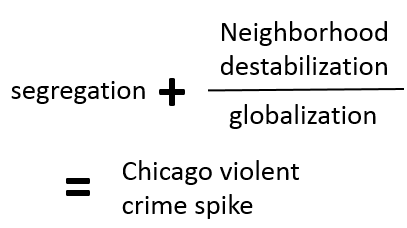
It's a simplistic, reductionist, even crude, but it explains the roots of Chicago's crisis as well as anything. read more »
This article first appeared at Foreign Affairs.
How countries hit the demographic sweet spot.
Demographics are among the most important influences on a country’s overall economic performance, but compared with other contributors, such as the quality of governance or institutions, their impact is underappreciated. read more »
A few recent days driving the Los Angeles freeways impressed me with how different they are from in most other places in the country. The intensity of the traffic is astounding. Even on the weekend, travel over Sepulveda Pass on the San Diego Freeway (I-405) was highly congested. Traffic really never stopped, but frustratingly inched along for parts of the way and approached 60 miles per hour on other parts. A Saturday trip I feared might take an hour and a half was completed from Simi Valley in less than 60 minutes. read more »
With two football teams moving to Los Angeles, a host of towers rising in a resurgent downtown and an upcoming IPO for L.A.'s signature start-up, Snapchat parent Snap Inc., one can make a credible case that the city that defined growth for a half century is back. According to Mayor Eric Garcetti, the Rams, Chargers and the new mega-stadium that will house them in neighboring Inglewood, show that “that this is a town that nobody can afford to pass up.” read more »
The cracks in the 50-year-old Oroville Dam, and the massive spillage and massive evacuations that followed, shed light on the true legacy of Jerry Brown. The governor, most recently in Newsweek, has cast himself as both the Subcomandante Zero of the anti-Trump resistance and savior of the planet. But when Brown finally departs Sacramento next year, he will be leaving behind a state that is in danger of falling apart both physically and socially. read more »
Sabotage has its root in the French word sabot, which is a kind of wooden shoe. In the early days of the Industrial Revolution craftsmen would throw their shoes into the gears of factory machines. Skilled labor was being replaced with mechanical production, undermining traditional professions, reducing incomes, and removing the social standing of workers. Wealth flowed up to the people who owned the factories and controlled the levers of political power. Sabotage was a form of negotiation. read more »
Dallas-Fort Worth and Dayton Ohio have the least traffic congestion among larger cities (urban areas) in the world, according to the 2017 Tom Tom Traffic Index. Dallas-Fort Worth had the shortest average all day delay, at 18 percent of the 43 cities with more than 5 million population. Dallas-Fort Worth also had the least average peak period traffic delay. This is the second year in a row the Dallas Fort Worth has had the best all day traffic congestion. read more »
What if the region we broadly understand as the Midwest, stretching from the foothills of the Alleghenies to the high plains, and from the chilly northern Great Lakes to the Ohio, Mississippi and Missouri river valleys, had been allowed to develop as organically as its eastern and southern -- and even western -- neighbors?
If it had, it would be far better understood, have a much stronger cultural clarity, and more recognized for its contributions to American society and economy. read more »
In one of the great scenes from the movie “Dr. Zhivago,” based on the novel by Soviet author Boris Pasternak, a young Bolshevik commander explains to the idealistic physician that “the private life is done in Russia. History has killed it.”
In America today, it also seems increasingly impossible to separate personal life from the political. In awards shows, sports broadcasts and fashion runways — which once provided escapes from politics — we find endless passionate anti-Trump protests and denunciations. Even corporations, like Under Armour, have faced opprobrium — and even boycotts — for daring to support Trump. Nordstrom faced a possible boycott for carrying a now-canceled fashion line of his daughter, Ivanka. read more »
Increasingly American politics are driven by generational change. The election of Donald Trump was not just a triumph of whiter, heartland America. It also confirmed the still considerable voting power of the older generation. Yet over time, as those of us who have lived long enough well know, generations decline, and die off, and new ones ascend. read more »
A recent Wall Street Journal article (“For Chinese buyers, Seattle is the new Vancouver”) reported that Seattle was replacing Vancouver as the most popular destination for Chinese buyers in North America. For years, there has been considerable concern about foreign investment in the Vancouver housing market, especially Chinese investment. read more »
While running for office, President Trump said the border wall would cost about $8 billion, a figure widely recognized as an unreasonably low estimate". This week, the Department of Homeland Security (DHS) estimated the cost of construction at $21.6 billion. Figuring out what the wall would cost has been a source of debate for longer than the last election cycle. In 2013, the bipartisan "Gang of Eight" senators set aside $1.5 billion for a plan to add 700 miles of wall - also a completely unrealistic budget. read more »
Trump did best in the states with the lowest percentages of foreign-born residents.
“I love the poorly-educated”, gushed Donald Trump after winning the Nevada primary in February. But in the end, what happened in the primary, stayed in the primary. Come November, Trump lost the state to Hillary Clinton, a turn that is explained by the fact that there is a higher percentage of foreign-born residents in Nevada than in any state won by Trump, save Florida. read more »
Global Squeeze: The Coming Crisis for First-World Nations
Richard C. Longworth
McGraw-Hill 1998
Whenever we see the reality of momentous shifts in society, it’s always good to go back and take a look at the people who saw it coming far away. Generally speaking, there were usually people who understood what was happening in advance. For example, Daniel Bell wrote his book The Coming of Post-Industrial Society in 1976. There were probably even other earlier books touting the same theme. read more »
Statistics Canada has just announced population counts from the 2016 census and the narrative is all about the Prairie Provinces. Alberta, Saskatchewan and Manitoba (yes, Manitoba) were the three fastest growing provinces. Metropolitan area growth was dominated by the Prairies, along with metropolitan areas outside the largest in Ontario and British Columbia. read more »
America is increasingly a nation haunted by fears of looming dictatorship. Whether under President Barack Obama’s “pen and phone” rule by decree, or its counterpoint, the madcap Twitter rule of our current chief executive, one part of the country, and society, always feels mortally threatened by whoever occupies the Oval Office. read more »
My friend Kirsten Dirksen at faircompanies.com recently posted a new video about Water Valley, Mississippi. It demonstrates that there are plenty of great compact mixed use walkable neighborhoods out there that can be re-inhabited. Building anything of this kind from scratch is theoretically possible, but it almost never happens due to endless zoning regulations, building codes, and cultural inertia. Water Valley is lucky in the sense that it’s just down the road from a prestigious university. read more »
A key reason for the prosperity found in the United States is the ability of universities and companies to attract the best and brightest people from abroad. Shutting out skilled individuals from entire countries could have grave consequences for America’s intellectual institutions as well as knowledge-intensive businesses. The obstacles put in place following the 2001 terrorist attack did reduce the position of the US in the global competition for talent, yet the regulations were about increasing security and allowed those that had been screened to enter. read more »
In comparison with Barack Obama, who was well regarded in the foreign media, Donald Trump does not come off as a good guy. He is also clearly redefining the country’s identity and global focus. The first American president since the 1920s to walk away from a role as global pooh-bah, Trump instead defines his job as helping the people who elected him. read more »
The last article outlined research on job access by cars, transit and walking by the University of Minnesota Accessibility Observatory that assesses mobility by car, transit and walking in 49 of the nation’s largest metropolitan areas. Of course, it is to be expected that the metropolitan areas will have the largest number of jobs accessible to the average employee simply by virtue of their larger labor markets. read more »
Americans agree that the country’s policies on handling immigration have long needed reform. However, what kinds of reform and the impact immigration itself has on the United States are matters of great controversy. For both former Presidents Barack Obama and George W. Bush, promising efforts at comprehensive immigration reform were blocked by the unrelenting opposition. read more »
American greatness was long premised on the common assumption that each generation would do better than the previous one. That is being undermined for the emerging millennial generation. read more »
Like most big cities that get the nod, Houston has spruced itself up for the Super Bowl, planting flowers and concentrating in particular on the rough stretches between Hobby Airport and NRG Stadium. Yet it’s unlikely the city’s reputation will be much enhanced by the traveling media circus that accompanies these games. read more »
For most of recent history, the world has worried about the curse of overpopulation. But in many countries, the problem may soon be too few people, and of those, too many old ones. In 1995 only one country, Italy, had more people over 65 than under 15; today there are 30 and by 2020 that number will hit 35. Demographers estimate that global population growth will end this century. read more »
The New York Times ran a piece in today’s paper about the state of America’s inner cities – and of course Donald Trump. Their conclusion is that the landscape of America’s cities, and of American blacks – the “inner city” is clearly a racially loaded term – is complex. read more »
In his 1950s satire Player Piano, author Kurt Vonnegut describes a dark dystopia where automation has led to a world of meager consumption and desperate idleness. The vision of workers displaced by machines predates this though, and is perhaps most associated with the 19th century Luddite movement where workers sabotaged machinery for fear of losing jobs. In economic thought, the prospect of labor-replacing technology has a still much longer history. read more »
In often needlessly harsh ways, President Donald Trump is forcing Americans to face issues that have been festering for decades, but effectively swept under the rug by the ruling party duopoly. Nowhere is this more evident than with immigration, an issue that helped to spark Trump’s quixotic, but ultimately successful, campaign.
Many Americans are clearly upset about an estimated 11 million undocumented immigrants, and many also fear the arrival of more refugees from Islamic countries. Perhaps no issue identified by Trump has been more divisive. read more »
10,000 years ago San Francisco Bay was a dry grassy valley populated by elephants, zebras, and camels. The planet was significantly cooler and dryer back then. Sea level was lower since glaciers in the north pulled water out of the oceans. The bay isn’t that deep so a relatively small change in sea level pushed the coastline out by twelve miles from its present location. Further back in pre-history when the earth was warmer than today sea level was higher. read more »
Access for residents to employment is critical to boosting city productivity. This has been demonstrated by researchers such as Remy Prud’homme and Chang-Woon Lee of the University of Paris, David Hartgen and M. Gregory Fields of the University of North Carolina, Charlotte. Generally, city productivity (economic growth and job creation) can be expected to improve more where employment access is better . Access is measured in the number of jobs that can be reached by the average employee in a certain period of time, like 30 minutes. read more »
The New Brooklyn: What It Takes to Bring a City Back
by Kay Hymowitz
My City Journal colleague Kay Hymowitz has written a number of great articles on Brooklyn, the borough that is her home. This inspired her to write a great book on the topic of the transformation of Brooklyn called The New Brooklyn.
It starts with a two-chapter history of the borough from its earliest settlement to the present day, followed by a series of chapters looking at Brooklyn today. This includes the transformation of Park Slope (where she and her husband moved in the early 1980s), Williamsburg, Bed-Stuy, and the Navy Yard. read more »
by Anonymous 01/24/2017
President Nixon, though possessing the instincts and speaking the increasingly conservative language of the mainstream Republican Party all his life (his writings on domestic policy attest to this,) governed within the boundaries set by the New Deal. Where other conservatives like Barry Goldwater had no interest in “streamlining government,” “making it more efficient,” and “promoting welfare,” Nixon sought to do exactly these things. read more »
“From the Beginning, California promised much. While yet barely a name on the map, it entered American awareness as a symbol of renewal. It was a final frontier: of geography and of expectation.”
— Kevin Starr, “Americans and the California Dream, 1850-1915” (1973)
read more »
Last year I engaged in a failed attempt to renovate and expand an old house in an 1890’s era neighborhood in Ohio. It ended badly. So I thought I’d do a follow up on what actually does work given the legal parameters and cultural context. read more »
I’m a fan of Strong Towns and share their thesis that the biggest sustainability problem with much of suburbia is its financial sustainability.
A recent article there about Lafayette, Louisiana has been making the rounds. That city’s public works director made some estimates of infrastructure maintenance costs and which parts of the city turned a “profit” from taxes and which were losses. Here’s their profit and loss map. read more »
Perhaps nothing has made modern progressivism look sillier than the often hysterical reaction to the election of Donald Trump. This has spanned everything from street protests, claims of Russian electoral manipulation and even reports of sudden weight gain and loss of sexual interest. Rather than become more introspective in the face of defeat, the bulk of left-leaning media and their intellectual allies have embraced the notion — even before the new president proposes anything — of following what UC Berkeley public policy professor and former U.S. read more »
I’ve been arguing that one thing struggling post-industrial cities need to do is take care of their own business, doing things like addressing legacy liabilities and rebuilding of core public services.
Last week I write about Buffalo doing just this by completely re-writing its zoning code and creating a new land use map of the city to bring its planning ordinances up to date for the 21st century. read more »
My family lived in this building when I was a kid in the 1970’s. This was the door to our old apartment. It’s in a nondescript part of the San Fernando Valley in Los Angeles. There are a million places just like this all over the Southland. These beige stucco boxes are the workhorses of semi-affordable market rate housing in California. The place hasn’t changed in forty years other than the on-going deferred maintenance. read more »
Perhaps no president in recent history has more pressure on him to perform economic miracles than Donald Trump. As someone who ran on the promise that he could fix the economy -- and largely won because of it -- Trump faces two severe challenges, one that is largely perceptual and another more critical one that is very real.
To start, Trump must cope with the widespread idea, accepted by much of the media, that we are experiencing something of an “Obama boom.” read more »
“If you are a very talented person, you have a choice: You either go to New York or you go to Silicon Valley.”
This statement by Peter Thiel, the PayPal founder and venture capitalist, unsurprisingly caused a stir, given that he made it in Chicago. Simon Kuper had made a similar observation in the Financial Times when he described how young Dutch up-and-comers had their sights set on London, not Amsterdam. “Many ambitious Dutch people no longer want to join the Dutch elite,” Kuper wrote. “They want to join the global elite.” read more »
The first time I presented a paper at an academic conference, I was accused of being nostalgic. My mistake, as my fellow academic pointed out, was that in my bid to find some value in working-class occupational cultures I was guilty of backward looking romanticism. It wasn’t meant to be constructive criticism, but over the years I’ve developed a longstanding interest in the idea of nostalgia which is often attached to working-class life. read more »
Tucked away in the bottom corner of the San Francisco Bay, tech royalty make themselves at home in their silicon castles. Santa Clara County is the wealthiest county in California, and 14th in the nation, boasting an average median household income of $96,310. However, where there are kings, there must be subjects. Despite its affluence, Santa Clara remains one of the most unequal counties in the United States. read more »
In every recent year, a black swan event has made top 10 lists appear quaintly naive and unimaginative. Our list is probably no better.
This time of year, top 10 predictions are all the rage. These lists can be interesting and entertaining but how useful are they really?
This question goes to the heart of forecasting. How futile or how useful is an attempt to forecast the economy, or technology, or world events for the next twelve months? There are three answers. read more »
In 1949 the historian Carey McWilliams defined California as the “the Great Exception” -- a place so different from the rest of America as to seem almost a separate country. In the ensuing half-century, the Golden State became not so much exceptional but predictive of the rest of the nation: California’s approaches to public education, the environment, politics, community-building and lifestyle often became national standards, and even normative. read more »
2016 is gone, 2017 is here. Here’s a look back at the most popular stories at New Geography in 2016. Happy New Year, and thanks for reading.
12. This is Why You Can’t Afford a House. Back in February, Joel Kotkin made the case that housing costs are a huge burden on America’s middle class and argued for more discussion on the topic at the national level. This piece was also published by The Daily Beast. read more »
The latest small area estimates from the Census Bureau indicate that suburban and exurban areas continue to receive the overwhelming share of growth in metropolitan areas around the country, with a single exception, New York. The new American Community Survey (Note 1) 5 year file provides an update of data at the ZCTA (zip code tabulation area), which are described below, as analyzed by the City Sector Model. The data was collected from 2011 through 2015, and can therefore be considered generally reflective of the middle year of the period, 2013. read more »
Across the country, white voters placed Donald Trump in office by a margin of 21 points over Clinton. Their backing helped the GOP gain control of a vast swath of local offices nationwide. But in California, racial politics are pushing our general politics the other direction, way to the left. read more »
Like a child star who reached his peak at age 15, Barack Obama could never fulfill the inflated expectations that accompanied his election. After all not only was he heralded as the “smartest” president in history within months of assuming the White House, but he also secured the Nobel Peace Prize during his first year in office. Usually, it takes actually settling a conflict or two — like Richard Nixon or Jimmy Carter — to win such plaudits. read more »
On December 30 the city of Atlanta began Year 3 of operating its much-ballyhooed Atlanta Streetcar System, and so far, all that can be discerned is a lot of bally hooey.
This month, the Atlanta City Council approved the final payment to URS for the design-build of the 2.7-mile Atlanta Streetcar project, making the total payment $61,630,655. That was, according to Public Works Commissioner Richard Mendoza, “$6 million less than URS originally submitted.” read more »
Surprisingly, the modern focal point for postfamilial urbanism comes from eastern Asia, where family traditionally exercised a powerful, even dominant influence over society. The shift toward post-familialism arose first in Japan, the region’s most economically and technologically advanced country. As early as the 1990s sociologist Muriel Jolivet unearthed a trend of growing hostility toward motherhood in her book Japan: The Childless Society? –a trend that stemmed in part from male reluctance to take responsibility for raising children. read more »
Professors David L. A. Gordon of Queens University (Canada) and Paul Maginn and Sharon Biermann of the University of Western Australia have now shown Australia to be a largely suburban nation. This follows on Professor Gordon’s work with colleagues in 2013 that came to the same conclusion on Canada based upon 2006 census data. read more »
Among many urbanites, a certain bunker mentality has already surfaced at key locations within the geography of the city. Here in Orlando, places like the Stardust Video and Coffee where once there was warmth, one feels coolness in the air, a little less eye contact, briefer conversations, a sharper tone. For many who practice tolerance and inclusiveness, and bend our lives towards mutual sustainability, this was a temporary setback. But this is no time for recriminations or succumbing to the temptation to snip at one another. read more »
It certainly seems as if boomers are in charge in America now, with Donald Trump about to move into the White House and members of the generation in the majority in Congress. Meanwhile, huge attention has been paid over the past few years to the emergence of the boomers’ children, the millennials, on the national scene. But relatively little thought has been accorded to the group sandwiched between the two mega-generations: Generation X. read more »
I was asked by Fortune to contribute a piece about Trump’s Carrier deal. They had gotten a lot of people criticizing it and were looking for someone who would give a different perspective. I think many of the criticisms are valid in a sense, but miss the larger context. So I wrote the piece which is now online. Here’s an excerpt: read more »
When Donald Trump described the “devastating” conditions in America’s inner cities, emphasizing poor schools and lack of jobs, he was widely denounced for portraying our urban centers in a demeaning and inaccurate way, much as he had been denounced previously for his supposed appeal to “racial exclusion” when he asked black voters “what the hell do you have to lose” by backing him. read more »
I had dinner in Rockford, Illinois recently with Jennifer and Michael Smith of the City Smiths. You will never find a more charming, kind, and industrious couple. Any town would be lucky to have such passionate and engaged citizens. read more »
New data from the Census indicates that population growth and domestic migration patterns have continued to move away from the East and the Midwest to the South and West, at accelerated rates. Equally important, pre-Great Recession interstate mobility rates have been restored. read more »
The news media was flattened on November 8th, but its recovery has already started.
One of the striking features in all the commentary on Facebook about Donald Trump's victory is the number of times that the words I, me and my appeared in member posts. For example, "I am proud", "I am optimistic", or "I am fearful", "I am worried", etc. The comments celebrating or lamenting the event were mostly about the way the writer felt about the event, not about the event itself. That looks like a subtle difference but it reveals a demarcating line between an introverted reaction vs. an extroverted one. read more »
Defenders of California’s status-quo claim to be proud of California’s economic growth and worry about what Trump will do to that growth. If you are so impolite as to mention that this has been California’s slowest recovery in 70 years, as the following chart shows, you will be told that slow growth is good. It avoids the excesses of previous business cycles. read more »
Back in 2008 or 2009 I gave a Pecha Kucha presentation in Indianapolis in which I said:
"Cities can’t survive on gentrification alone. The broad community has to be a participant in its success. That’s why I’m somewhat down on the notion of the creative class. It’s good as far as it goes, but it’s a self-consciously elitist vision. Where’s the working class in that? read more »
Houston is a city (metropolitan area) of superlatives. The most recent Brookings Institution data shows that Houston has the seventh strongest per capita economy (gross domestic product) in the world (Figure 1). This places Houston above New York and more surprisingly, perhaps, other cities perceived to have strong economies are far below Houston and outside of the top 10, such as London, Tokyo and Chicago. read more »
The oligarchs’ ball at Trump Tower revealed one not-so-well-kept secret about the tech moguls: They are more like the new president than they are like you or me.
In what devolved into something of a love fest, Trump embraced the tech elite for their “incredible innovation” and pledged to help them achieve their goals—one of which, of course, is to become even richer. And for all their proud talk about “disruption,” they also know that they will have to accommodate, to some extent, our newly elected disrupter in chief for at least the next four years. read more »
Much has been written about the growth of the sharing economy where information technology, such as mobile apps and automated software facilitate interactions between businesses, individual workers, and customers. Proponents argue that the system provides greater access to goods and services at lower prices while reducing costs for employers and independent contractors. read more »
Reading the recent report “The Texas Way of Urbanism” promptly reminded me of my status – twice a migrant; from small town to big city (Athens) and from big city to another country. These moves were propelled by a singular motivation: seeking opportunity to better my lot. I knew next to nothing about the cities I moved to: their shape and history, their culture, their social divisions and even language were absent from my viewfinder. All that mattered was the chance for a new start. read more »
Now and again Australia erupts in controversy about housing affordability. Each time it follows the same course. Some new statistic or media story confirms that prices are out of control. A senior politician is prompted to call for deregulation and more supply, and is backed-up by the property industry. Then come progressive policy wonks saying no, the issue is high investor demand stimulated by tax concessions. Next emerge the welfare lobby, calling for tax reform as well as more social housing and “inclusionary zoning”. read more »
This is the first in an occasional series of articles that will look at some of the campaign promises made by Donald Trump in his run-up to November 8, 2016. I will be taking a “by the numbers” look at ideas ranging from immigration and border security to trade and infrastructure. I will not be taking a position on whether these are good ideas or bad ideas – this is not a normative analysis. Instead, I will be outlining the feasibility and the economic consequences of several potential policies. read more »
The rise, and then the improbable election, of Donald Trump have reawakened progressive fears of a mounting authoritarian tide. With his hyperbole and jutting chin, he strikes some progressives as a new Benito Mussolini who will threaten free speech and other basic human rights. read more »
Jane Jacobs talked about the “sidewalk ballet” of her neighborhood and the importance of eyes on the street. But her conception of that, one where shopkeepers policed the sidewalks in front of their stores and kept an eye out for neighborhood kids, is far away from what we have today.
My latest post looking at this is over at City Journal and is called “The End of Eyes on the Street“: read more »
From its inception, the American experiment has been dogged by racial issues. Sadly, this was even truer this year. Eight years after electing the first African-American president, not only are race relations getting worse, according to surveys, but the electorate remains as ethnically divided as in any time of recent history. read more »
The Economy of Cities
Cities have been called “engines of growth”. What does that mean?
Fly over a major city and what do you see? Not well defined centers and sub-centers. More likely, an amazing complexity. We argue that what is actually down there, but hard to actually see, is a large number of superimposed and spatially realized supply chains. read more »
The Brookings Institution is again out with data on the world’s most affluent metropolitan areas. The GDP data is in Redefining Global Cities, which contains a treasure trove of data. read more »
Contrary to the media notion that Donald Trump's surprising electoral victory represented merely the actions of unwashed “deplorables," his winning margin was the outcome of rational thinking in those parts of the country whose economies revolve around the production of tangible goods.
And their economies stand to gather more steam in the years ahead. read more »
The ever worsening polarization of American politics—demonstrated and accentuated by the Trump victory—is now an undeniable fact of our daily life. Yet rather than allowing the guilty national parties to continue indulging political brinkmanship, we should embrace a strong, constitutional solution to accommodating our growing divide: a return to local control. read more »
This essay is part of a new report from the Center for Opportunity Urbanism titled "The Texas Way of Urbanism". Download the entire report here.
A new economic corridor is emerging in the center of Texas. Hays and Comal Counties are part of the Austin and San Antonio metropolitan areas respectively. But they are not merely suburbs capturing overflow from larger cities. They are becoming part and parcel of an emerging 80-mile long economic corridor between San Antonio and Austin, along the I-35. In the process, this region centered around San Marcos and Hays County, is emerging as a hub in its own right. read more »
This essay is part of a new report from the Center for Opportunity Urbanism titled "The Texas Way of Urbanism". Download the entire report here.
For decades, as many U.S. cities declined, and others became overly exclusive, cities in Texas evolved into places of opportunity. Due in large part to liberalized economic policies, the state’s “Big Four” metro areas — Houston, Dallas, Austin and San Antonio — consistently rank among the nation’s leaders in population growth and job growth, experiencing the rapid urbanization once common among America’s legacy cities. In a state once defined by cowboy towns, these metros have become intense human and business agglomerations, growing more global and ethnically diverse in the process. read more »
This essay is part of a new report from the Center for Opportunity Urbanism titled "The Texas Way of Urbanism". Download the entire report here.
The long presence of military installations extending back approximately a century has led to the designation of San Antonio as Military City USA. The military continues to be one of the city’s major employers. The area’s six military bases — Fort Sam Houston, Lackland Air Force Base, Randolph Air Force Base, Brooks City-Base, Camp Bullis, and Camp Stanley — together represent one of the largest active and retired military populations in the country. A 2011 study found that the Department of Defense (DoD) had a $27.7 billion impact on the city’s economy; supported 189,148 jobs in the city; granted $4 billion in contracts locally; and provided support for 55,000 DoD retirees in the community. read more »
by Anonymous 12/02/2016
This essay is part of a new report from the Center for Opportunity Urbanism titled "The Texas Way of Urbanism". Download the entire report here.
Any observer of urbanism in America knows that Austin tops numerous rankings of urban dynamism. Austin --- defined as a metropolitan area, not just the city --- is consistently atop Forbes’ annual list of Best Cities for Jobs in America over the past five years, which is why so many people move there in the first place. read more »
This essay is part of a new report from the Center for Opportunity Urbanism titled "The Texas Way of Urbanism". Download the entire report here.
Creative friction – unchaperoned and unprescribed – is Houston’s secret sauce.
At a time when Americans’ confidence in all major U.S. institutions – minus the military and small business – has sunk below the historic average, and only about 20 percent of Americans say they spend time with their neighbors, one would expect pessimism to be universal. But come to the concrete sprawl just north of the Gulf and you’ll find a different vibe, one that other cities would do well to emulate. read more »
This essay is part of a new report from the Center for Opportunity Urbanism titled "The Texas Way of Urbanism". Download the entire report here.
Dallas-Fort Worth (DFW) has started the 21st century with a bang. Like the other major metro areas in Texas, the DFW area has grown far faster than most large U.S. cities: 35 percent population growth for the DFW metro area between 2000 and 2014, compared to an average growth rate of 21 percent for America’s top 40 cities. GDP per capita growth in the metro area has also handily outpaced the average of its “Top 40” peers as well, 46 percent versus 39 percent. read more »
This essay is part of a new report from the Center for Opportunity Urbanism titled "The Texas Way of Urbanism". Download the entire report here.
The future of American cities can be summed up in five letters: Texas. The metropolitan areas of the Lone Star state are developing rapidly. These cities are offering residents a broad array of choices — from high density communities to those where the population is spread out — and a wealth of opportunities. read more »
This essay is part of a new report from the Center for Opportunity Urbanism titled "The Texas Way of Urbanism". Download the entire report here.
Throughout the history of the United States, much of the nation’s economic vitality can be traced to specific regions and their mastery of the productive sectors which propelled the country forward. Today we see this most evident in the remarkable emergence of the “Texas Triangle” encompassing Houston, Dallas-Ft. Worth, and Austin-San Antonio. read more »
The Democratic Party’s current festival of re-examination is both necessary and justified. They have just lost to the most unpopular presidential candidate in recent memory. Lockstep media support and a much larger war chest were not enough to save them from losing not only the presidency, but also in state races across the country. read more »
Donald Trump’s election victory has been widely credited attracting households who have been “left behind,” by stagnating or declining income and lost jobs. But the left-behind also includes many households whose standards of living are being reduced by the rising cost of housing. This is not about affordable housing for low-income households, itself very important, but a crisis among middle-income households no longer able to afford their own homes in some parts of the nation. read more »
Almost everyone agrees that we just finished the most painful election season in anyone’s living memory, an agony made worse by the fact that it was nearly two years long. Fortunately, we aren’t doomed to repeat it, as we know many other countries have shorter and more civil election campaigns. Three changes to our method of electing presidents could reduce costs, save time, and make the process less divisive and more welcoming to voters. read more »
At the corner of Maitland Avenue and Maitland Boulevard, the Holocaust Memorial Center is squeezed between tennis courts and a small courtyard, part of the Jewish Community Center. Inside, the classrooms are nicely squared off. The exhibit “Two Regimes” takes up one classroom’s walls with about 40 paintings depicting life during the Stalin and Hitler regimes for Jews living in Mariupol, Ukraine. From this industrial port town on the shore of the Azov Sea to a ramshackle stilt house in north Florida, the exhibit is a strange tale, partly told. read more »
Much of the New York and Washington press corps has concluded that Donald Trump’s surprising journey to the Oval Office was powered by country bumpkins expressing their inner racist misogyny. However, the real foundations for his victory lie not in the countryside and small towns, but in key suburban counties. read more »
Donald Trump’s presidential campaign was based on the notion that he could “Make America Great Again.” But beyond the rhetoric — sometimes lurching into demagoguery — the newly elected president comes to office, as one commentator suggests, “the least policy-savvy president in history.” read more »
One obvious, if little discussed, reason the progressive wave receded last week: The left’s increasingly unappealing economic agenda. In the past, progressives focused on improving conditions for working and middle class Americans through economic growth, home ownership and expansive infrastructure projects. read more »
The rising cost of entitlements will test inter-generational harmony.
In the week following the Brexit vote, a recurrent complaint from the losing side was that a majority of older people voted to leave while a majority of younger people voted to remain. In the eyes of the complainers, this rendered the leave outcome less legitimate because younger people have more years of life ahead of them and therefore would allegedly suffer more than old people from a decision to leave the European Union. So much for the wisdom of old age knowing what is best. And so much for the principle of one person one vote, regardless of age, gender or race or whatever. read more »
I made quite a few trips to San Francisco during the late 90s into the early 2000s, but hadn’t been back in a very long time – probably close to 15 years.
Recently I was there for a conference and a long weekend and got to spend some time exploring the city. I won’t claim a comprehensive review, but I did have a few takeaways to share. read more »
In its decades of unprecedented population growth, California was a land of superlatives. Regrettably, the superlatives have changed from mostly positive to largely negative. For example, the latest Census Bureau Supplemental Poverty Estimates, indicated that California continues to have the highest poverty rate of any state, after adjustment for housing costs (Figure 1). Not even Mississippi can compete with that, sitting 3.6 percentage points lower. read more »
The 2016 election is in the rear-view mirror. But the votes and views of a key demographic group—young women—will reverberate significantly in future elections. Two members of this group, Ivanka Trump and Chelsea Clinton, were the most visible representatives of their peers during the campaign. Examining their unique demographic characteristics and attitudes provides clues about what we can expect from the emerging female electorate going forward. read more »
At the end of most US presidential elections, most Americans are ready to see the last of campaign ads, social media commentaries and tension-fraught news coverage. That’s even more true this year. But more than in most recent elections, we shouldn’t expect the frustrations and divisions that have surfaced over the past 18 months to disappear after the ballots have been counted. Tensions over class and race, especially, may die down, but they aren’t going away. If a new president will take them on, something good might yet emerge from this ugly election. read more »
America may have trended toward the GOP, but California seems determined to find its own direction. The only question is, simply, how much more progressive the Golden State will become, even in the face of a far more conservative country beyond the Sierras. read more »
The 2016 presidential election revealed a strongly divided nation. Donald Trump’s victory has been characterized as a “landslide” by some, noting the surprisingly high electoral vote tally. Others note the likelihood that Hillary Clinton will win the popular vote. In any event, the result is far different than many expected. read more »
She had it all—the pliant media, the tech oligarchs, Wall Street, the property moguls, the academics, and the all-around “smart people.” What Hillary Clinton didn’t have was flyover country, the economic “leftovers,” the small towns, the unhipstered suburbs, and other unfashionable places. As Thomas Frank has noted, Democrats have gone “from being the party of Decatur to the party of Martha’s Vineyard.” No surprise, then, that working- and middle-class voters went for Donald Trump and helped him break through in states—Michigan, Wisconsin, Iowa—that have usually gone blue in recent presidential elections. read more »
n an election so ugly and so close, one is reluctant to proclaim winners. But it’s clear that there’s a loser — the very notion of the United States of America.
Instead we have populations and geographies that barely seem to belong in the same country, if not on the same planet. The electorate is so divided that many states went for either Donald Trump or Hillary Clinton by lopsided margins. The Northeast was solidly Democratic, with Clinton winning New York, Massachusetts and Vermont with three-fifths of the vote or more. Washington, D.C., heavily black and the seat of the bureaucracy and pundit class, delivered an almost Soviet-style 93% to 4% margin. read more »
by Anonymous 11/08/2016
This piece first appeared at Real Clear Policy.
POLICIES FOR THE NEXT ADMINISTRATION. PART 10: ECONOMIC INEQUALITY
This is the tenth in a series on the major policy ideas — from Left and Right — that should guide the next presidential administration's agenda. (For the opposing view, see David Madland, "A Path Forward for the Middle Class and the Country.")
Do we want to live in a society in which people profit when they have new ideas, products, and abilities that others are willing to pay for? If so, then we will also have economic inequality. read more »
Can the party of oligarchy also be the party of the people? Besides fending off the never-ending taint of corruption, which could weaken the extent of her “mandate,” this may prove the central challenge of a Hillary Clinton regime. read more »
A friend recently expressed an interest in how some cities are reforming their land use regulations. “I mean, there are places like LA that say they’ve thrown out the code books and are rewriting their zoning.” My short response was… No. The reality is that the city plays an expensive and byzantine game of cat and mouse with each individual neighborhood. read more »
The Canadian Mortgage and Housing Corporation (CMHC) has issued a “red warning” for the entire housing market in Canada.” According to CMHC the red warnings are due to “strong evidence of problematic conditions for Canada overall. Home prices have risen ahead of economic fundamentals such as personal disposable income and population growth. This has resulted in overvaluation in many Canadian housing markets.” read more »
When Americans consider a move to another part of the country, they sometimes are forced to make a tough choice: should they go to a city with the best job opportunities, or a less economically vital area that offers a better standard of living, particularly more affordable housing? However, there are still plenty of metropolitan areas in the U.S. where you can get the best of both worlds. read more »
Retraining the employed and the unemployed for higher value-added skills is now more important than simply adding to the number of jobs.
Coal and steel magnate Wilbur Ross, a senior policy advisor to the Trump campaign, has just made in the pages of the Wall Street Journal an economic prediction that looks mathematically unattainable. read more »
From Southern California to Shanghai and London, inflated real estate prices have evolved into a simulacrum for broader prosperity. In an era of limited income gains, growing inequality, political dysfunction and fading productivity, the conjunction of low interest rates and essentially free money for the rich and well-placed has sparked the construction of often expensive, high-density residential housing. read more »
One of the great pleasures of China is a walk along the Bund promenade.
Shanghai’s Bund is one of China’s great tourist and historic sites. Its history lessons are from two distinctively different periods. All of this can be witnessed from the raised promenade along the west bank of the Huang Pu River, which separates the old Puxi (west of the river) commercial core of Shanghai from the new, iconic business district that has grown up in Pudong (east of the river). It is clear that the promenade at the Bund is a very popular local tourist attraction as well. read more »
It’s increasingly unfashionable to celebrate those who made this republic and established its core values. On college campuses, the media and, increasingly, in corporate circles, the embrace of “diversity” extends to demeaning the founding designers who arose from a white population that was 80 percent British. read more »
I explored the Orange Line Bus Rapid Transit (BRT) system that runs for eighteen miles across the San Fernando Valley in Los Angeles. The Valley is a profoundly suburban city-within-a-city and home to 1.8 million people spread out over 260 square miles. Attempts to upgrade public transit by the central authorities in LA proper have been fought tooth and nail by folks in the Valley and illustrate why transit just doesn’t work when the local culture doesn’t want it. I’m not sure why LA keeps pushing on this particular string. read more »
The story of skyrocketing rents has two components: residential and commercial.
My New York neighborhood, the Upper West Side, features fairly stable residential rents, but commercial rents seem to have been soaring. This has caused the familiar angst over the loss of neighborhood businesses to the ubiquitous bank branches and drug stores. read more »
The consumer technology boom, largely responsible for a resurgence in California’s economy after the tech wreck of 2001, seems to be coming to an end. The signs are widespread: slowing employment, layoffs from bell-weather social media companies, the almost embarrassing difficulty of finding buyers for Twitter, the absorption of Yahoo by Verizon and the acquisition by Microsoft of LinkedIn. read more »
For progressives, the gloating is about to begin. The Washington Monthly proclaims that we are on the cusp of a “second progressive era,” where the technocratic “new class” overcomes a Republican Party reduced to “know-nothing madness.”
To be sure, Trump himself proved a mean-spirited and ultimately ineffective political vessel. But the forces that he aroused will outlive him and could get stronger in the future. In this respect Trump may reprise the role played another intemperate figure, the late Senator Barry Goldwater. read more »
The other day when I was riding my bike in Minneapolis crossing I-94 near Riverside I encountered a small townhome project built during the first (failed) green era under the Carter administration. It was built to showcase the future. One thing I've learned over the years building my own green homes is to not listen blindly to the experts who parrot others' ideas without thinking of the ramifications.
The world's first solar and earth-berm grass-roof townhome projects look like this today: read more »
In recent years, the plight of renters in a stagnant economy has been covered extensively. A book title incorporated the phrase “the rent is too damn high” (by Matthew Iglesias). The “Rent is Too Damn High Party” ran candidates in both city and state of New York elections. However, as bad as rent increases have been, more serious has been the escalation of house prices in the major metropolitan areas of the United States. read more »
You may have heard that Detroit is in the midst of a modest but enduring revival in and around its downtown. Residents and businesses are returning to the city, filling long-vacant skyscrapers, prompting new commercial development and revitalizing adjacent old neighborhoods. As a former Detroiter I'm excited to see the turnaround. After so many false starts, Detroit's post-bankruptcy rebound seems very real. read more »
What comes to mind when you think about Orange County? Probably, images of lascivious housewives and blonde surfers. And certainly, at least if you know your political history, crazed right-wing activists, riding around with anti-UN slogans on their bumpers in this county that served as a crucial birthplace of modern movement conservatism in the 1950s. read more »
Politicians, housing advocates, planners and developers often blame the NIMBY — “not in my backyard” — lobby for the state’s housing crisis. And it’s true that some locals overreact with unrealistic growth limits that cut off any new housing supply and have blocked reasonable ways to boost supply.
But the biggest impediment to solving our housing crisis lies not principally with neighbors protecting their local neighborhoods, but rather with central governments determined to limit, and make ever more expensive, single-family housing. Economist Issi Romem notes that, based on the past, “failing to expand cities [to allow sprawl] will come at a cost” to the housing market. read more »
Economics, history, English and communications Professor Diedre N. McCloskey, of the University of Illinois, Chicago offers a unique interpretation of economic history that is well summarized in the subtitle of her book, “Bourgeois Equality: How Ideas, Not Capital or Institutions Enriched the World.”
This is a magisterial volume, which Matthew Ridley praised in his Times of London review, saying “It is so rich in vocabulary, allusion and fact as to be a contender for the great book of our age.” That is not an exaggeration. read more »
If you drive south from Dallas, or west from Houston, a subtle shift takes place. The monotonous, flat prairie that dominates much of Texas gives way to a landscape that rises and ebbs. read more »
In this disgusting election, dominated by the personal and the petty, the importance of the nation’s economic geography has been widely ignored. Yet if you look at the Electoral College map, the correlation between politics and economics is quite stark, with one economy tilting decisively toward Trump and more generally to Republicans, the other toward Hillary Clinton and her Democratic allies. read more »
Our mental model of the world shapes our behavior at fundamental levels in ways we often can’t even recognize. I was struck by this when reading two books almost back to back, Scott Adams’ How to Fail at Almost Everything and Still Win Big and Peter Thiel’s Zero to One.
Both authors lay out a schema for modeling the future and how to behave relative to it, but come to very different conclusions. read more »
Millions of people pass through O'Hare, settle into the adjacent hotels, go to conferences and meetings in the nearby convention centers, shop in the nearby stores or drink and eat in the nearby bars and restaurants, and believe they're in Chicago. But they're not. In most cases, they're in the small village of Rosemont, the tiny town that's done more than any community I know to capitalize on its location. read more »
Are you ready to become a “real” city yet, Southern California? Being “truly livable,” our betters suggest, means being “infatuated” with spending more billions of dollars on outdated streetcars (trolleys) and other rail lines, packing people into ever small spaces and looking toward downtown Los Angeles as our regional center. read more »
My recent post at Granola Shotgun described how a town in Georgia spent an enormous amount of public money on a new civic center and road expansions, but somehow managed to devalue nearby private property in the process. Here’s an example of a neighborhood in Nashville, Tennessee that took a different approach that cost a lot less and achieved a radically better set of outcomes. read more »
With its official cost now having risen to $8.6 billion and a funding gap of $1.8 billion, both of which are certain to rise, Honolulu’s rail project will run out of money before construction reaches the downtown area, perhaps even before it reaches Middle Street. read more »
At a time when technology and public opinion should be expanding the boundaries of innovation and self-expression, we appear to be entering a new era of ever greater economic and political centralization, Wendell Cox and I suggest in a new paper. read more »
When you’re a kid, there are certain cartoons you just love. That love remains over time as your warmly think back on childhood memories. It lasts, that is, until you foolishly go back and watch an episode of two of a favorite show, what which point you say, “Holy cow! That show is terrible.” read more »
Working families and the middle class are becoming an increasingly endangered species in many parts of United States. Median household income remains below its 1999 peak (inflation adjusted). But the problem is not just stagnant incomes. Expenses are also rising, especially the costs of housing in some cities. As a result, it is becoming more and more difficult to make ends meet. read more »
The East End of London has a long history of working-class community. It has been a place of industry, where the river Thames and the river Lea have provided work for many people. The area attracted many immigrants, including workers from Africa since Tudor times, sailors from China, former slaves from America, French Protestants facing religious persecution in the 1600s and Irish weavers working in the textile industries. There have been Jewish communities in the East End for centuries, too. The twentieth century saw an increase in immigrants from the former British colonies, including South Asia, particularly Bangladesh. Not only has it been a place to seek a livelihood, but it has also been a place of refuge. read more »
This is the introduction to a new report on Orange County published by the Chapman University Center for Demographics and Policy titled, "OC Model: A Vision for Orange County's Future." Read the full report (pdf) here.
Blessed by a great climate and a highly skilled workforce, Orange County should be at the forefront of creating high wage jobs. The fact that it is not should be a worrying sign to the area’s business, academic, political and media leaders. Despite some signs of recovery in OC, long-term trends, such as a dependence on asset inflation and low wage employment, seem fundamentally incompatible with sustainable and enduring growth in the County. read more »
Transit best serves commuting destinations that have high concentrations of employment. For the most part, this means downtowns, or central business districts (CBDs). This is where transit lives up to its “mass transit" name, carrying many people concurrently and efficiently to concentrated destinations. read more »
Peter Thiel recently made one of his trademark provocative statements by saying, “If you are a very talented person, you have a choice: You either go to New York or you go to Silicon Valley.”
The problem for Thiel was that he said this while speaking at an event in Chicago. No surprise, it didn’t go over well. An enquiring questioner wanted to know, “Who comes to Chicago if first-rate people go to New York or Silicon Valley?” read more »
Whether he loses or, more unlikely, wins, Donald Trump creates an existential crisis for the Republican Party. The New York poseur has effectively undermined the party orthodoxy on defense, trade and economics, policies which have been dominant for the last half century within the party but now are falling rapidly out of fashion among the rank and file. read more »
Is New York City helping or holding back Upstate New York?
Towards the end of times, when all of mankind congregates in a final purgatory to draw the main lessons of this grand adventure called Life, there will be special attention paid to the centuries’ long efforts at harmonizing individual happiness with the needs of the collective. There will be seminars on leadership and war. There will be a thick chapter on the blessings and dangers of science. There will be a long section, co-written by poets and undertakers, on the success of freedom and the failure of tyranny. There will be wonder and consternation about religion and the nature of the universe. And there will be, inevitably, extensive reporting on economic ideology. read more »
Cities, noted René Descartes, should provide “an inventory of the possible,” a transformative experience—and a better life—for those who migrate to them. This was certainly true of seventeenth-century Amsterdam, about which the French philosopher was speaking. And it’s increasingly true of Texas’s fast-growing metropolises—Houston, Dallas–Fort Worth, Austin, and San Antonio. In the last decade, these booming cities have created jobs and attracted new residents—especially young families and immigrants—at rates unmatched by coastal metropolitan areas. read more »
by Anonymous 09/23/2016
The Western states, and California in particular, have had a long history of spearheading progressive reforms, especially in their electoral and governmental systems. A former Governor of California, Hiram Johnson, actually ran with Theodore Roosevelt on the Progressive Party presidential ticket of 1912. If you are looking for reform ideas, look no further than the Golden State. read more »
This piece by Zelda Bronstein (original to 48hills.org) goes behind the story of the Peninsula planning commissioner who made national news by saying she had to leave town to buy a house for her family.
On August 10, Kate Vershov Downing, a 31-year-old intellectual-property lawyer, set the media aflutter when she posted on Medium a letter to the Palo Alto City Council stating that she was resigning from the city’s Planning Commission because she was moving to Santa Cruz. The reason for her move: She and her 33-year-old husband Steven, a software engineer, couldn’t find a house they could afford to buy in Palo Alto. Downing said that they currently rented a place with another couple for $6,200 a month, and that if they “wanted to buy the same house and share it with children and not roommates, it would cost $2M.” read more »
After a long period of stagnation, last week’s announcement of the first substantial annual income gains since 2007 was certainly welcome. Predictably, analysts inclined toward a more favorable view of President Obama’s policies reacted favorably. Progressive icon Paul Krugman crowed that last year the “economy partied like it was 1999,” which he said validated the president’s “trickle up economics.” read more »
New research supports the conclusion that anti-sprawl policy (urban containment policy) is incompatible with housing affordability. Build-zoom.com economist Issi Romem finds that: “Cities that have curbed their expansion have – with limited exception – failed to compensate with densification. read more »
Texas’s spectacular growth is largely a story of its cities—especially of Austin, Dallas–Fort Worth, Houston, and San Antonio. These Big Four metropolitan areas, arranged in a layout known as the “Texas Triangle,” contain two-thirds of the state’s population and an even higher share of its jobs. Nationally, the four metros, which combined make up less than 6 percent of the American population, posted job growth equivalent to 30 percent of the United States’ total since the financial crash in 2007. read more »
In an election cycle full of spittle and bile, arguably the greatest issue --- the nature of governance and the role of citizens --- has been all but ignored. Neither candidate for president has much feel for the old American notion of dispersed power. Instead each has his or her own plans for ever greater centralization: Trump by the force of his enormous narcissistic self-regard; Hillary Clintonthrough the expansion of the powers increasingly invested in the federal regulatory apparatus. read more »
As its economy started to recover in 2010, progressives began to hail California as a kind of Scandinavia on the Pacific — a place where liberal programs also produce prosperity. read more »
This is an introduction to a new report from the Center for Opportunity Urbanism, "Our Town: Restoring Localism." Download the full report here.
America is facing a critical moment in its evolution, one that threatens both its future prosperity and the integrity of its institutions. Over the past several decades, government has become increasingly centralized, with power shifting from local communities to the federal level. This has been accompanied by a decline in non-governmental institutions, a matter of concern to thinkers on both the right and the left. read more »
After decades of serious economic decline, the inner cores in many of America’s largest metropolitan areas have experienced much improvement in recent years. This is indicated by the “City Sector Model,” (Image 9) which we developed to analyze the largest cities (metropolitan areas) using small functional areas, ZIP Code calculation areas (ZCTAs). read more »
The Blues Brothers and Ferris Bueller’s Day Off are two of the seminal films set in Chicago. Indeed, Chicago itself is a character in both films.
The films are radically different even though released only six years apart. There are many ways to slice this. Some have said that one is the South Side movie (The Blues Brothers) and the other the North Side movie (Ferris Bueller). Some see one as more urban, one more suburban. read more »
Maryland officials have announced that a proposal to build a maglev line from Washington to Baltimore has received a commitment for the feasibility study of $2 million from Japanese government. read more »
When comparing the health of state economies, we usually look at employment and incomes. Another critical indicator worth closer attention is where Americans choose to move, and the places they are leaving.
American history has been shaped by migration, from England to the Eastern seaboard, and later from the Atlantic Coast toward the Midwest, and later to the Pacific. read more »
Cronyism remains unchecked in the world’s largest economy.
We might object to the phrase crony capitalism for two reasons:
First, because cronyism is in some ways the antithesis of capitalism. The freedom to compete and the freedom to fail that are central tenets of capitalism are severely compromised by cronyism when in the former case powerful politicians intervene to shield their friends in business and finance from competition, and in the latter intervene again to save them from bankruptcy or occasionally from criminal prosecution. Of course, these friends in turn are no disloyal slouches and they later show themselves to be supremely appreciative by underwriting, financially and otherwise, those same politicians who had all but guaranteed their continued dominance in normal times and their survival against bad odds in times of distress. read more »
Conventional wisdom tells us that all evangelicals must be anti-union because they are theologically and politically conservative. Therefore, you might assume, labor has nothing to gain from the sixty two million adult adherents of evangelicalism in the U.S. Yet evangelicals were at the forefront of many progressive movements in the nineteenth century, such as abolitionism. Today, evangelicals play leading roles in issues of climate change, immigration reform, torture, and human trafficking. Some are also active in the labor movement. read more »
I have seen the best minds of my generation, to steal a phrase from the late Allen Ginsberg, driven to heights of self-absorption, advocating policies that assure the failure of the next. Nothing so suggests the failure of my generation — the boomers — than its two representatives running for president.
What Hillary Clinton and Donald Trump reflect are two sides of the same nasty boomer coin. read more »
I was walking home from downtown San Francisco and passed through the South of Market neighborhood. The area is full of tech company offices like Twitter, Uber, and Airbnb. I saw this minivan advertising, “Low Cost Commuting” and “Ride Share” with the Enterprise Rent-A-Car logo and thought hmmmmm. read more »
Jerry Brown worrying about the California housing crisis is akin to the French policeman played by Claude Rains in “Casablanca” being “shocked, shocked” about gambling at the bar where he himself collects his winnings.
Brown has long been at the forefront on drafting and enforcing regulations that make building housing both difficult and very expensive. And now he has pushed new legislation, which seems certain to be passed by the Legislature and signed by the governor, that makes it worse by imposing even more stringent regulations on greenhouse gas emissions, mandating a 40 percent cut from 1990 levels by 2030. read more »
The stirring speech made by the openly gay tech billionaire Peter Thiel at the Republican National Convention in Cleveland marked a critical change in the nature of the Culture Wars in the US. Rather than boo him for talking about his sexuality, or using it as a convenient opportunity for indulging in prayer, the sometimes less than gay-friendly GOP greeted his affirmation of his ‘proud’ sexuality with cheers, not jeers. read more »
The Port of Shanghai is by far the largest seaport in the world, according to the authoritative 2014 figures published by the American Association of Port Authorities. AAPA is an "alliance of the ports of Canada, the Caribbean, Latin America and the United States." read more »
Middle-class rage has dominated this election, but ultimately 2016 seems destined to produce not a populist victory but the triumph of oligarchy. Blame goes to a large section of the middle and working class itself, which, in rejecting political convention, ended up with a candidate who never would have served their interests. You can blame “elites” all you want, but in a republic, citizens need to act responsibly. And choosing Donald Trump doesn’t fit that description. read more »
The intractability of poverty has been recognized since at least the time the Deuteronomist wrote, “The poor will never cease to be in the land.” Explanations vary: ill favor of the gods, deficient natural endowments, personal defects, the culture of the poor, external circumstances such as a lack of economic opportunity, some type of oppression—all have been popular options. read more »
Most discussions of our slow economic growth includes a seemingly compulsory demand for increased public capital spending, so-called infrastructure spending or simply “roads and bridges.” Both Donald Trump and Hillary Clinton promise increased public capital spending on their websites. Larry Summers made perhaps the best case for public spending when he claimed that our failure to invest in public capital creates the “worst and most toxic debts.” read more »
After Trump made a recent speech in Milwaukee in which he directly asked for black votes, I was asked to write a about it. My piece is now online in City Journal and is called “Trump’s Pitch to Blacks.” read more »
Joel Kotkin’s new report, “Geographies of Inequality,” is the latest in a series of ahead-of-the-curve, groundbreaking pieces published through Third Way’s NEXT initiative. NEXT is made up of in-depth, commissioned academic research papers that look at trends that will shape policy over the coming decades. In particular, we are aiming to unpack some of the prevailing assumptions that routinely define, and often constrain, Democratic and progressive economic and social policy debates.
Dowload the .pdf report or read it on the web here. read more »
Summer is usually a time for light reading, and for the most part, I indulged the usual array of historical novels, science fiction as well as my passion for ancient history. But two compelling books out this year led me to more somber thoughts about the prospects for the decline and devolution of western society. read more »
Professor Robert J. Gordon's The Rise and Fall of American Growth: The U.S. Standard of Living Since the Civil War is a magisterial volume that will benefit any serious student of economics, demographics or history. I took the opportunity of the 28 hours of sunlight on a round trip from Detroit to Shanghai to read it, which was a productive and delightful way to make the time go faster.
Gordon is the Stanley G. Harris Professor in the Social Sciences and Professor of Economics at Northwestern University, in Evanston, Illinois. This review will summarize the basic thesis of the nearly 800 page book, and refers to Gordon's comments on urbanization and transport, which are of particular interest to newgeography.com readers. read more »
Recently I published a piece on my Forbes site that discusses the disparate impact that demographic and social shifts had on larger, older U.S. cities over the second half of the 20th century. Basically, the smaller American household size, generated by later marriages, rising divorce rates, lower fertility rates and rising life expectancy, among other things, has meant that unless cities were adding housing, they simply weren't growing. read more »
Will a unified Europe survive Britain’s vote on Brexit? The referendum of last June pointed the country out of the European Union. Will France or Italy follow suit? If so, it could doom the structure that began in the 1950s as a customs union, if not an uneasy economic alliance to keep Germany from rearming and dominating central Europe. And will a consequence of Brexit be the re-emergence of Russia as the dominant power in Eastern Europe? Or will the European Union last long enough to bring prosperity to the forgotten countries of Eastern Europe? read more »
From the earliest days of the Republic, banking and finance has largely been the purview of what one historian calls the “Yankee Empire.” Based largely in New York and Boston, later on financial centers grew along the main route of Yankee migration to Chicago and San Francisco.
Yet, if you look at where financial jobs are now headed, perhaps it’s time, as the Dallas Morning News cheekily suggested recently, to substitute Y’all Street for Wall Street. Finance, increasingly conducted electronically, is no longer tethered to its traditional centers. Large global financial companies like UBS, Deutsche Bank , Morgan Stanley and Goldman Sachs are all committed to relocating operations to less expensive locations. read more »
I live on the Upper West Side in New York and love it. But when Paul Krugman wrote a blog post using the UWS an example of what’s right in America – “If you want to feel good about the state of America, you could do a lot worse than what I did this morning: take a run in Riverside Park” – I had to respond. Not only is the UWS obviously unrepresentative of America, but many people see its prosperity as purchased at least in part at their expense. read more »
“Old in error,” writes historian Kevin Starr, “California remains an American hope.” Historically, our state has been a beacon to outsiders seeking a main chance: from gold miners and former Confederates to Midwesterners displaced by hardship, Jews seeking opportunity denied elsewhere, African Americans escaping southern apartheid, Asians fleeing communism and societal repression, Mexicans looking for a way out of poverty, counter-culture émigrés looking for a place where creation can overcome repression. read more »
Yes, Jay Gould was a bad guy. But at least he helped build societal wealth. Not so our Silicon Valley overlords. And they have our politicians in their pockets. read more »
The Internal Revenue Service (IRS) has released its 2013 to 2014 migration data. This data provides estimates of residential movement between counties and states based on the number of claimed exemptions on IRS income tax forms. According to IRS, this "approximates the number of individuals" who moved between jurisdictions. read more »
I recently got into a discussion on Twitter about the soundness of upzoning, or the increase in the allowance of residential units in cities, as a rational and reasonable response to the lack of affordable housing in our nation's large cities. Anyone who's been reading my writing knows that I've disagreed with this for quite some time, and tried many ways to articulate my views and reach some understanding. read more »
Intellectuals — a category that includes academics, opinion journalists, and think tank experts — are freaks. I do not mean that in a disrespectful way. I myself have spent most of my life in one of the three roles mentioned above. I have even been accused of being a “public intellectual,” which sounds too much like “public nuisance” or even “public enemy” for my taste. read more »
In Ghana, about 80 percent of the working-age population is self-employed in an economy of improvisation and self-reliance where the quest to make a living is played out daily. The complexity of operating in the business environment — characterized sometimes as fetching water with a basket — has deterred many entrepreneurs from upgrading their business skills, raising capital and taking risks to grow. read more »
In Sacramento, and much of the media, California is enjoying a “comeback” that puts a lie to the argument that regulations and high taxes actually matter. The hero of this recovery, Gov. Jerry Brown, in Bill Maher’s assessment, “took a broken state and fixed it.” read more »
Be careful what you wish for, if that is what you wish for.
Except for the oil shocks of the 1970s and a few other recessionary years, the US economy has generally been strong in the postwar era since 1945. Huge advances in technology and trade, a favorable business environment and strong demographics combined to create tens of trillions of dollars of new wealth in the US and around the world. read more »
In 2009, when Rio de Janeiro was awarded the Summer Games, many saw it as a validation of Brazil’s ascension on the world stage. Yet seven years later, this estimation seems to have been a bit premature, as Rio and other Brazilian cities struggle to meet the basic needs of the Olympians. read more »
Some time back my brother recommended I watch the documentary film Medora, about a high school basketball team from rural Southern Indiana. I finally got around to doing it.
Someone described this film as an “inverse Hoosiers“, which is an apt description. Hoosiers is a fictional retelling of the Milan Miracle, the legendary story of how tiny Milan High School (enrollment 161) won the state’s then single-class basketball championship in 1954. read more »
Orlando has taken on a new “web city” form. Its dispersal over a wide geographical area allows distinct and unique pockets of culture to arise within it, a kind of archipelago of art and design. It is a microcosm of the archipelago of many Florida cities. The overall effect is marvelous, if somewhat diluted by distance, and the broad metropolitan area has come to be a proving ground for artists, architects, and urban designers. As an artist and designer commenting on these topics, the single biggest trend I have seen in the last fifteen or so years is a growing sense of maturation. read more »
The nomination of Hillary Clinton has been secured, but the future of the Democratic Party is far from certain. Despite the patina of unity at the end, the Democrats, like their GOP adversaries, seem divided as to their future direction. Each party is being pulled to the extremes by an increasingly unruly base which regards its own establishment as a cesspool of corruption, influence-peddling and naked opportunism. read more »
This is Riga, Latvia. The Baltic Republics had a particularly difficult time during the twentieth century with Nazi Germany invading in 1941 and Soviet Russia occupying them until 1991. What had been a prosperous group of small Scandinavian style countries became relatively impoverished and isolated. read more »
How will new carpool options like LyftLine and UberPool affect the marketplace of transit services? When mobility conversations turn to Lyft, Uber and other ridesourcing — or ridesharing — companies, the discussion typically centers on their effects on the taxicab business. Here in Chicago, Lyft and Uber recently survived a turbo-charged regulatory battle with cabbies that could have forced them to entirely withdraw from our city. read more »
Is long term privatization of government assets in the form of leases or concessions a good idea?
The answer is not Yes or No but rather What and How.
Done right, long-term privatization can be a great thing to the public. But given the multi-decade nature of some of these deals, the risk of getting it wrong is high. read more »
In the latest Quinnipiac poll, Hillary Clinton and Donald Trump are tied in battleground Ohio. This suggests a very close race in Ohio in the fall. Economic issues, especially trade, led many former Democrats to cross party lines to support Trump in the Republican primaries. Many who hadn’t voted in recent elections joined them. We’re likely to see a repeat of this in November unless Democrats change their trade policies. read more »
The sad decline in race relations has focused, almost exclusively, on the age-old, and sadly growing, chasm between black and white. Yet this divide may prove far less important, particularly in this election, than the direction of the Latino community. read more »
Ordos, in China's Autonomous Region of Inner Mongolia (equivalent to a province) has received international notoriety as a "ghost city." I had already visited one other ghost city and found the reports considerably exaggerated (The Zhengzhou New Area in Henan, a commercial and residential district). But Ordos has received by far the most publicity. read more »
The information sector may have glamour and manufacturing, nostalgia appeal, but the real action in high-wage job growth in the United States is in the vast realm of professional and business services. This is not only the largest high-wage part of the economy, employing just under 20 million people at an average salary of $30 an hour, it’s also one the few high-wage sectors in which employment has expanded steadily since 2010, at more than 3% a year, adding nearly 3 million white-collar jobs. read more »
You say you want a revolution
Well you know
We’d all want to change the world.____ The Beatles (1968)
Apparently not. Not any more. Not everyone wants to change the world. To the Beatles in 1968, when young people aged less than 30 added up to 52% of the US population, it might have looked like everyone wanted a revolution and that a nascent movement had a deep reserve of younger cohorts ready to push for change. But the percentage of the population aged less than 30 today is only 39% and falling. read more »
As part of a thought experiment I examined one specific neighborhood in a typical small city in Georgia. I’m using this town not because it’s unique, but because it’s absolutely normative. I could do the same analysis on the town where my mom, sisters, and brother live in southern New Jersey and it would be nearly identical. This is Everytown, USA. read more »
The technology driven global economy is brutally competitive and has put enormous stress on businesses to adapt or die. read more »
Barack Obama came to office with a promise of “fundamentally transforming the United States.” Through what one admirer calls “a profound course correction engineered by relentless government activism,” Obama has, indeed, transformed the country and shifted it to what now passes for the Left agenda on America’s role in the world, the environment, gender issues, labor rights and untrammeled executive power over both Congress and local governments. read more »
An examination of American Community Survey (ACS) data in the major metropolitan areas of the United States shows that suburbs and exurbs have the shortest one-way work trip travel times for the largest number of people. The analysis covers metropolitan areas with more than 1,000,000 population in 2012, from the 2010-2014 ACS (2012 average data) using the City Sector Model.
The City Sector Model read more »
Data on population growth from 2010 to 2015 show a continuing concentration of people in metropolitan areas, especially in the large areas with over a million people, where presumably traditional values are most challenged. I show an amazing table, in which I have disaggregated population change by type of settlement, from the million-metro areas to the purely rural counties, comparing growth amounts and rates, plus noting how these areas actually voted in 2012. read more »
Hillary Clinton, Bernie Sanders and numerous other American politicians want to increase taxes, regulate businesses and create a society where government takes responsibility for many aspects of daily life. If you are sick, the public sector should pay for your treatment and give you sick leave benefits. If you quit your job, taxpayers should support you. If you have a low income, the government should transfer money from your neighbor who has a better job. read more »
“I think, if you want to write a new narrative at some specific moment in the story of a city, it is important that you have to feel the transformation and see the transformation. So the physical transformation is important but always there is more a spiritual thing, as happens with emotional connections and inspirational things.” ______Architect Alejandro Echeverri. read more »
Space has value. Even the mere perception of space has value. As land becomes more scarce, space becomes more valuable, and has a direct impact on housing costs and a developer’s profit (or loss). Both developers and the New Urbanists who preach that dense cities are good places know this, even as they pressure town councils and planning commissions to authorize reduced lot sizes. Where they have succeeded, the resulting compressed lots sacrifice quality organic space — green space — to the point of oblivion. read more »
by Anonymous 07/08/2016
The result of Australia’s recent Federal election remains unclear, as the count has continued — as of this writing — for days. What is clear is that the major parties suffered a rebuff. One in four Australians voted for an alternative to the traditional mainstream parties, a historic record. Even if incumbent Prime Minister Malcolm Turnbull can win enough seats to control the lower house (nearly tossing out a first term Prime Minister is another first for this election), the Senate is well beyond reach of a majority. read more »
With a stronger economy and a growing number of women of child-bearing age, Americans should be producing offspring at a healthy clip. But the most recent data suggest that this is not happening, as the birthrate in 2015 dropped to a historic low. A new study from the University of New Hampshire suggests that these trends have resulted in 3.4 million fewer births since 2008, based on the pre-recession fertility rate, or roughly 15 percent fewer births than would have occurred at the 2007 birth rate. read more »
In Milton Keynes, perhaps the most radical of Britain’s post-Second World War “New Towns,” the battle over Brexit and the culture war that it represents is raging hard. There, the consequences of EU immigration policy, of planning instituted by national authority, and of the grassroots yearning to preserve local character have clashed together to shape a platform that may set a precedent for whether central planners or local residents will determine the urban future. read more »
The latest Statistics Canada population estimates indicate that much of the nation's growth continues to be in the census metropolitan areas (CMAs) of the Greater Golden Horseshoe, centered on Toronto, and in the Prairie Provinces of Alberta, Saskatchewan and Manitoba.
In addition to Toronto, the Greater Golden Horseshoe includes Hamilton, Kitchener-Waterloo, Oshawa, Brantford, Barrie, Peterborough St. Catherine's-Niagara and Guelph census metropolitan areas. The Prairie Provinces metropolitan areas are Calgary, Edmonton, Winnipeg, Saskatoon and Regina. read more »
An unconventional, sometimes incoherent, resistance arises to the elites who keep explaining why changes that hurt the middle class are actually for its own good.
The Great Rebellion is on and where it leads nobody knows.
Its expressions range from Brexit to the Trump phenomena and includes neo-nationalist and unconventional insurgent movement around the world. It shares no single leader, party or ideology. Its very incoherence, combined with the blindness of its elite opposition, has made it hard for the established parties across what’s left of the democratic world to contain it. read more »
First the two world wars, then a decline in the birth rate.
Newspapers these days are full of stories on World War I which started 100 years ago. They are also full of stories on today’s anemic European economy, as for example with Italy’s negative growth rate in the second quarter and France’s struggle to reach 1% GDP growth this year. At first blush, these two sets of stories are unrelated. But on closer look, it is apparent that the economy today is a distant echo of the war a century ago. And it all comes down to Europe’s demographics. read more »
The issue of race has scarred the entirety of U.S. history. Although sometimes overshadowed by the arguably more deep-seated issue of class, the racial divide is a festering wound that decent Americans, including politicians, genuinely want to heal. read more »
A reader comment on a feature by John Sanphillipo (“Finally! Great New Affordable Bay Area Housing! Caught my eye.”). The comment ("You shouldn't have to go to Nashville") expressed an understandable frustration about the sad reality that firms leaving coastal California often skip right over the Central Valley “where the housing costs are reasonable, there are some lovely old homes on tree lined streets, the humidity is less, the mountains are nearby, and you can drive there in 2-3 hours rather than fly.” read more »
Orlando is now a place where suffering may finally catalyze a response to social violence. The spontaneous outpouring of grief and reconciliation by its people shows that public space lives, and has a useful function in our digital age. In multiple places around the city remembrances of the victims of the Pulse nightclub shooting, and of musician and Voice contestant Christina Grimmie who was shot the previous day, are poignant, tangible evidence of the human spirit that one cannot ignore. read more »
The famous shot heard “’round the world” this time came from the other side of the Atlantic, but its longtime impact could be equally profound. By voting to leave the European Union and its intrusive bureaucracy, the British people have also risen up against a regime of crony capitalism that has encumbered and perverted democracy across the entire Western world.
The implications, of course, are greatest for Britain and Europe, but they will affect politics here in North America. The Brexit raises to first priority the more general debate about the trajectory of global capitalism which, for all its many accomplishments, has grown to resemble, in its haughtiness and inbreeding, the very statist despotisms that it was supposed to overturn. read more »
The UK has voted to leave the European Union.
The Brexit campaign was revealing because it was based on the exact opposite of the urban triumphalist vision that so often dominates the discourse. read more »
On Thursday night the first results from Britain’s referendum on pulling out of the European Union came in.
A small clue to the way things were going last night was the vote in the North East. read more »
The statistical authorities of various nations survey commuting behavior of their citizens in periodic population censuses and related surveys. Most of this data relates to the residential location of workers, but not to the work location. Both sets of data are important for understanding the dynamics of mobility within urban areas. However, in some countries, like Canada and the United States work location is not readily available. read more »
The campaign to take the United Kingdom out of the European Union, widely known as “Brexit,” is potentially on the verge of a huge victory Thursday despite overwhelming opposition in the media and among the corporate and political establishment. The outcome matters not just as an expression of arcane British insularity, but as evidence of a growing rebellion against the ever greater consolidation and concentration of power now occurring across all of Europe, as well as here in the United States. read more »
Perhaps no sector in the U.S. economy generates more angst than manufacturing. Over the past quarter century, manufacturing has hemorrhaged over 5 million jobs. The devastation of many regional economies, particularly in the Midwest, is testament to this decline. If the information sector has been the golden child of the media, manufacturing has been the offspring that we pity but can’t comfortably embrace. read more »
On June 23, Britain votes on whether to remain in the European Union or to leave it. Either way, the point has been made and registered around the European continent that the British have more faith in the white rabbits of political fairy tales than they do in the sinkhole of Brussels and its economic policies. read more »
In a state ruled by a former Jesuit, perhaps we should not be shocked to find ourselves in the grip of an incipient state religion. Of course, this religion is not actually Christianity, or even anything close to the dogma of Catholicism, but something that increasingly resembles the former Soviet Union, or present-day Iran and Saudi Arabia, than the supposed world center of free, untrammeled expression. read more »
Central Park jogs and carriage rides, Broadway shows, world-class museums and restaurants, the allure of Times Square: these are the things that make downtown New York City so appealing… for tourists. But for those who aren’t just visiting — for the millions who live and work in this bustling, densely populated area — the relationship with the core of the Big Apple can be equal parts love and hate. read more »
Over the past decade, Southern California has lagged well behind its chief rivals – New York and the Bay Area, as well as the fast-growing cities of the Sun Belt – in everything from job creation to tech growth. Yet, in what the late economist Jack Kyser dubbed “the creative industries,” this region remains an impressive superpower.
By creative industries, we mean not just Hollywood’s film and television complex, which remains foundational, but those serving a host of other lifestyle-oriented activities, from fashion and product design to engineering theme parks, games and food. We may be lagging Silicon Valley in technology and New York in finance or news media, but when it comes to entertaining people, and defining lifestyle, the Southland remains a powerful, even primal, force. read more »
In a recent column in the Sunday Independent, Ireland's largest weekend newspaper, one of Ireland's leading economists, Colm McCarthy of University College (Dublin) raised the prospect another housing bubble in Dublin, Ireland's leading weekend newspaper. Dublin is the nation's capital and home to approximately 40% of the population. read more »
Late last year, economists Anne Case and Angus Deaton published a paper in the Proceedings of the National Academy of Science documenting the rising morbidity and mortality in mid-life white men and women in America, especially for those with a high school degree or less. They attributed this increase, a reversal of historic trends, to an epidemic of alcoholism, other drug use disorders, and suicide. Their findings are a wake up call for the US. Not only is something seriously wrong — it’s getting worse. read more »
Following up on the Pew study that found many states will face declining work age populations in the future, I want to highlight a recent Atlantic article called “The Graying of Rural America.” It’s a profile of the small Oregon town of Fossil, which is slowly dying as the young people leave and a rump population of older people – median age 56 – begin to pass on.
Like the Pew study, this one has implications that weren’t fully traced out.
There’s a lot of urban triumphalism these days, as cities crow about Millennials wanting to live downtown and such. read more »
With Bernie Sanders now dispatched by Hillary Clinton and the Democratic Party machine, Donald Trump has emerged as the unlikely populist standard-bearer. Not since the patrician Julius Caesar rallied the Roman plebeians, or the aristocratic Franklin Roosevelt spoke for the “forgotten man,” has someone so detached from everyday struggles won over such a large part of the working and middle classes. read more »
Pew Charitable Trusts recently posted an analysis of population projections that show several states with stagnant to declining workforces.
This means that for nearly 20 states, it’s basically impossible to add jobs in the future. How can you add more jobs with fewer workers? read more »
Probably no city in the high income world evokes impressions of urban decline more than Detroit --- and for good reason. The core city of Detroit has lost more of its population than any developed world city of more than 500,000 since 1950. The city's population peaked at 1,850,000 residents in 1950 and at its decline rate since 2010 could drop below 650,000 residents by 2020 census. read more »
Arguably the most critical industry in the new economy, information is also often the cruelest. It is the ultimate disruptor of jobs and growth, blessing some regional economies but leaving most in the dust. Overall, the sector accounts for almost 3 million jobs, but it has only added a paltry net 70,000 jobs over the last five years. read more »
by Anonymous 06/07/2016
Infrastructure investment is a hot topic and the focus of that discussion tends to lean towards transport infrastructure over other categories (like energy or water for example). When it comes to transport, trains seem to feature prominently on the wish lists of big investment or ‘nation building’ projects. But how far could billions of dollars in new rail infrastructure actually go in improving congestion across our cities? Will cars inevitably win? If so, why? read more »
The mainstream media are having a field day, and rightfully so, chronicling the meltdown of the once-formidable Republican Party. Less focus has been placed on what may be equally, or greater, divisions emerging among Democrats, both in California and around the country. read more »
From steamy Miami to the thriving cores of cities from New York, San Francisco, Houston and Chicago, swank towers, some of them pencil thin and all richly appointed. This surge in the luxury apartment construction has often been seen as validation of the purported massive shift of population, notably of the retired wealthy, to the inner cities. Indeed with the exception of a brief period right after the Great Recession, there was slightly greater growth in core cities than the suburbs and exurbs. It was said that we were in the midst of a massive “return to the city.” read more »
These are highly educated well paid workers at a San Francisco tech company. They’re mostly young. Some are single. Some are newly coupled. Some are married with young children. There are exceptions, but they tend to want to live in a vibrant urban neighborhood with a short commute rather than a distant suburb. read more »
The 2015 Tom Tom Traffic Index shows that Dallas-Fort Worth has the least overall congestion among world (urban areas) with more than 5,000,000 population. The Tom Tom Traffic Index for Dallas-Fort Worth is 17, which means that, on average, it takes 17 percent longer to travel in the urban area because of traffic congestion. read more »
In his still improbable path to the White House, Donald Trump has an opening, right through the middle of the country. From the Appalachians to the Rockies, much of the American heartland is experiencing a steady decline in its fortunes, with growing fears about its prospects in a Democratic-dominated future. This could prove the road to victory for Trump. read more »
What distinguishes a ‘smart city’ from one that merely possesses smart technology? At the basic level, ‘smart’ implies a threshold level of technology uptake. Cities with fast internet, straddling buses, and driverless police cars could be considered smart. However, if technology is the only prerequisite, smart is neither revolutionary nor interesting. It is time to move towards a more enlightened understanding of what makes a city smart. read more »
In the past, it was other people’s governments that would seek to make your life more difficult. But increasingly in California, the most effective war being waged is one the state has aimed at ourselves. read more »
Census results last week show Chicago as the only one of the twenty largest cities in America to lose population. The freaking out over a tiny loss isn’t really warranted. The comparison to Houston is bogus. Etc, etc. Yet Chicago’s leaders have refused to grapple with the real and severe structural and cultural challenges that face the city. That’s something they need to do if they want it to succeed over the longer term. read more »
Book Review: "The Rise and Fall of Urban Economies: Lessons from San Francisco and Los Angeles." Michael Storper, Thomas Kemeny, Naji P. Makarem and Taner Osman; Stanford University Press, 2015.
How and why do places differ in their pace of economic development? Why do some flourish while others lag? These are among the most profound questions in economics and related fields. Are explanations found in geography, culture, institutions, or fortune? read more »
Throughout the recession and the decidedly uneven recovery, Southern California has tended to lag behind, particularly in comparison to the Bay Area and other booming regions outside the state. Once the creator of a dispersed, multipolar urban model – “the original in the Xerox machine” as one observer suggested – this region seems to have lost confidence in itself, and its sense of direction. read more »
This is the introduction to an new report "The Cost of NOT Housing" authored by Joel Kotkin for the National CORE Symposium on Affordability of Housing. Download the entire report (pdf) here.
It is a commonplace view that housing does not contribute to the overall fiscal and economic condition of cities. Recent trends—both nationally and here in California—suggest that this is not the case. New housing, including affordable units, provide some direct stimulation through construction jobs, but also allow people, particularly young families, to stay, work and shop locally. Lack of affordable housing ultimately drives people, particularly the entry level and young educated, out of regions where their labor would be coveted by local companies. read more »
So much for peak VMT. The planners and analysts who watched vehicle miles traveled (VMT) trends seemingly peak are no doubt anxious as the preliminary 2015 VMT numbers produced by the U.S. Department of Transportation showed new record total VMT well ahead of the 2007 number that many had hoped signaled peak U.S. VMT. Perhaps even more disconcerting was the sharp increase in per capita VMT, up approximately 2.6 percent for 2015. read more »
Housing affordability has been a tenacious and intractable urban problem for as long as stats have been kept. Several cities recently declared it a crisis. But what kind of problem is it? Opinions vary widely. An economic problem, or a social one? A land resource issue? Or, as traded wisdom would have it, the result of reliance on the wrong urban form? Proposed solutions vary accordingly. Now, new evidence rules out one potential source of unaffordable housing: clearly, it is not an urban form problem. The widely-believed theory that a city's lack of affordable housing can be fixed with increased compactness — when combined with public transit — is apparently wrong. read more »
I coined the portmanteau murbanism some years ago on a trip to Salt Lake. Mormon urbanism is shorthand for a theory I have about adaptation and resilience. The term connotes a place that has all the qualities that should result in long term failure, but will probably thrive because of the local culture. Murbanism doesn’t necessarily have to involve a single Mormon. Let me explain… read more »
When we look at how the U.S. economy is performing, we usually focus on the largest metropolitan areas. But some 29% of non-farm jobs in the U.S. are in small and midsize metro areas. And since they tend to be less economically diverse and more volatile, these metro areas often are where we can more clearly see the fissures in the economy — the sectors that are growing, and which are shrinking. read more »
The New York subway is unlike any other transit system in the United States. This system extends for 230 miles (375 kilometers) with approximately 420 stations. It serves the four highly dense boroughs of the city (Manhattan, Brooklyn, Queens and the Bronx), each of which is 20 percent or more denser than any municipality large municipality in the United States or Canada. read more »
Much has been made of working class pain in this election, but the problems go well beyond that. I don’t like the 1% vs. 99% frame, but it captures something important about our society, namely a sort of bifurcation that has occurred between top and bottom. Roughly the top 20% are doing quite well, and increasingly live in communities surrounded by others like themselves. The bottom 80% does not seem to be faring so well on a variety of social and economic statistics. read more »
In which part of the world should we expect most women to reach the top? The answer has to be the Nordic countries. According to The Global Gender Gap report, for example, Iceland is the most gender equal country in the world followed by Norway, Finland and Sweden. Yet as I will discuss below, this has not translated in women making it to “the top”, as one might expect. This a paradox that I will seek to address. read more »
It took the Roman Republic five centuries to devolve into a centralized despotism. It may take ours roughly 240 years to get to the same place, but with decidedly less upside. read more »
The California High-Speed Rail Authority (CHSRA) has won the Independent Institute’s first California Golden Fleece Award for its lack of transparency and history of misleading the public about key details of the state’s “bullet-train” project, which no longer reflect what voters approved in 2008. read more »
While speculation is mounting that they’re overheating, the tech boom is still creating jobs at a rapid pace in the Bay Area and Silicon Valley, placing them atop our annual assessment of The Best Cities For Jobs for the third year in a row. A number of secondary tech centers are posting strong growth as well on the back of the boom, as well as spillover from Northern California as high prices push expanding companies and startups to locate elsewhere. read more »
The deceleration of China and resulting commodities crash have created a problem for developers of ultra luxury condominiums.
The ancient Egyptians believed that the sky was a solid dome, the belly of the goddess Nut who arched her body from one side of the horizon to the other. Every day, the sun god Ra emerged in the east and sailed in his boat across the sky until dusk when he disappeared in the west by dipping below the surface of Nun, the ocean upon which the whole flat earth floated. read more »
In his new book, The Human City, Joel Kotkin looks at the ways cities succeed or fail in terms of how their residents are best served. Here’s a tour of some past models.
Throughout history, urban areas have taken on many functions, which have often changed over time. Today, this trend continues as technology, globalization, and information technology both undermine and transform the nature of urban life. Developing a new urban paradigm requires, first and foremost, integrating the traditional roles of cities—religious, political, economic—with the new realities and possibilities of the age. Most importantly, we need to see how we can preserve the best, and most critical, aspects of urbanism. Cities should not be made to serve some ideological or aesthetic principle, but they should make life better for the vast majority of citizens. read more »
In an election year in which the top likely candidates come from New York, big cities arguably dominate American politics more than at any time since New Deal. The dynamics of urban politics, which are characterized by high levels of inequality and racial tensions—may be pushing Democrats ever further to the left and Republicans toward the inchoate resentment of Donald Trump.
read more »
Black lives matter, we’re told—but in many American cities, black residents are either scarce or dwindling in number, chased away by misguided progressive policies that hinder working- and middle-class people. Such policies more severely affect blacks than whites because blacks start from further behind economically. Black median household income is only $35,481 per year, compared with $57,355 for whites. read more »
The Reason Foundation has published my new research reviewing the potential for urban containment (or other restrictive policies that are sometimes called "smart growth") to reduce greenhouse gas (GHG) emissions. Principal reports cited by advocates of urban containment are reviewed. The conclusion is that only minimal reductions if the gains from improved automobile fuel economy are excluded. read more »
The real winners in election 2016 are going to be the new-economy oligarchs who are among Clinton’s biggest donors.
This presidential election may have been driven by populist fever in both parties, but at the end, the campaign has left the nation’s oligarchs in better position than ever. As Bernie Sanders now marches to his own inevitable defeat, leaving the real winners those oligarchs—notably in tech, media, urban real estate and on Wall Street—who are among Hillary Clinton’s most reliable supporters. read more »
With her massive win last month in New York, followed up with several other triumphal processions through the Northeast, Hillary Clinton has, for all intents and purposes, captured the Democratic nomination. And given the abject weaknesses of her two most likely opponents, Donald Trump and Ted Cruz, she seems likely to capture the White House this fall as well. read more »
Over the years I’ve belonged to a variety of different organizations that had the ostensible goal of accomplishing X or Y. At a certain point I would realize that all anyone was doing was exercising their fears and frustrations. Most of all they were trying to stop other people from doing things they didn’t like. read more »
Washington's Metro (subway), often called "America's subway," may well be America's embarrassment. As a feature article by Robert McCartney and Paul Duggan in the Washington Post put it: “'America’s subway,' which opened in 1976 to great acclaim — promoted as a marvel of modern transit technology and design — has been reduced to an embarrassment, scorned and ridiculed from station platforms to the halls of Congress. Balky and unreliable on its best days, and hazardous, even deadly, on its worst, Metrorail is in crisis, losing riders and revenue and exhausting public confidence." (emphasis by author.) read more »
I’ve long noted that the civic identity or culture of many places seems to be a cipher. What is our identity as a city? is a question frequently asked. And one that needs to be. Cities will succeed best when they undertake policies that are true to the place. To most successfully build or rebuild a place, it’s important to articulate that civic identity and work with it, not against it. read more »
Press coverage of the recent European violence often draws a line from the Arab slums around Paris to the violence that has recently engulfed Brussels and Paris. According to this theory, Arab refugees from Morocco and Algeria, and, more recently, Syria, who have settled on the impoverished outskirts of Paris, are to blame for the terrorist attacks because France and Belgium have been reluctant to assimilate Arabs into their European cultures. And youth unemployment rates in the banlieues -- suburbs -- of Paris and Brussels are, indeed, more than fifty percent in some districts. read more »
In this oligarchic era, dominated as never before in modern history by the ultra-rich, their movements are far more than grist for gossip columns. They are critical to the health of city economies around the world. read more »
For the better part of a century, Southern California has been seen as the land of surfers, hipsters and youthful innovators. Yet the land of sun and sea is becoming, like its East Coast counterpart Florida, increasingly geriatric.
This, of course, is a global and national phenomenon. From 2015-25, the number of senior-headed U.S. households, according to the Joint Center on Housing Studies at Harvard University, will grow by 10.7 million, compared with 2.5 million households headed by people ages 35-44. read more »
The key drivers that propelled the Reagan economy are now tapped out or out of favor.
The name of Ronald Reagan is frequently evoked by the current contenders to the GOP nomination. Donald Trump speaks admiringly of the 40th President of the United States and uses a truncated version of his 1980 campaign slogan “Let’s Make America Great Again”. Ted Cruz promises to implement Reagan’s solution of lower taxes, lower regulation and a stronger military. Before he bowed out recently, Marco Rubio was equal in his praise. And John Kasich stakes an even more tangible claim by reminding us that he is the only candidate who actually worked with Reagan. read more »
On June 23rd, voters in the UK get a say on whether to remain in the European Union (EU). The UK first joined what was then called the European Economic Community (EEC) back in 1973, and in a 1975 vote, 67% voted to stay in the EEC. The issue was fairly settled until Conservative Prime Minister David Cameron, under pressure from the right wing of his party and anti EU sentiment, promised an in/out referendum in the Party’s manifesto for last year’s General election. read more »
New Yorkers like to think of themselves as ahead of the curve but, this year, they seem to be embracing the most regressive politics. The overwhelming favorite in Tuesday’s primary among Republican candidates – with more than 50 percent support, according to RealClearPolitics – is Donald Trump, the brash New Yorker whose campaign vows to “make America great again.” On the Democratic side, New Yorkers appear to prefer Hillary Clinton, their former U.S. senator and quintessential avatar of the gentry liberals, rather than feeling “the Bern.” read more »
Tokyo-Yokohama continues to be the largest city in the world, with nearly 38 million residents, according to the just released Demographia World Urban Areas (12th Annual Edition). Demographia World Urban Areas (Built-Up Urban Areas or Urban Agglomerations) provides annual estimates of the population, urban land area and urban population density of all identified built-up urban areas in the world. This year's edition includes 1,022 large urban areas (with 500,000 or more residents), with a total population of 2.12 billion, representing 53 percent of the world urban population. read more »
Where is America’s tech and software industry thriving? In a new study conducted for the San Diego Regional Economic Development Corp., researchers took an interesting stab at that question, assessing which metro areas have the strongest concentrations of software developers, spread across a broad array of industries, as well as the best compensation and job growth, and access to venture capital funding. read more »
Most commentary on California’s decision to increase the state minimum wage to $15 over time is either along the lines of it being a boon to minimum-wage workers and their families or a disaster for California’s economy. Neither is accurate. Different regions sill see different outcomes. Central California, the great valley that runs from Bakersfield to Redding, once again, will bear a disproportionate burden. read more »
My old boss, Bruce Brugmann, who ran the Bay Guardian, told me early on in my career that you could tell the real politics of a big-city newspaper by the person they endorse for mayor.
Nice liberal outfits like the New York Times support Democrats for president and (typically) governor and US Senate. The SF Chronicle doesn’t endorse many Republicans any more. But when it comes to the local stuff, the decisions on who should run the city where they live and operate and connect with the power structure, the truth comes out. read more »
A recent piece by Joe Cortright in the City Observatory touched on the often discussed issue of extreme commutes, a favored topic among reporters complaining about sprawl and traffic congestion. The notion of extreme commutes is obviously a fun topic. But it is one that is ripe for analysis based on travel time data that has been available through the Census since 1980 . read more »
“What do we do with this worthless area, the region of savages and wild beasts, of shifting sands and whirlwinds of dust, of cactus and prairie dogs? To what use could we ever hope to put these great deserts and these endless mountain ranges?”
– U.S. Secretary of State Daniel Webster, on the American West, 1852 read more »
When voters passed in the November 2008 election, Prop 1A, they approved partially funding a 800 mile High Speed Rail project, that was to run from San Francisco to San Diego. The project was to be constructed quickly and be up and running by 2020.
Approved Business plans in 2012 and 2014, then projected construction to start from the Central Valley, near Fresno, and proceeding south through the Tehachapi Mountains to Los Angeles Union Station. read more »
Americans are moving to middle-sized metropolitan areas, according to the latest Census Bureau population estimates. Between 2010 and 2015, all of the domestic migration gain was in a broadly defined middle of metropolitan areas between 250,000 and 5,000,000. Both above and below that range there were huge domestic migration losses. read more »
In principle, there is solid moral ground for the recent drive to boost the minimum wage to $15, with California and New York State taking dramatic steps Monday toward that goal. Low-wage workers have been losing ground for decades, as stagnant incomes have been eroded by higher living costs. read more »
|